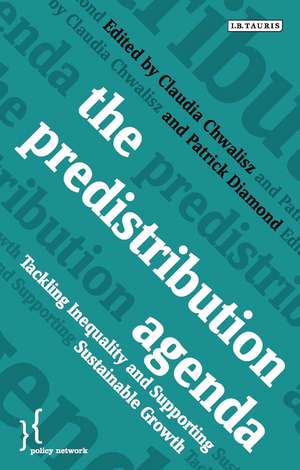
The Predistribution Agenda: Tackling Inequality and Supporting Sustainable Growth
Editat de Patrick Diamond, Claudia Chwaliszen Limba Engleză Paperback – 16 sep 2015
Preț: 151.86 lei
Preț vechi: 193.03 lei
-21%
Puncte Express: 228
Carte disponibilă
Livrare economică 31 octombrie-14 noiembrie
Livrare prin curier în România Termenul estimat este afișat lângă disponibilitate.
Transport gratuit de la 400.00 lei Plată online sau ramburs, în funcție de opțiunile comenzii.
Retur gratuit în 14 zile Comandă securizată și suport în română.
Specificații
ISBN-13: 9781784534417
ISBN-10: 1784534412
Pagini: 304
Dimensiuni: 134 x 214 x 24 mm
Greutate: 0.38 kg
Editura: Bloomsbury Publishing
Colecția I.B.Tauris
Locul publicării:London, United Kingdom
ISBN-10: 1784534412
Pagini: 304
Dimensiuni: 134 x 214 x 24 mm
Greutate: 0.38 kg
Editura: Bloomsbury Publishing
Colecția I.B.Tauris
Locul publicării:London, United Kingdom
V-ar putea interesa
-
 Theories of RightsJeremy Waldron-22%Preț: 388.92 lei496.67 lei
 -
 Contemporary Political Philosophy: An IntroductionWill Kymlicka-21%Preț: 405.79 lei510.84 lei
 -
 Ethics, Economics, and Politics: Principles of Public PolicyI. M. D. Little-33%Preț: 705.62 lei1051.05 lei
 -
 A World beyond Politics? – A Defense of the Nation–StatePierre Manent-23%Preț: 428.89 lei557.00 lei
 -
 The Philosophy of FriendshipM. Vernon-15%Preț: 659.04 lei775.34 lei
 -
 The Crosland Legacy: The Future of British Social DemocracyPatrick DiamondPreț: 175.40 lei
 -
 General Theory of Law and StateHans KelsenPreț: 379.00 lei
 -
 Governing Britain: Power, Politics and the Prime MinisterPatrick Diamond-26%Preț: 174.04 lei233.73 lei
 -
 Inventing Peace: A Dialogue on PerceptionWim Wenders-24%Preț: 188.53 lei249.55 lei
 -
 The Function of CriticismTerry EagletonPreț: 111.49 lei
 -
 Sexuality in the Field of VisionJacqueline RosePreț: 102.14 lei
 -
 The Metastases of EnjoymentSlavoj ZizekPreț: 128.24 lei
 -
 Preț: 266.12 lei
 -
 For They Know Not What They DoSlavoj ZizekPreț: 147.42 lei
 -
 Strategy of DeceptionPaul VirilioPreț: 78.33 lei
Cuprins
Table of Contents*Preface by Ernst Stetter
Foreword: The promise of predistribution by Jacob Hacker
Introduction
Pre-distribution: A new governing prospectus for the centre-left by Patrick Diamond, Claudia Chwalisz and Michael McTernan
Welfare states after the crisis by Andrew Gamble
Part I: Future changes in welfare societies
1. Public opinion, pre-distribution and progressive taxation: Distributional politics and voter preferences after the financial crisis by Lucy Barnes
2. Progressive policies for intergenerational justice in ageing societies: Demography is not destiny by Pieter Vanhuysse
Part II: Welfare states after the crisis: A pre-distribution agenda?
3. Pre-distribution and redistribution: Alternative or complementary policies? By Evelyne Huber and John D. Stephens
4. The potential and limits of pre-distribution in the UK: Tackling inequality and poverty by Paul Gregg
Part III: Pre-distributive labour market policies
5. Fostering equitable labour market outcomes: A focus on raising employment by Paul de Beer
6. Labour market flexibility and income security in old age: The policy and political challenges of pension reform by Karen Anderson
7. Technology, the labour market and inequality: Ensuring the benefits of new technology are widely shared by Alan Manning
8. Labour market institutions as pillars of pre-distribution: Focusing on pre-tax income distribution to tackle inequality by Rémi Bazillier
9. Pre-distribution and labour market actors: Looking at the trade union movement by Dimitris Tsarouhas
Part IV: Pre-distribution and the social investment state
10. Social investment, skills and inequality: The importance of institutional design by Marius Busemeyer
11. Looking to the Nordics? The Swedish social investment model in view of 2030 by Ingrid Esser
12. The demography of pre-distribution: Families, economic inequalities and social policies by Sophie Moullin
13. A 'family-friendly' welfare state: Addressing the gender equality paradox by Anke Hassel
Part V: The politics of pre-distribution
14. The political economy of the service transition: New political coalitions for pre-distributive strategies by Anne Wren
15. Welfare futures, Changing needs, risks and tools: Innovation and the new welfare state by Geoff Mulgan
16. Future challenges in new welfare societies by Ania Skrzypek
Conclusion
Postscript: The future of the welfare state by Peter A. Hall
Foreword: The promise of predistribution by Jacob Hacker
Introduction
Pre-distribution: A new governing prospectus for the centre-left by Patrick Diamond, Claudia Chwalisz and Michael McTernan
Welfare states after the crisis by Andrew Gamble
Part I: Future changes in welfare societies
1. Public opinion, pre-distribution and progressive taxation: Distributional politics and voter preferences after the financial crisis by Lucy Barnes
2. Progressive policies for intergenerational justice in ageing societies: Demography is not destiny by Pieter Vanhuysse
Part II: Welfare states after the crisis: A pre-distribution agenda?
3. Pre-distribution and redistribution: Alternative or complementary policies? By Evelyne Huber and John D. Stephens
4. The potential and limits of pre-distribution in the UK: Tackling inequality and poverty by Paul Gregg
Part III: Pre-distributive labour market policies
5. Fostering equitable labour market outcomes: A focus on raising employment by Paul de Beer
6. Labour market flexibility and income security in old age: The policy and political challenges of pension reform by Karen Anderson
7. Technology, the labour market and inequality: Ensuring the benefits of new technology are widely shared by Alan Manning
8. Labour market institutions as pillars of pre-distribution: Focusing on pre-tax income distribution to tackle inequality by Rémi Bazillier
9. Pre-distribution and labour market actors: Looking at the trade union movement by Dimitris Tsarouhas
Part IV: Pre-distribution and the social investment state
10. Social investment, skills and inequality: The importance of institutional design by Marius Busemeyer
11. Looking to the Nordics? The Swedish social investment model in view of 2030 by Ingrid Esser
12. The demography of pre-distribution: Families, economic inequalities and social policies by Sophie Moullin
13. A 'family-friendly' welfare state: Addressing the gender equality paradox by Anke Hassel
Part V: The politics of pre-distribution
14. The political economy of the service transition: New political coalitions for pre-distributive strategies by Anne Wren
15. Welfare futures, Changing needs, risks and tools: Innovation and the new welfare state by Geoff Mulgan
16. Future challenges in new welfare societies by Ania Skrzypek
Conclusion
Postscript: The future of the welfare state by Peter A. Hall