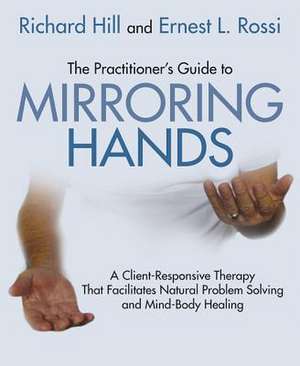
The Practitioner's Guide to Mirroring Hands
Autor Richard Hill, Ernest L Rossien Limba Engleză Paperback – 15 dec 2017
Bazându-ne pe arhivele clinice și cercetările fundamentale ale lui Ernest L. Rossi, lucrarea The Practitioner's Guide to Mirroring Hands reprezintă manualul definitiv pentru aplicarea unei tehnici terapeutice centrate pe răspunsul clientului. Remarcăm modul în care autorii, Richard Hill și Ernest L. Rossi, reușesc să transforme o moștenire ericksoniană într-un instrument practic, destinat facilitării proceselor de vindecare minte-corp prin proiecția dificultăților și rezoluțiilor în mișcările mâinilor. Structura cărții este riguros organizată, pornind de la fundamentele teoretice ale sistemelor non-liniare și ajungând la protocoale specifice de intervenție. Subliniem importanța celor șapte variații ale tehnicii prezentate, care oferă practicianului flexibilitatea necesară pentru a naviga prin complexitatea psihicului uman fără a impune soluții externe. Sub aspectul experienței de lectură, volumul funcționează ca un ghid de etapizare, oferind instantanee ale terapiei în acțiune și scripturi lingvistice precise. Această ediție reușește să pună în legătură rezultatele terapeutice intenționate cu efectele neurologice măsurabile, oferind o bază științifică solidă pentru intuiția clinică. În peisajul literaturii de specialitate, acest titlu completează perspectiva oferită de Therapeutic Trances de Stephen Gilligan, adăugând o metodologie fizică, tactilă, prin care transa este ancorată în mișcarea ideodinamică a mâinilor, spre deosebire de accentul pus de Gilligan pe relația hipnotică generală. De asemenea, față de abordarea din Constructive Psychotherapy de Michael J. Mahoney, care explorează construcția sensului prin exerciții de întrupare, lucrarea de față oferă un cadru mult mai specific și structurat pentru facilitarea „conștiinței terapeutice” prin ciclul de patru etape: informație, incubație, descoperire și verificare.
Preț: 222.82 lei
Carte disponibilă
Livrare economică 14-28 mai
Livrare express 30 aprilie-06 mai pentru 38.50 lei
Specificații
ISBN-10: 1785832468
Pagini: 304
Dimensiuni: 180 x 216 x 22 mm
Greutate: 0.6 kg
Ediția:B106 edition
Editura: Crown House Publishing
V-ar putea interesa
-
 A Therapist’s Handbook to Dissolve Shame and Defense: Master the MomentSusan Warren Warshow-5%Preț: 280.51 lei295.27 lei
 -
 -18%Preț: 1070.21 lei1305.13 lei
 -
 Silk and SteelRichard HillPreț: 106.19 lei
 -
 -18%Preț: 1070.03 lei1304.92 lei
 -
 Preț: 462.93 lei
 -
 Haiti And SpainRichard HillPreț: 129.80 lei
 -
 Help Me Move onAngie HemmingsPreț: 71.76 lei
 -
 Finding FamilyRichard HillPreț: 110.17 lei
 -
 Big-Data Analytics and Cloud ComputingMarcello Trovati-20%Preț: 728.45 lei910.56 lei
 -
 Soziale Ängste bei jungen ErwachsenenGötz BerberichPreț: 213.51 lei
 -
 -15%Preț: 619.92 lei729.33 lei
 -
 Beiträge zur Psychologie und Psychopathologie der BrandstifterHeinrich TöbbenPreț: 396.99 lei
 -
 Heilung und Wachstum der verletzten SeeleSerge K. D. Sulz-5%Preț: 223.92 lei235.71 lei
 -
 Der kleine PaarberaterMichael MaryPreț: 63.49 lei
 -
 Invicto - UnbezwingbarMarcos VázquezPreț: 118.28 lei
De ce să citești această carte
Această lucrare este esențială pentru psihoterapeuți și studenți care doresc să integreze o abordare non-directivă în practica lor. Cititorul câștigă acces la o metodă validată neuroștiințific care deblochează capacitățile naturale de rezolvare a problemelor ale clientului. Este un instrument valoros pentru cei care caută să treacă de la rolul de „expert” la cel de facilitator al proceselor de autovindecare, folosind mișcarea fizică ca punte către inconștient.
Despre autor
Richard Hill este un expert recunoscut în domeniul neuroștiințelor aplicate și al terapiei centrate pe client, colaborând strâns cu Ernest L. Rossi pentru a dezvolta modele terapeutice bazate pe neuroplasticitate. Rossi, un colaborator de lungă durată al celebrului Milton H. Erickson, a dedicat decenii studierii bazelor biologice ale psihoterapiei și hipnozei. Împreună, autorii aduc în această lucrare o sinteză între practica clinică de vârf și rigoarea academică, Richard Hill fiind implicat și în cercetarea biofizicii medicale. Lucrările lor anterioare și experiența vastă în formarea terapeuților fundamentează autoritatea acestui ghid practic.
Descriere scurtă
Foreword by Jeffrey K. Zeig, Ph.D.
Mirroring Hands is a practical therapeutic technique that can be utilized by all practitioners for the benefit of their clients. With a tranquil state of focused attention as the starting point, the practitioner invites the client to explore an issue by projecting it into their hands; with one hand representing the difficulty or disturbance, the other becomes the natural container for the opposite reflections - resolution, ease and comfort. This enables the client to engage with their deeper therapeutic self - thereby facilitating the shift into a therapeutic consciousness - and connect to the natural flow, cycles and self-organizing emergence that shift the client toward beneficial change.
In this instructive and illuminating manual, Hill and Rossi show you how Mirroring Hands enables clients to unlock their natural problem-solving and mind-body healing capacities to arrive at a resolution in a way that many other therapies might not. The authors offer expert guidance as to its client-responsive applications and differentiate seven variations of the technique in order to give the practitioner confidence and comfort in their ability to work within and around the possibilities presented while in session. Furthermore, Hill and Rossi punctuate their detailed description of how Mirroring Hands is conducted with a diverse range of illustrative casebook examples and stage-by-stage snapshots of the therapy in action: providing scripted language prompts and illustrative images of a client's hand movement that demonstrate the processes behind the technique as it takes the client from disruption into the therapeutic; and from there to integration, resolution, and a state of well-being.
The Practitioner's Guide to Mirroring Hands begins by tracing the emergence of the Mirroring Hands approach from its origins in Rossi's studies and experiences with Milton H. Erickson and by presenting a transcription of an insightful discussion between Rossi and Hill as they challenge some of the established ways in which we approach psychotherapy, health, and well-being. Building upon this exchange of ideas, the authors define and demystify the nature of complex, non-linear systems and skillfully unpack the three key elements of induction to therapeutic consciousness - focused attention, curiosity, and nascent confidence - in a section dedicated to preparing the client for therapy. Hill and Rossi also supply preparatory guidance for the therapist through explanation of therapeutic dialogue's non-directive language principles, and through exploration of the four-stage cycle - information, incubation, breakthrough and illumination, and verification - that facilitates the client's capacity to access their natural problem-solving and mind-body healing.
The authors also take care to advocate Mirroring Hands as not only a therapeutic technique, but also an approach to practice for all practitioners engaged in solution-focused therapy. Through its enquiry into the vital elements of client-cue observation, symptom-scaling, and rapport-building inherent in the therapist-client relationship, The Practitioner's Guide to Mirroring Hands shares a great store of wisdom and insight that will help the practitioner become more attuned to their clients' inner worlds and communication patterns. Hill and Rossi draw on a wealth of up-to-date neuroscientific research and academic theory to help bridge the gap between therapy's intended outcomes and its measured neurological effects, and, towards the book's close, also open the door to the study of quantum field theory to inspire the reader's curiosity in this fascinating topic.
An ideal progression for those engaged in mindfulness and meditation, The Practitioner's Guide to Mirroring Hands is the first book on the subject specially written for all mental health practitioners and is suitable for students of counseling, psychotherapy, psychology, and hypnotherapy, as well as anyone in professional practice.