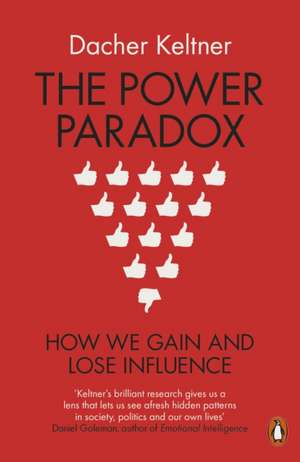
The Power Paradox
Autor Dacher Keltneren Limba Engleză Paperback – 4 mai 2017
Observăm în mediul academic și profesional o nevoie acută de redefinire a leadershipului, iar The Power Paradox răspunde acestei cerințe prin fundamentarea influenței pe baze neuropsihologice și sociale. Pentru studenții la psihologie, sociologie sau management, lucrarea este esențială deoarece demontează mitul machiavelic al puterii ca instrument de coerție, oferind în schimb un model validat de cercetare despre cum se câștigă și, mai ales, cum se menține autoritatea în grupuri. Apreciem structura riguroasă în 20 de principii care explică de ce empatia și generozitatea sunt, de fapt, motoarele succesului social. Comparabil cu The Social Psychology of Power de Ana Guinote în rigurozitatea academică, volumul de față este însă actualizat pentru dinamica socială modernă, punând un accent mai mare pe mecanismele de menținere a influenței pe termen lung. În contextul operei autorului, The Power Paradox reprezintă o evoluție firească de la abordările descriptive din Social Psychology și Understanding Emotions, transformând teoria emoțiilor sociale într-un ghid aplicat despre impactul interpersonal. Dr. Dacher Keltner ne arată că puterea nu este o trăsătură de caracter, ci o stare pe care ceilalți ne-o conferă atunci când acționăm spre binele colectiv. Analiza sa asupra modului în care abuzul de putere duce la erodarea cognitivă și socială oferă o perspectivă necesară pentru oricine ocupă o funcție de decizie, explicând mecanismul prin care liderii devin insensibili la nevoile celor pe care îi conduc.
Preț: 62.65 lei
Preț vechi: 92.07 lei
-32%
Carte disponibilă
Livrare economică 30 octombrie-10 noiembrie
Livrare express 14-20 octombrie pentru 46.75 lei
Specificații
ISBN-10: 0718197631
Pagini: 208
Dimensiuni: 128 x 195 x 17 mm
Greutate: 0.16 kg
Editura: Penguin Books
Locul publicării:London, United Kingdom
V-ar putea interesa
-
 Obedience to AuthorityStanley MilgramPreț: 105.23 lei
 -
 The Subtle Art of Not Giving a F*ckMark MansonPreț: 135.88 lei
 -
 The Subtle Art of Not Giving a F*ckMark MansonPreț: 120.19 leiRecomandat
 -
 Descartes' ErrorAntonio Damasio-19%Preț: 75.37 lei93.32 lei
 -
 The Beginning of InfinityDavid DeutschPreț: 108.31 lei
 -
 -30%Preț: 643.28 lei924.91 lei
 -
 How Children FailJohn Holt-47%Preț: 80.26 lei152.33 lei
 -
 Preț: 280.02 lei
 -
 #GirlbossSophia Amoruso-19%Preț: 62.64 lei77.62 lei
 -
 The World Is Flat 3.0Thomas L. FriedmanPreț: 164.06 lei
 -
 The CircleDavid EggersPreț: 105.63 lei
 -
 Girls Think of EverythingCatherine ThimmeshPreț: 73.67 lei
 -
 How Did I Begin?Mick Manning-36%Preț: 42.34 lei66.24 lei
 -
 StoriesAl Sarrantonio-25%Preț: 59.90 lei79.45 lei
 -
 Invent To LearnSylvia Libow MartinezPreț: 435.02 lei
 -
 Pulling TogetherJohn J. MurphyPreț: 81.49 lei
 -
 Moral TribesJoshua GreenePreț: 76.00 lei
 -
 Homo Deus: A Brief History of TomorrowYuval Noah Harari-17%Preț: 80.09 lei96.07 lei
 -
 Cat's EyeMargaret Atwood-24%Preț: 60.86 lei80.33 lei
 -
 O fată din bucățiKathleen GlasgowPreț: 59.00 lei
De ce să citești această carte
Această carte este recomandată profesioniștilor care doresc să își exercite influența fără a recurge la autoritarism. Cititorul va înțelege paradoxul prin care succesul poate corupe abilitățile sociale care l-au generat și va învăța, prin cele 20 de principii practice, cum să rămână un lider respectat. Este o lectură despre cum să transformi puterea într-o forță pozitivă, utilă atât în carieră, cât și în viața de familie.
Despre autor
Dacher Keltner este profesor de psihologie la University of California, Berkeley și o figură centrală în studiul modern al emoțiilor și interacțiunii sociale. În calitate de director al Berkeley Social Interaction Lab și fondator al Greater Good Science Center, acesta a dedicat decenii cercetării modului în care bunătatea și compasiunea modelează creierul și societatea. Expertiza sa l-a condus spre roluri de consultant științific pentru Pixar (Inside Out) și spre publicarea unor manuale fundamentale precum Social Psychology, fiind recunoscut la nivel mondial pentru capacitatea de a traduce datele complexe de laborator în principii de viață aplicabile.
Notă biografică
Dacher Keltner is Professor of Psychology and the Director of the Greater Good Science Center at the University of California, Berkeley. A renowned expert in the biological and evolutionary origins of human emotion, he has received numerous prizes for his research, which has been covered in The New York Times, Newsweek, the BBC and CNN. He is the bestselling author of Born to Be Good and has served as a consultant to Google, Facebook, and on the award-winning Pixar film, Inside Out. In 2008, the Utne Reader listed him as one of the fifty visionaries changing the world.
Recenzii
Lively and intriguing ... The Power Paradox delivers a much-needed dose of positivity in the study of how managers and leaders can get the best out of their workers and populations
The Westminster old guard sat all around him may not realise it, but Dacher Keltner and his ideas may pose a severe challenge to their way of doing business. And it gets worse: as he and his cohorts render them obsolete, they will rub it in by being nice to them
Dacher Keltner is the most interesting psychologist in America. He's busy changing the minds of Americans about how power works, how inequality works. It's only a matter of time before his ideas spread everywhere. And unlike most psychologists I know, he's not a weirdo
The Power Paradox brings clarity to our confusion, brimming with evidence-based insights into powerlessness, the selfish uses of power, and the best kind: power that furthers the greater good. Dacher Keltner's brilliant research gives us a lens that lets us see afresh hidden patterns in society, politics, and our own lives. No doubt this will be one of the most significant science books of the decade
Keltner shares insights into many aspects of power, including afternoon tea in Britain and how Lincoln won the presidency ... Provocative and intriguing
That power is not taken but given is true for most human relations today. It has ancient roots in primate behavior. Dacher Keltner applies a lifetime of research to this topic, offering a lively description of how true power is like a return on a social investment in others
With personal insight and the latest science, Keltner is both realistic and idealistic: The Power Paradox sheds light on human power's dark side, as well as its redeeming qualities. Everyone can learn from this wise book
Descriere
A revolutionary rethinking of everything we know about power
It shapes every interaction we have, whether we're trying to get a two-year-old to eat green vegetables or ask for a promotion at work. But how do we really gain and maintain power - through coercion or cooperation? What does it do to our behaviour? And what makes us lose power? In twenty revolutionary 'power principles', renowned psychologist Dacher Keltner turns everything we thought we knew about influence and status upside down, redefining power for our times.
'Keltner is the most interesting psychologist in America. It's only a matter of time before his ideas spread everywhere' Michael Lewis
'Sheds light on human power's dark side, as well as its redeeming qualities. Everyone can learn from this wise book' Susan T. Fiske, author of Social Cognition
'A lively description of how true power is like a return on a social investment in others' Frans de Waal, author of Are We Smart Enough to Know How Smart Animals Are?
'Lively and intriguing ... A much-needed dose of positivity' Prospect