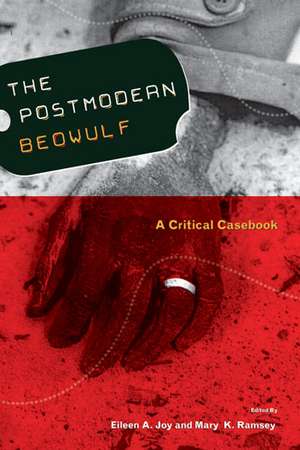
The Postmodern Beowulf
Autor Eileen A Joy, Mary K Ramseyen Limba Engleză Paperback – 20 sep 2006
This work includes twenty-four essays including a preface, introduction, afterword, and sections containing seminal methodological pieces by such giants as Edward Said and Michel Foucault, as well as contemporary applications to Beowulf and other Old English and Germanic texts focusing on historicism, psychoanalysis, gender, textuality, and post-colonialism.
Preț: 291.70 lei
Puncte Express: 438
Preț estimativ în valută:
51.59€ • 61.05$ • 44.98£
51.59€ • 61.05$ • 44.98£
Carte disponibilă
Livrare economică 13-27 martie
Specificații
ISBN-13: 9781933202082
ISBN-10: 1933202084
Pagini: 772
Dimensiuni: 151 x 226 x 45 mm
Greutate: 1.14 kg
Ediția:First Edition
Editura: West Virginia University Press
ISBN-10: 1933202084
Pagini: 772
Dimensiuni: 151 x 226 x 45 mm
Greutate: 1.14 kg
Ediția:First Edition
Editura: West Virginia University Press
V-ar putea interesa
-
 Talking about Laughter: and Other Studies in Greek ComedyAlan H. Sommerstein-27%Preț: 631.56 lei870.84 lei
 -
 Preț: 260.95 lei
 -
 Preț: 442.48 lei
 -
 Unity and Design in Horace's OdesMatthew S. SantiroccoPreț: 270.80 lei
 -
 Trials of CharacterJames M MayPreț: 291.15 lei
 -
 Fragments for a History of a Vanishing HumanismMyra SeamanPreț: 301.72 lei
 -
 Heliand: Text and CommentaryJAMES E. CATHEYPreț: 262.54 lei
 -
 Bacchylides: The Victory PoemsArthur S. McDevitt-23%Preț: 197.06 lei255.21 lei
 -
 AetnaRobinson EllisPreț: 451.24 lei
 -
 Seven of Her LaysMarie de FrancePreț: 76.97 lei
 -
 Isidorean Perceptions of Order: The Exeter Book Riddles and Medieval Latin EnigmataMercedes Salvador-BelloPreț: 272.42 lei
 -
 Preț: 288.01 lei
 -
 Bede and AethelthrythStephen J. HarrisPreț: 263.35 lei
 -
 Tragedy and OthernessNicholas RayPreț: 344.54 lei
 -
 -23%Preț: 571.91 lei742.73 lei
 -
 -23%Preț: 818.69 lei1063.24 lei
 -
 Tiere und Fabelwesen im MittelalterSabine Obermaier-23%Preț: 818.57 lei1063.08 lei
 -
 Alexanders Saga: AM 519a 4° in The Arnamagnæan Collection, CopenhagenAndrea de Leeuw van Weenen-28%Preț: 708.21 lei982.75 lei
Notă biografică
Eileen Joy is a professor in the Department of English and Literature at Southern Illinois University Edwardsville. Joy has a PhD in English from the University of Tennessee-Knoxville and an MFA and BA in creative writing and English from Virginia Commonwealth University.
Mary K. Ramsey is Assistant Professor of English at Southeastern Louisiana University.
Mary K. Ramsey is Assistant Professor of English at Southeastern Louisiana University.
Textul de pe ultima copertă
This work includes twenty-four essays including a preface, introduction, afterword, and sections containing seminal methodological pieces by such giants as Edward Said and Michel Foucault, as well as contemporary applications to Beowulf and other Old English and Germanic texts focusing on historicism, psychoanalysis, gender, textuality, and post-colonialism.
Recenzii
“Most of us are not looking to find adventure in Beowulf, much less the meaning of life. What we are looking for at this moment is the sort of knowledge that might proceed from a radical defamiliarization of this far-too-familiar text, setting it free from centuries of encrusted ideologies. In the case of Beowulf, I think, such a radical defamiliarization will reveal a radical strangeness in the poem. Freed from its roles in all our grand narratives, Beowulf stands apart, an unexpected singularity. It is, not to put too fine a point on it, weird.” James W. Earl, Associate Professor of English at the University of Oregon