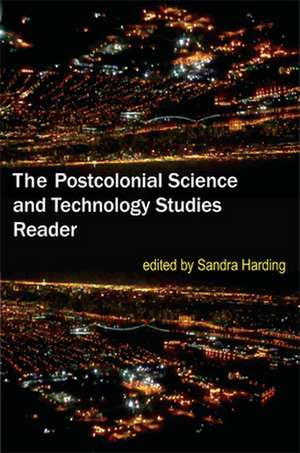
The Postcolonial Science and Technology Studies Reader
Editat de Sandra Hardingen Limba Engleză Paperback – 12 sep 2011
Observăm în The Postcolonial Science and Technology Studies Reader o sinteză metodologică pe care mediul academic o aștepta de două decenii: dialogul critic dintre studiile științifice și tehnologice (STS), teoriile postcoloniale și critica feministă. Această lucrare nu este doar o antologie de texte, ci un instrument pedagogic riguros, conceput de Sandra Harding special pentru utilizarea la cursuri, oferind un cadru teoretic stabil pentru o disciplină aflată la intersecția mai multor câmpuri de cercetare. Structura volumului propus de Duke University Press ghidează cititorul prin patru secțiuni distincte, începând cu „Contraistorii” care reevaluează narațiunile convenționale despre descoperirile occidentale. Capitolele analizează rolul corporațiilor de lungă distanță și al grădinilor botanice regale britanice în expansiunea colonială, oferind o perspectivă materială asupra modului în care s-a format „știința mare”. Un element distinctiv este includerea studiilor despre sistemele de navigație tradiționale și diversitatea ecolingvistică, provocând distincția clasică dintre „știința” Vestului și „mitul” restului lumii. Cititorii familiarizați cu Is Science Multicultural? vor aprecia modul în care acest volum extinde discuția de la interogații teoretice la studii de caz concrete și strategii aplicate pentru democratizarea științei. Față de The Science Studies Reader coordonat de Mario Biagioli, care se concentrează pe practicile moderne în contexte instituționale, volumul de față prioritizează demontarea structurilor de putere coloniale și integrarea perspectivei de gen, temă centrală și în The Feminist Standpoint Theory Reader. Sandra Harding reușește să mențină o coerență narativă prin introducerile sale detaliate la fiecare secțiune, transformând o colecție diversă într-un argument unitar despre necesitatea unei științe multiculturale.
Preț: 305.27 lei
Carte tipărită la comandă
Livrare economică 02-16 decembrie
Specificații
ISBN-10: 0822349574
Pagini: 504
Ilustrații: 3 maps, 3 figures, 3 tables
Dimensiuni: 156 x 234 x 32 mm
Greutate: 0.68 kg
Editura: Duke University Press
V-ar putea interesa
-
 Preț: 231.01 lei
 -
 Sex and Scientific InquirySandra HardingPreț: 165.15 lei
 -
 Preț: 105.01 lei
 -
 Preț: 169.04 lei
 -
 -18%Preț: 1311.86 lei1599.83 lei
 -
 Preț: 408.09 lei
 -
 Preț: 222.60 lei
 -
 The Science Question in FeminismSandra G. HardingPreț: 281.09 lei
 -
 Symbolic Earth-PaJames G CantrillPreț: 229.89 lei
 -
 Preț: 277.80 lei
 -
 In Search of the AmazonSeth GarfieldPreț: 286.29 lei
 -
 How Climate Change Comes to MatterCandis CallisonPreț: 205.07 lei
 -
 Colonial Buganda and the End of EmpireJonathon L. EarlePreț: 301.04 lei
 -
 Environmental EthicsJoseph R Des Jardins-23%Preț: 740.89 lei962.19 lei
 -
 Discovering RealitySandra Harding-18%Preț: 986.56 lei1203.12 lei
 -
 Preț: 130.72 lei
 -
 Statistik in Geodäsie, Geoinformation und BauwesenWilhelm BenningPreț: 210.39 lei
 -
 Can Theories be Refuted?Sandra Harding-18%Preț: 1604.43 lei1956.62 lei
 -
 Discovering RealitySandra HardingPreț: 410.92 lei
 -
 Encyclopedia of Agricultural MeteorologyL. K. DhaliwalPreț: 362.07 lei
De ce să citești această carte
Această lucrare este esențială pentru studenții și cercetătorii din domeniul științelor sociale, sociologiei științei și studiilor culturale. Cititorul câștigă o înțelegere profundă a modului în care colonialismul a modelat standardele științifice actuale și descoperă modele alternative de cunoaștere. Este un volum necesar pentru oricine dorește să exploreze intersecția dintre justiția socială, gen și progresul tehnologic într-un context globalizat.
Despre autor
Sandra Harding este profesor emerit de educație și studii despre femei la UCLA și o figură centrală în epistemologia feministă contemporană. Recunoscută ca unul dintre fondatorii „teoriei punctului de vedere” (Standpoint Theory), Harding a explorat constant în opera sa, inclusiv în lucrări precum Discovering Reality sau Objectivity and Diversity, modul în care contextul social și politic influențează obiectivitatea științifică. Activitatea sa editorială și teoretică a redefinit standardele de incluziune în filosofia științei, promovând o viziune multiculturală asupra cunoașterii.