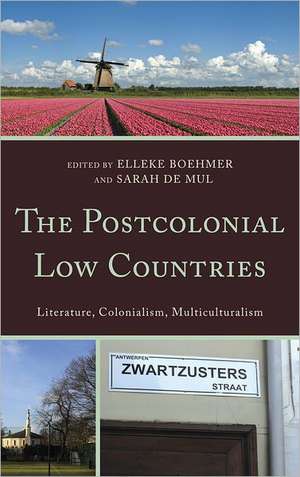
The Postcolonial Low Countries: Literature, Colonialism, and Multiculturalism
Editat de Elleke Boehmer, Sarah De Mul Contribuţii de Frances Gouda, Theo D’haen, Sarah Bracke, Nadia Fadil, Isabel Hoving, Pamela Pattynama, Louise Viljoen, Liesbeth Minnaard, Henriette Louwerse, Mireille Rosello, Murat Aydemir, Ieme Van Der Poelen Limba Engleză Hardback – 31 mai 2012
In the Low Countries, local and regional issues concerning multiculturalism and colonial belatedness have raised important questions about the possible grounds on which postcolonial critical concepts might be not only translated but also generated afresh, to suit these paradoxically new contexts. As The Postcolonial Low Countries incisively demonstrates, the Low Countries demand a careful rearticulation of such postcolonial 'readymades' as hybridity, accommodation and creolization.
Gathering together contributions from both internationally renowned scholars and newly established researchers in the field, The Postcolonial Low Countries maps previously underexplored national and transnational literary critical trajectories. The book challenges in boundary shifting ways current readings of the so-described multicultural and postcolonial Netherlands and Belgium.
Preț: 659.90 lei
Preț vechi: 1053.96 lei
-37%
Puncte Express: 990
Carte tipărită la comandă
Livrare economică 27 noiembrie-11 decembrie
Livrare prin curier în România Termenul estimat este afișat lângă disponibilitate.
Transport gratuit pentru acest produs Plată online sau ramburs, în funcție de opțiunile comenzii.
Retur gratuit în 14 zile Comandă securizată și suport în română.
Specificații
ISBN-13: 9780739164280
ISBN-10: 0739164287
Pagini: 260
Dimensiuni: 161 x 235 x 23 mm
Greutate: 0.57 kg
Editura: Bloomsbury Publishing
Colecția Lexington Books
Locul publicării:New York, United States
ISBN-10: 0739164287
Pagini: 260
Dimensiuni: 161 x 235 x 23 mm
Greutate: 0.57 kg
Editura: Bloomsbury Publishing
Colecția Lexington Books
Locul publicării:New York, United States
Cuprins
Chapter 1. Introduction: Postcolonialism and the Low Countries, Elleke Boehmer and Sarah De Mul
Part 1: Towards a Neerlandophone Postcolonial Studies
Chapter 2. Postcolonial Studies in the context of the 'diasporic' Netherlands, Elleke Boehmer and Frances Gouda
Chapter 3. Polderpoko: why it cannot exist, Isabel Hoving
Chapter 4. The "Ends" of Postcolonialism, Theo D'haen
Chapter 5. "Is the headscarf oppressive or emancipatory?" Field notes on the gendrification of the 'multicultural debate', Sarah Bracke and Nadia Fadil
Part 2: Postcolonial Memory
Chapter 6. (Un)happy Endings: Nostalgia in post-imperial and postmemory Dutch films, Pamela Pattynama
Chapter 7. Transnational Contact-Narratives: Dutch Post-Coloniality from a Turkish-German Viewpoint, Liesbeth Minnaard
Chapter 8. Representing post-apartheid South Africa: mothers, motherlands and mother tongues in the work of selected Afrikaans women writers, Louise Viljoen
Chapter 9. The Holocaust as a Paradigm for the Congo Atrocities: Adam Hochschil
Part 1: Towards a Neerlandophone Postcolonial Studies
Chapter 2. Postcolonial Studies in the context of the 'diasporic' Netherlands, Elleke Boehmer and Frances Gouda
Chapter 3. Polderpoko: why it cannot exist, Isabel Hoving
Chapter 4. The "Ends" of Postcolonialism, Theo D'haen
Chapter 5. "Is the headscarf oppressive or emancipatory?" Field notes on the gendrification of the 'multicultural debate', Sarah Bracke and Nadia Fadil
Part 2: Postcolonial Memory
Chapter 6. (Un)happy Endings: Nostalgia in post-imperial and postmemory Dutch films, Pamela Pattynama
Chapter 7. Transnational Contact-Narratives: Dutch Post-Coloniality from a Turkish-German Viewpoint, Liesbeth Minnaard
Chapter 8. Representing post-apartheid South Africa: mothers, motherlands and mother tongues in the work of selected Afrikaans women writers, Louise Viljoen
Chapter 9. The Holocaust as a Paradigm for the Congo Atrocities: Adam Hochschil
Recenzii
In an era when many in the Netherlands and Belgium, in spite of their fiercely colonialist past, consider postcolonial thought 'outdated'-another word for the sigh of relief at escaping the need to engage an object of resistance-this book couldn't be more timely. 'Postcolonizing' the Low Countries is more necessary than ever. Smart, witty, and brave, the essays, sometimes tongue-in-cheek, offer an incisive critique of the reiteration of colonial clichés, the refusal to rethink the remnants of injustice, and the attempts to justify neonationalism.
Finally, a postcolonial turn in Dutch literary criticism has taken place. The Postcolonial Low Countries is the first book to theorize and bring together approaches that can be called neerlandophone postcolonial studies. The need for such a perspective has been enormous, not only because of the colonial legacies of the Netherlands and Belgium but also because of the transnational formations through which the study of literatures in Dutch is currently being challenged. From now on, Dutch and Belgian literature can no longer be read the same.
The Postcolonial Low Countries holds sparkling examples of boundary-pushing work. Intersecting postcolonial studies and multicultural critique this timely intervention is likely to unsettle neerlandophone literary establishments.
Finally, a postcolonial turn in Dutch literary criticism has taken place. The Postcolonial Low Countries is the first book to theorize and bring together approaches that can be called neerlandophone postcolonial studies. The need for such a perspective has been enormous, not only because of the colonial legacies of the Netherlands and Belgium but also because of the transnational formations through which the study of literatures in Dutch is currently being challenged. From now on, Dutch and Belgian literature can no longer be read the same.
The Postcolonial Low Countries holds sparkling examples of boundary-pushing work. Intersecting postcolonial studies and multicultural critique this timely intervention is likely to unsettle neerlandophone literary establishments.