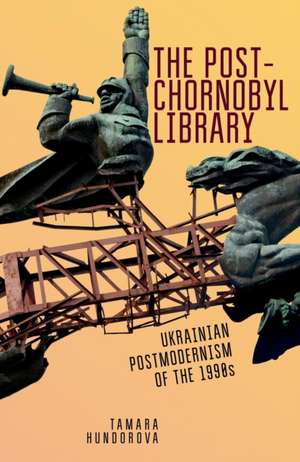
The Post-Chornobyl Library: Ukrainian Studies
Autor Tamara Hundorovaen Limba Engleză Paperback – 26 noi 2019
Recomandăm acest volum ca o lucrare de referință pentru nivelul de master și doctorat în studiile slave și comparatiste, oferind o analiză profundă a modului în care un dezastru tehnologic a redefinit identitatea culturală a unei națiuni. Tamara Hundorova propune în The Post-Chornobyl Library o metaforă fascinantă a bibliotecii ca spațiu de reconstrucție după trauma din 26 aprilie 1986. Apreciem modul în care autoarea demonstrează că postmodernismul ucrainean nu a fost doar un curent estetic importat, ci o reacție necesară la prăbușirea sistemului sovietic, transformând 'conștiința nucleară' într-un instrument de decolonizare.
Subliniem rigoarea structurii, care ghidează cititorul de la analiza discursului realist socialist despre Cernobîl către estetica fragmentată și ironică a anilor '90. Cartea explorează 'carnivalizarea apocalipsei' prin studiul unor figuri centrale precum Yuri Andrukhovych și grupul Bu-Ba-Bu, explicând cum ludicul și grotescul au servit la umplerea golurilor lăsate de cenzura totalitară. Această lucrare completează perspectiva oferită de Transit Culture and Postcolonical Trauma, unde Tamara Hundorova se concentra pe resentimentul postcolonial și memoria familială, adăugând aici dimensiunea specifică a traumei ecologice și transformarea acesteia în text literar. În contextul operei sale, volumul se leagă tematic de Revolution and War in Contemporary Ukraine, extinzând cercetarea asupra modului în care crizele majore — fie ele nucleare sau militare — accelerează schimbările culturale.
Față de Ukraine's Quest for Identity de Maria G. Rewakowicz, care oferă o privire de ansamblu asupra construcției identitare post-1991, The Post-Chornobyl Library este mult mai focalizată pe estetica traumei și pe modul în care limbajul 'post-verbal' și virtualitatea au apărut ca răspuns la criza reprezentării realului.
Din seria Ukrainian Studies
-
 Preț: 130.72 lei
 -
 Preț: 129.95 lei
 -
 Preț: 284.79 lei
 -
 Preț: 274.17 lei
 -
 Preț: 196.41 lei
 - 23%
 Preț: 871.74 lei
Preț: 265.73 lei
Carte disponibilă
Livrare economică 04-18 mai
Specificații
ISBN-10: 1644692384
Pagini: 338
Dimensiuni: 156 x 234 x 18 mm
Greutate: 0.47 kg
Editura: Academic Studies Press
Seria Ukrainian Studies
V-ar putea interesa
-
 In the Rose Garden of the MartyrsChristopher De BellaiguePreț: 74.65 lei
 -
 An Island in TimeGeert MakPreț: 94.27 lei
 -
 Women and the Vote: A World HistoryJad Adams-18%Preț: 122.12 lei148.30 lei
 -
 -6%Preț: 148.19 lei158.25 lei
 -
 The Gothic: A Very Short IntroductionNick Groom-20%Preț: 54.31 lei68.30 lei
 -
 -15%Preț: 570.24 lei670.87 lei
 -
 -5%Preț: 380.62 lei400.65 lei
 -
 The Roman Empire and Its Germanic PeoplesHerwig WolframPreț: 285.05 lei
 -
 The Making of Modern British PoliticsMartin PughPreț: 299.72 lei
 -
 Becoming Yellow – A Short History of Racial ThinkingMichael KeevakPreț: 508.89 lei
 -
 The Axe and the OathRobert FossierPreț: 149.11 lei
 -
 The Battle for Kinder ScoutBenny RothmanPreț: 89.23 lei
 -
 Lesya UkrainkaConstantine BidaPreț: 298.33 lei
 -
 A History of SilenceAlain CorbinPreț: 102.08 lei
 -
 Preț: 273.86 lei
 -
 In the shadow of Enoch PowellShirin HirschPreț: 166.27 lei
 -
 Your Ad Could Go HereOksana ZabuzhkoPreț: 54.86 lei
 -
 Poetry and PsychiatryMagnus LjunggrenPreț: 127.29 lei
 -
 Performing HistoryNancy November-19%Preț: 622.27 lei768.23 lei
 -
 FanaticismAlberto ToscanoPreț: 228.58 lei
 -
 Selected LettersHorace Walpole-17%Preț: 100.10 lei121.00 lei
 -
 The Scottish WorldBilly Kay-19%Preț: 74.16 lei91.06 lei
 -
 Trench ArtNicholas J SaundersPreț: 89.53 lei
De ce să citești această carte
Este o resursă esențială pentru cercetătorii interesați de intersecția dintre ecocritică, studii postcoloniale și literatură est-europeană. Cititorul câștigă o înțelegere nuanțată a modului în care Ucraina s-a eliberat de trecutul sovietic prin ironie și experiment literar. Este recomandată celor care doresc să descopere cum trauma de la Cernobîl a devenit catalizatorul unei explozii de creativitate care a reconectat cultura ucraineană la postmodernismul european.
Descriere scurtă
Cuprins
1. Nuclear Discourse, or Literature after Chornobyl
2. Nuclear Apocalypse and Postmodernism
3. The Socialist Realist Chornobyl Discourse
4. Nuclear (Non)-Representation
5. Chornobyl and Virtuality
6. Chornobyl and the Cultural Archive
7. Chornobyl Postmodern Topography
8. Chornobyl and the Crisis of Language
9. Postmodernism: The Synchronization of History
10. Ukrainian Postmodernism: The Historical Framework
11. A Farewell to the Classic
12. The ¿Ex-Centricity¿ of the Great Character
13. Postmodernism and the ¿Cultural Organic¿
14. Postmodernism as Ironic Behavior
15. Bu-Ba-Bu: A New Literary Formation
16. The Carnivalesque Postmodern
17. Yuri Andrukhovych¿s Carnival: A History of Self-Destruction
18. After the Carnival: Bu-Ba-Bu Postmortem
19. Narrative Apocalypse: Taras Prokhasko¿s Topographic Writing
20. The Virtual Apocalypse: The Post-Verbal Writing of Yurko Izdryk
21. The Grotesques of the Kyiv Underground: DibroväZholdak¿Poderviansky
22. Feminist Postmodernism: Oksana Zabuzhko
23. Postmodern Europe: Revision, Nostalgia, and Revenge
24. The Chornobyl Apocalypse of Yevhen Pashkovsky
25. The Postmodern Homelessness of Serhiy Zhadan
26. Volodymyr Tsybulko¿s Pop-Postmodernism
27. The (De)KONstructed Postmodernism of Yuriy Tarnawsky
28. PS. A Comment from the ¿End of Postmodernism¿
29. Types of Postmodernism