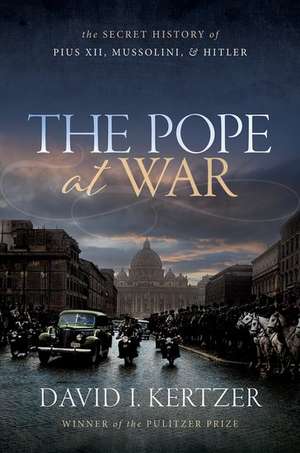
The Pope at War: The Secret History of Pius XII, Mussolini, and Hitler
Autor David I. Kertzeren Limba Engleză Hardback – 17 noi 2022
Preț: 218.68 lei
Preț vechi: 270.15 lei
-19%
Puncte Express: 328
Carte disponibilă
Livrare economică 13-18 noiembrie
Livrare express 29 octombrie-04 noiembrie pentru 113.95 lei
Livrare prin curier în România Termenul estimat este afișat lângă disponibilitate.
Transport gratuit de la 400.00 lei Plată online sau ramburs, în funcție de opțiunile comenzii.
Retur gratuit în 14 zile Comandă securizată și suport în română.
Specificații
ISBN-13: 9780192890733
ISBN-10: 0192890735
Pagini: 672
Ilustrații: 40 black and white illustrations/maps
Dimensiuni: 160 x 240 x 55 mm
Greutate: 0.94 kg
Editura: OUP OXFORD
Colecția OUP Oxford
Locul publicării:Oxford, United Kingdom
ISBN-10: 0192890735
Pagini: 672
Ilustrații: 40 black and white illustrations/maps
Dimensiuni: 160 x 240 x 55 mm
Greutate: 0.94 kg
Editura: OUP OXFORD
Colecția OUP Oxford
Locul publicării:Oxford, United Kingdom
Recenzii
Magnificent... Kertzer is a gifted writer ... He is also to be congratulated on avoiding polemic. It would have been easy, given the evidence, to have suffused the pages with moral outrage. But because he lays the facts bare and presents all sides of the argument, he lets readers come to their own conclusion. And that conclusion ought to be a devastating one ... What a tragedy, the reader might think after finishing this groundbreaking book, that the Pope did not "love" the Jews as much as he "loved" Germany.
The Pope at War is the idea that it does not matter whether we are popes, prime ministers, or chancellors. Rather, our failings and shortcomings as individuals (of any station) can result in crimes whose magnitude boggles the mind; thus, even as we castigate the pontiff, we look inwards in ways at once discomfiting and necessary.
An engrossing, often exciting and sometimes moving book.
The Pope at War shares with its two predecessors a dramatic sense of history.
Compelling
...One of the best accounts of [Pius, the] wartime pontificate. Kertzer had already acquired a reputation as an elegant stylist with a commanding gift for explanation. That reputation will be further burnished by this tome.
A book, which, to all intents and unequivocal purposes, is even more rightly pugilist in its undertaking, than those for whom power and the ducking and diving of the truth has become an elongated second nature of distorted discourse.
A thorough exploration of the Vatican archives for the pontificate of Pope Pius XII has long been awaited. David I. Kertzer's splendid book now provides it, presenting a plethora of highly unflattering evidence of the pope's role during the Second World War and his silence regarding the Holocaust. The book ends much of the debate about the pope and surely makes any lingering apologia for his stance implausible.
A magisterial new study of how the Vatican navigated World War II and why Pope Pius XII stayed silent in the face of the mass murder of Jews.
Disputes over the role of Pope Pius XII in World War II have been hopelessly mired either in sanctimony or hostility because of gaps in the historical record. David Kertzer's supremely well-informed analysis of the newly opened Vatican archives now establishes once and for all the massive scale of the pope's moral failure in the face of Europe's conflagration and Hitler's murder of six million Jews. If the faint-hearted pope was no war criminal, he was surely no saint. With Kertzer's magnum opus, the book on Pius XII is written, the dispute resolved, case closed.
Not many expected the memory of Pope Pius XII's dealing with Jews during World War II to be sweetened by the recent opening of Vatican archives from that period. But who could have guessed how sordid the revelations would be? David I. Kertzer has the learning and courage to read the new documents and show what deep slime the Vatican was wading in during Pius XII's papacy. Brace yourself for a story full of horrors.
David I. Kertzer has outdone himself and crowned his extraordinary career with this volume on Pope Pius XII. He writes a simply riveting account with a worldwide cast of characters that includes Mussolini, Hitler, FDR, Churchill, and Eisenhower. This remarkably researched book is replete with revelations that deserve the adjective 'explosive' and with so much more. The book is a masterpiece.
Kertzerâ restricts himself for the most part to a sober, factual narrative, avoiding facile expressions of moral outrage.
The Pope at War is the idea that it does not matter whether we are popes, prime ministers, or chancellors. Rather, our failings and shortcomings as individuals (of any station) can result in crimes whose magnitude boggles the mind; thus, even as we castigate the pontiff, we look inwards in ways at once discomfiting and necessary.
An engrossing, often exciting and sometimes moving book.
The Pope at War shares with its two predecessors a dramatic sense of history.
Compelling
...One of the best accounts of [Pius, the] wartime pontificate. Kertzer had already acquired a reputation as an elegant stylist with a commanding gift for explanation. That reputation will be further burnished by this tome.
A book, which, to all intents and unequivocal purposes, is even more rightly pugilist in its undertaking, than those for whom power and the ducking and diving of the truth has become an elongated second nature of distorted discourse.
A thorough exploration of the Vatican archives for the pontificate of Pope Pius XII has long been awaited. David I. Kertzer's splendid book now provides it, presenting a plethora of highly unflattering evidence of the pope's role during the Second World War and his silence regarding the Holocaust. The book ends much of the debate about the pope and surely makes any lingering apologia for his stance implausible.
A magisterial new study of how the Vatican navigated World War II and why Pope Pius XII stayed silent in the face of the mass murder of Jews.
Disputes over the role of Pope Pius XII in World War II have been hopelessly mired either in sanctimony or hostility because of gaps in the historical record. David Kertzer's supremely well-informed analysis of the newly opened Vatican archives now establishes once and for all the massive scale of the pope's moral failure in the face of Europe's conflagration and Hitler's murder of six million Jews. If the faint-hearted pope was no war criminal, he was surely no saint. With Kertzer's magnum opus, the book on Pius XII is written, the dispute resolved, case closed.
Not many expected the memory of Pope Pius XII's dealing with Jews during World War II to be sweetened by the recent opening of Vatican archives from that period. But who could have guessed how sordid the revelations would be? David I. Kertzer has the learning and courage to read the new documents and show what deep slime the Vatican was wading in during Pius XII's papacy. Brace yourself for a story full of horrors.
David I. Kertzer has outdone himself and crowned his extraordinary career with this volume on Pope Pius XII. He writes a simply riveting account with a worldwide cast of characters that includes Mussolini, Hitler, FDR, Churchill, and Eisenhower. This remarkably researched book is replete with revelations that deserve the adjective 'explosive' and with so much more. The book is a masterpiece.
Kertzerâ restricts himself for the most part to a sober, factual narrative, avoiding facile expressions of moral outrage.
Notă biografică
David I. Kertzer is Professor of Anthropology and Italian Studies at Brown University, where he served as Paul Dupree, Jr. University Professor of Social Science, and from 2006 to 2011 as provost. He is the author of twelve books, including The Pope and Mussolini, also published by OUP and winner of the 2015 Pulitzer Prize for biography; The Pope Who Would Be King (OUP, 2018), The Popes Against the Jews, a finalist for the Mark Lynton History Prize; and The Kidnapping of Edgardo Mortara, a finalist for the National Book Award in 1997. He has twice been awarded the Marraro Prize from the Society for Italian Historical Studies for the best book on Italian history, and in 2005 was elected to membership in the American Association of Arts and Sciences. He and his wife, Susan, live in Providence, Rhode Island, and Harpswell, Maine.