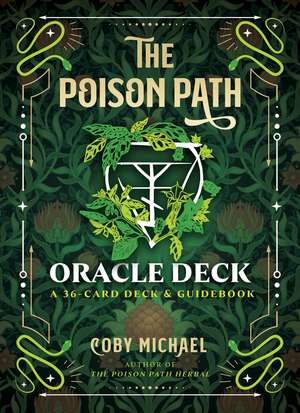
The Poison Path Oracle Deck: A 36-Card Deck and Guidebook
Autor Coby Michaelen Limba Engleză Cards – 22 oct 2026
• Includes 23 poisonous plants along with 13 veneficae, the historical and mythological women who’ve used these poisons
• Explores the nature of the poison path, containing a specific reading for each poison and poisoner, and plant spirit glyphs for use in meditation and spellwork
• Provides spreads that allow you to meditate on the nature of each poison and connect with its essence on a spiritual and energetic level
Though the word “poison” tends to cause fear, some of the most potent healing medicines are poisonous at high doses. Similarly, many substances thought of as poisons can, in small amounts, provide powerful therapeutic benefits.
In The Poison Path Oracle Deck, occult herbalist Coby Michael enables readers to access the power and wisdom of 23 poisonous plants, including nightshade, henbane, datura, foxglove, mistletoe, and hemlock. Each card contains plant lore, a description of the plant’s poisonous and medicinal qualities, and a plant spirit glyph that can be employed in meditation and spellwork. The author also offers 13 cards representing famous women—the venefica—from history and mythology who have wielded poison in empowering ways. Included among the venefica are Circe, Hekate, and Lucrezia Borgia. Similar to the Major Arcana of the tarot deck, the venefica cards convey archetypal messages, and they encourage you to embrace your power in transformative and often unexpected ways.
Each card is beautifully illustrated in full color, with the 23 plant cards using 18th–early 20th century botanical illustrations and the 13 venefica cards drawing inspiration from folk art. They offer insights in a direct way, often revealing truths that may at times be difficult to receive. The author’s unique spreads are designed to allow you to reflect and meditate on the nature of each poison and connect with its essence on a spiritual and energetic level.
“Poisonous plants act as mirrors, reflecting aspects of our shadow,” Michael writes. With The Poison Path Oracle Deck, you can engage the most complex aspects of your nature to find clarity, wisdom, and power.
Preț: 110.09 lei
Nou
Puncte Express: 165
Disponibil
Livrare economică 09-23 noiembrie
Livrare prin curier în România Termenul estimat este afișat lângă disponibilitate.
Transport gratuit de la 400.00 lei Plată online sau ramburs, în funcție de opțiunile comenzii.
Retur gratuit în 14 zile Comandă securizată și suport în română.
Specificații
ISBN-13: 9798888504437
Pagini: 144
Ilustrații: Includes 36 color cards and 144-page book
Dimensiuni: 102 x 140 x 28 mm
Greutate: 0.25 kg
Editura: Inner Traditions/Bear & Company
Colecția Destiny Books
Pagini: 144
Ilustrații: Includes 36 color cards and 144-page book
Dimensiuni: 102 x 140 x 28 mm
Greutate: 0.25 kg
Editura: Inner Traditions/Bear & Company
Colecția Destiny Books
Notă biografică
Coby Michael is an occult herbalist and magical practitioner specializing in the ritual use of poisonous and psychoactive plants. The owner of The Poisoner’s Apothecary, he is the author of The Poison Path Herbal, The Poison Path Grimoire, and The Poison Path Oracle. He lives in St. Petersburg, Florida.
Extras
1. THE FORBIDDEN FRUIT
Lore
The forbidden fruit card calls us to confront the raw, untamed power of desire, knowledge, and choice. Represented by the apple, pomegranate, mandrake, and the otherworldly Amanita muscaria, this card weaves together themes of sensuality, taboo, and sacred transgression. These fruits have long symbolized the mysteries that lie just beyond the boundaries of what is permitted, temptations that awaken both danger and divine insight. At the heart of the imagery lies the Tree of Knowledge in the Garden of Eden, where the “original sin” was not one of evil but of curiosity, agency, and the hunger for wisdom. The story of Eve and the apple has been used for centuries to shift blame for the fall of man onto the first woman, branding her a temptress and casting the pursuit of knowledge as rebellion.
But this card offers a reclamation. The forbidden fruit is not a curse. It is a sacrament. To bite into it is to activate free will, to choose experience over ignorance, and to step into your own power, even at great cost. Whether it’s the blood-red pomegranate of Persephone binding her to the underworld, the aphrodisiac mandrake and its poison, or the psychedelic Amanita muscaria guiding travelers through realms unseen, each symbol represents a choice to walk the edge between worlds forever cast out from the sleeping ignorance of the ordinary.
Divinatory Meaning
Like Eve, who dared to take that first bite of the forbidden fruit of knowledge, we must always question and strive to learn more. We must be willing to step into the unknown and to question what we are told by those in power so that we may fully live and experience things on our own terms. The forbidden fruit tempts us to ask whether or not there is more to the story than what we are being presented with.
Poison
The poison of the forbidden fruit offers heresy, corruption, transgression, taboo, and the understanding that knowledge changes us in permanent ways, and we can’t go back to the way things were once we are made aware of the true nature of reality. Like the fairy-tale poison apple, not every gift that comes to us is a blessing.
Medicine
The plant spirit medicine of the forbidden fruit asks: What taboos have you inherited that keep you from your truth? What desires have you been taught to suppress? The forbidden fruit is never handed to you. It must be claimed. Are you ready to experience what lies beyond the garden’s walls?
2. BITTERSWEET NIGHTSHADE
SOLANUM DULCAMARA
Lore
Its entangling and twining growth habits make bittersweet nightshade a great plant for binding and setting boundaries. The fresh stems can be wrapped around poppets or made into circlets and allowed to dry before being used in ritual. It can be hung in bundles over entryways and in areas where protection is needed. Bittersweet nightshade is used in folk magic to protect against the evil eye and malefic witchcraft. The stems, which become woodier with age, can be cut and bundled with rosewood and iron nails as a protective talisman. The root of the woody nightshade grows large and spreads through rhizomes. It can be harvested and kept as a plant spirit fetish. When placed on the altar, it helps to obscure the workings from those who would undermine your operations. It helps to connect to the shadow realm and assists in the integration of the shadow self.
Divinatory Meaning
Bittersweet nightshade appears as a guide through the delicate dance of boundaries: when to build them, when to reinforce them, and when to dismantle them. Its vining, entangling nature speaks to the need for upholding boundaries, grounding your energy, warding off toxicity, and guarding against emotional or spiritual drain. But this plant spirit also asks a hard question. Have your protections become prison walls? What once served to keep you safe may now be keeping you stuck.
This card invites you to examine the spaces in your life where fear, old wounds, or past betrayals have led to overfortification. It offers the medicine of discernment: recognizing patterns that no longer serve, reconnecting to your roots, and safely descending into the subconscious to reclaim what was hidden or lost. Bittersweet nightshade calls for balance, bringing the strength to say no and the courage to open again.
Poison
The poison of bittersweet nightshade can appear in areas of life where we have constructed boundaries that have become blockages. What was once a wall of protection can quickly become a cage when we are too wary of what may be on the other side of the wall. We must protect ourselves when needed but remember to take down the walls and allow ourselves to be vulnerable again.
Medicine
The plant spirit medicine of bittersweet nightshade asks us, Where do we need to set or strengthen our boundaries? It helps us to learn to recognize toxic patterns that keep us entangled. It helps with grounding and helps us to better contain and hold on to our own energy.
3. BLACK HELLEBORE
HELLEBORUS NIGER
Lore
In ancient Greece hellebore was called melampodium, after the physician and soothsayer Melampus, who used it to cure King Argos’s daughter of madness induced by maenads. The maenads were the much-feared female worshippers of Dionysus who engaged in ecstatic frenzies during their rites. Whether she was mad or just an independent woman who chose to worship with others like her is unknown. As one of the classical witchcraft herbs of medieval lore, hellebore has associations with practicing necromancy, raising and banishing spirits, and appeasing spiritual forces when they have been disturbed.
Divinatory Meaning
Black hellebore is a plant ally of self-sovereignty. As an herb of exorcism, it can help with banishing harmful influences and removing blockages that hold us back. It helps us to step into our own power and realize that we are the ones in control of our own lives. Magically, hellebore can help us with cutting cords and creating boundaries to help us reclaim our personal sovereignty. Hellebore is cold resistant and blooms when most other flowering plants are still in their winter hibernation. This beautiful forest flower waits for no one and is ready to show itself to the world. Being the first to bloom, it blooms alone and reminds us that sometimes we need to be alone to process and integrate new insights and healing so that growth can take place.
Poison
The poison of black hellebore manifests as stagnant energy, feeling lost in the shadow, heavy, and overwhelmed, and being swallowed by low vibrations. Intrusive thoughts and the sense of sinister presences can also manifest with long-term exposure to heavy energies.
Medicine
Call to the medicine of black hellebore for guidance during a dark night of the soul and to initiate cathartic experiences. Hellebore keeps us grounded during times of upheaval. It anchors us to the present while unearthing the past and supports ancestral healing, severing attachments and ending harmful relationships.
4. BLACK HENBANE
HYOSCYAMUS NIGER
Lore
As one of the earliest herbs of necromantic and funerary rites, black henbane seeds have been found in neolithic funerary vessels buried with the dead. Hercules was said to wear a crown of henbane and poplar leaves, which signified his ability to travel to the underworld and back. The newly returning dead were also crowned with a circlet of henbane when crossing the river Lethe; their purpose was to cause the dead to forget the toils of their former lives.
In Greek mythology, it was named Herba Apollinaris after the god Apollo. It was burned and smoked for its visionary effects, opening the gates of the upper and lower worlds. It is also a powerful herb of consecration, particularly for spirit vessels, tools of divination, and relics of shamanic travel intended to be taken to the spirit world.
Divinatory Meaning
Despite the fear surrounding many of the plants in the nightshade family, henbane seems to have a rather jovial spirit and reminds us that things are not always what they seem. It is ruled by Saturn, like all poisonous plants, but it also has associations to the gods of thunder, such as Jupiter, Thor, and Zeus. It is a plant spirit of both the underworld and the upper world. While there may be a risk of poisoning, as with all tropane alkaloid–containing plants, there are no human deaths irrefutably linked to henbane poisoning, and it has been used historically as an additive to increase the intoxicating power of beer, another connection to the celebratory side of this plant.
Memento mori, “remember you will die,” was a popular saying during the Victorian era. The saying reminds us to cherish life and all its moments because one day it will come to an end. As a plant spirit ally, black henbane shows us that we do not have to fear death. It can help us to approach life’s transitions and physical death without fear and to be happy while we are alive. Henbane helps us to enjoy the present moment by providing us with a broader perspective, seeing beyond the life and death cycle.
Poison
The poison of black henbane can appear as forgetting personal power, loss of identity, disconnection from ancestral spirits, numbness, obsessive thoughts, and loss of inspiration. It can also indicate attachment and a fear of letting go.
Medicine
The plant spirit medicine of black henbane offers support in assisting and facilitating ego death, healing grief and mourning, and processing and coming to terms with mortality, our own and the death of loved ones. It allays fear and offers support during transitional periods, when we’re at a crossroads in life and the way forward is unknown.
Lore
The forbidden fruit card calls us to confront the raw, untamed power of desire, knowledge, and choice. Represented by the apple, pomegranate, mandrake, and the otherworldly Amanita muscaria, this card weaves together themes of sensuality, taboo, and sacred transgression. These fruits have long symbolized the mysteries that lie just beyond the boundaries of what is permitted, temptations that awaken both danger and divine insight. At the heart of the imagery lies the Tree of Knowledge in the Garden of Eden, where the “original sin” was not one of evil but of curiosity, agency, and the hunger for wisdom. The story of Eve and the apple has been used for centuries to shift blame for the fall of man onto the first woman, branding her a temptress and casting the pursuit of knowledge as rebellion.
But this card offers a reclamation. The forbidden fruit is not a curse. It is a sacrament. To bite into it is to activate free will, to choose experience over ignorance, and to step into your own power, even at great cost. Whether it’s the blood-red pomegranate of Persephone binding her to the underworld, the aphrodisiac mandrake and its poison, or the psychedelic Amanita muscaria guiding travelers through realms unseen, each symbol represents a choice to walk the edge between worlds forever cast out from the sleeping ignorance of the ordinary.
Divinatory Meaning
Like Eve, who dared to take that first bite of the forbidden fruit of knowledge, we must always question and strive to learn more. We must be willing to step into the unknown and to question what we are told by those in power so that we may fully live and experience things on our own terms. The forbidden fruit tempts us to ask whether or not there is more to the story than what we are being presented with.
Poison
The poison of the forbidden fruit offers heresy, corruption, transgression, taboo, and the understanding that knowledge changes us in permanent ways, and we can’t go back to the way things were once we are made aware of the true nature of reality. Like the fairy-tale poison apple, not every gift that comes to us is a blessing.
Medicine
The plant spirit medicine of the forbidden fruit asks: What taboos have you inherited that keep you from your truth? What desires have you been taught to suppress? The forbidden fruit is never handed to you. It must be claimed. Are you ready to experience what lies beyond the garden’s walls?
2. BITTERSWEET NIGHTSHADE
SOLANUM DULCAMARA
Lore
Its entangling and twining growth habits make bittersweet nightshade a great plant for binding and setting boundaries. The fresh stems can be wrapped around poppets or made into circlets and allowed to dry before being used in ritual. It can be hung in bundles over entryways and in areas where protection is needed. Bittersweet nightshade is used in folk magic to protect against the evil eye and malefic witchcraft. The stems, which become woodier with age, can be cut and bundled with rosewood and iron nails as a protective talisman. The root of the woody nightshade grows large and spreads through rhizomes. It can be harvested and kept as a plant spirit fetish. When placed on the altar, it helps to obscure the workings from those who would undermine your operations. It helps to connect to the shadow realm and assists in the integration of the shadow self.
Divinatory Meaning
Bittersweet nightshade appears as a guide through the delicate dance of boundaries: when to build them, when to reinforce them, and when to dismantle them. Its vining, entangling nature speaks to the need for upholding boundaries, grounding your energy, warding off toxicity, and guarding against emotional or spiritual drain. But this plant spirit also asks a hard question. Have your protections become prison walls? What once served to keep you safe may now be keeping you stuck.
This card invites you to examine the spaces in your life where fear, old wounds, or past betrayals have led to overfortification. It offers the medicine of discernment: recognizing patterns that no longer serve, reconnecting to your roots, and safely descending into the subconscious to reclaim what was hidden or lost. Bittersweet nightshade calls for balance, bringing the strength to say no and the courage to open again.
Poison
The poison of bittersweet nightshade can appear in areas of life where we have constructed boundaries that have become blockages. What was once a wall of protection can quickly become a cage when we are too wary of what may be on the other side of the wall. We must protect ourselves when needed but remember to take down the walls and allow ourselves to be vulnerable again.
Medicine
The plant spirit medicine of bittersweet nightshade asks us, Where do we need to set or strengthen our boundaries? It helps us to learn to recognize toxic patterns that keep us entangled. It helps with grounding and helps us to better contain and hold on to our own energy.
3. BLACK HELLEBORE
HELLEBORUS NIGER
Lore
In ancient Greece hellebore was called melampodium, after the physician and soothsayer Melampus, who used it to cure King Argos’s daughter of madness induced by maenads. The maenads were the much-feared female worshippers of Dionysus who engaged in ecstatic frenzies during their rites. Whether she was mad or just an independent woman who chose to worship with others like her is unknown. As one of the classical witchcraft herbs of medieval lore, hellebore has associations with practicing necromancy, raising and banishing spirits, and appeasing spiritual forces when they have been disturbed.
Divinatory Meaning
Black hellebore is a plant ally of self-sovereignty. As an herb of exorcism, it can help with banishing harmful influences and removing blockages that hold us back. It helps us to step into our own power and realize that we are the ones in control of our own lives. Magically, hellebore can help us with cutting cords and creating boundaries to help us reclaim our personal sovereignty. Hellebore is cold resistant and blooms when most other flowering plants are still in their winter hibernation. This beautiful forest flower waits for no one and is ready to show itself to the world. Being the first to bloom, it blooms alone and reminds us that sometimes we need to be alone to process and integrate new insights and healing so that growth can take place.
Poison
The poison of black hellebore manifests as stagnant energy, feeling lost in the shadow, heavy, and overwhelmed, and being swallowed by low vibrations. Intrusive thoughts and the sense of sinister presences can also manifest with long-term exposure to heavy energies.
Medicine
Call to the medicine of black hellebore for guidance during a dark night of the soul and to initiate cathartic experiences. Hellebore keeps us grounded during times of upheaval. It anchors us to the present while unearthing the past and supports ancestral healing, severing attachments and ending harmful relationships.
4. BLACK HENBANE
HYOSCYAMUS NIGER
Lore
As one of the earliest herbs of necromantic and funerary rites, black henbane seeds have been found in neolithic funerary vessels buried with the dead. Hercules was said to wear a crown of henbane and poplar leaves, which signified his ability to travel to the underworld and back. The newly returning dead were also crowned with a circlet of henbane when crossing the river Lethe; their purpose was to cause the dead to forget the toils of their former lives.
In Greek mythology, it was named Herba Apollinaris after the god Apollo. It was burned and smoked for its visionary effects, opening the gates of the upper and lower worlds. It is also a powerful herb of consecration, particularly for spirit vessels, tools of divination, and relics of shamanic travel intended to be taken to the spirit world.
Divinatory Meaning
Despite the fear surrounding many of the plants in the nightshade family, henbane seems to have a rather jovial spirit and reminds us that things are not always what they seem. It is ruled by Saturn, like all poisonous plants, but it also has associations to the gods of thunder, such as Jupiter, Thor, and Zeus. It is a plant spirit of both the underworld and the upper world. While there may be a risk of poisoning, as with all tropane alkaloid–containing plants, there are no human deaths irrefutably linked to henbane poisoning, and it has been used historically as an additive to increase the intoxicating power of beer, another connection to the celebratory side of this plant.
Memento mori, “remember you will die,” was a popular saying during the Victorian era. The saying reminds us to cherish life and all its moments because one day it will come to an end. As a plant spirit ally, black henbane shows us that we do not have to fear death. It can help us to approach life’s transitions and physical death without fear and to be happy while we are alive. Henbane helps us to enjoy the present moment by providing us with a broader perspective, seeing beyond the life and death cycle.
Poison
The poison of black henbane can appear as forgetting personal power, loss of identity, disconnection from ancestral spirits, numbness, obsessive thoughts, and loss of inspiration. It can also indicate attachment and a fear of letting go.
Medicine
The plant spirit medicine of black henbane offers support in assisting and facilitating ego death, healing grief and mourning, and processing and coming to terms with mortality, our own and the death of loved ones. It allays fear and offers support during transitional periods, when we’re at a crossroads in life and the way forward is unknown.
Cuprins
Introduction
Working with This Deck
Plant Cards
Plant Spirit Glyphs
Venefica Cards
THE CARDS OF THE POISON PATH
1. The Forbidden Fruit
2. Bittersweet Nightshade Solanum dulcamara
3. Black Hellebore Helleborus niger
4. Black Henbane Hyoscyamus niger
5. Black Nightshade Solanum nigrum
6. Blackthorn Prunus spinosa
7. Bloodroot Sanguinaria canadensis
8. Brugmansia Brugmansia spp.
9. Datura Datura spp.
10. Deadly Nightshade Atropa belladonna
11. Foxglove Digitalis purpurea
12. Lily of the Valley Convallaria majalis
13. Malevolence Solanum atropurpureum
14. Mandrake Mandragora officinarum
15. Mistletoe Viscum album
16. Poison Hemlock Conium maculatum
17. Poppy Papaver somniferum
18. Rose Rosa spp.
19. Tobacco Nicotiana rustica
20. Venus Flytrap Dionaea muscipula
21. Wolfsbane Aconitum napellus
22. Wormwood Artemisia absinthium
23. Yew Taxus baccata
24. Catherine de Medici
25. Circe
26. Cleopatra
27. Echidna
28. Giulia Tofana
29. Hecate
30. Hydra
31. Locusta
32. Lucrezia Borgia
33. Medea
34. Medusa
35. The Weird Sisters
36. Venus
Spreads
Poison and Antidote: Two-Card Spread
Gate of Venus: Five-Card Spread
Path of the Serpent: Seven-Card Spread
Botanical Illustrations
Recommended Reading
About the Author
Working with This Deck
Plant Cards
Plant Spirit Glyphs
Venefica Cards
THE CARDS OF THE POISON PATH
1. The Forbidden Fruit
2. Bittersweet Nightshade Solanum dulcamara
3. Black Hellebore Helleborus niger
4. Black Henbane Hyoscyamus niger
5. Black Nightshade Solanum nigrum
6. Blackthorn Prunus spinosa
7. Bloodroot Sanguinaria canadensis
8. Brugmansia Brugmansia spp.
9. Datura Datura spp.
10. Deadly Nightshade Atropa belladonna
11. Foxglove Digitalis purpurea
12. Lily of the Valley Convallaria majalis
13. Malevolence Solanum atropurpureum
14. Mandrake Mandragora officinarum
15. Mistletoe Viscum album
16. Poison Hemlock Conium maculatum
17. Poppy Papaver somniferum
18. Rose Rosa spp.
19. Tobacco Nicotiana rustica
20. Venus Flytrap Dionaea muscipula
21. Wolfsbane Aconitum napellus
22. Wormwood Artemisia absinthium
23. Yew Taxus baccata
24. Catherine de Medici
25. Circe
26. Cleopatra
27. Echidna
28. Giulia Tofana
29. Hecate
30. Hydra
31. Locusta
32. Lucrezia Borgia
33. Medea
34. Medusa
35. The Weird Sisters
36. Venus
Spreads
Poison and Antidote: Two-Card Spread
Gate of Venus: Five-Card Spread
Path of the Serpent: Seven-Card Spread
Botanical Illustrations
Recommended Reading
About the Author
Descriere
A divinatory deck to engage the power and wisdom of poisonous plants