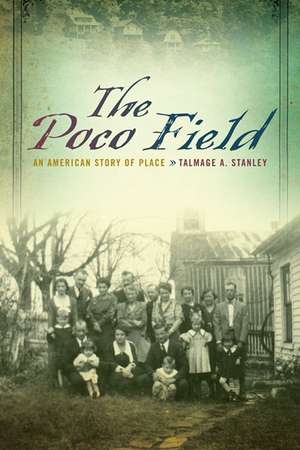
The Poco Field: An American Story of Place
Autor Talmage A. Stanleyen Limba Engleză Paperback – 28 feb 2012
Observăm în The Poco Field o abordare curajoasă a istoriei regionale, care debutează prin analiza eforturilor clasei de mijloc de a-și construi o identitate stabilă în contextul boom-ului carbonifer din Virginia de Vest. Talmage A. Stanley reușește să deconstruiască mitul conform căruia regiunea Appalachia ar fi o excepție izolată de la cultura americană, prezentând-o în schimb ca pe un simbol al tensiunilor naționale dintre progres și declin. Suntem de părere că forța acestui volum rezidă în modul în care autorul împletește istoria personală a bunicilor săi cu evenimente macroeconomice, precum falimentul fraudulos al Keystone National Bank sau segregarea locuitorilor de culoare.
Textul examinează critic modul în care structurile industriale și controlul local au modelat orașele Keystone și Newbern. Autorul nu se limitează la o simplă nostalgie, ci investighează modul în care valorile clasei de mijloc au fost erodate sub presiunea forțelor economice globale. Din punct de vedere vizual și documentar, ediția publicată de University of Illinois Press este susținută de 33 de fotografii de arhivă și hărți care ancorează narațiunea în realitatea geografică a bazinului Pocahontas. Această lucrare completează perspectiva oferită de Culture, Class, and Politics in Modern Appalachia, adăugând o dimensiune intimă, de memoriu personal, care lipsește din analizele pur sociologice sau politice ale regiunii. Credem că The Poco Field oferă un instrument necesar pentru înțelegerea modului în care simțul locului influențează cetățenia activă și democrația în secolul XXI.
Preț: 225.34 lei
Carte disponibilă
Livrare economică 21 septembrie-05 octombrie
Specificații
ISBN-10: 025207839X
Pagini: 256
Ilustrații: 33 black and white photographs, 1 map, 1 table
Dimensiuni: 152 x 229 x 25 mm
Greutate: 0.34 kg
Ediția:1st Edition
Editura: University of Illinois Press
Colecția University of Illinois Press
V-ar putea interesa
-
 Being IndianPavan VarmaPreț: 112.95 lei
 -
 How the Other Half LivesJacob A. RiisPreț: 88.12 lei
 -
 The Origin of Human Social InstitutionsW. G. Runciman-34%Preț: 388.74 lei592.61 lei
 -
 -34%Preț: 667.47 lei1006.78 lei
 -
 -31%Preț: 635.97 lei920.50 lei
 -
 Preț: 187.17 lei
 -
 Colonial Situations: Essays on the Contextualization of Ethnographic KnowledgeGeorge W. Stocking, Jr.Preț: 148.52 lei
 -
 The Old WayElizabeth Marshall ThomasPreț: 147.15 lei
 -
 An Introduction to Theories of Popular CultureDominic StrinatiPreț: 363.71 lei
 -
 Fan CulturesMatthew HillsPreț: 395.42 lei
 -
 Cultural Studies: A Critical IntroductionSimon DuringPreț: 363.66 lei
 -
 The Stars Down to EarthTheodor AdornoPreț: 155.57 lei
 -
 Natural Symbols: Explorations in CosmologyProfessor Mary DouglasPreț: 155.71 lei
 -
 The Subcultures Reader: Second EditionKen Gelder-15%Preț: 483.41 lei568.71 lei
 -
 -15%Preț: 418.56 lei492.42 lei
 -
 Preț: 256.95 lei
 -
 Interaction Ritual ChainsRandall CollinsPreț: 317.10 lei
De ce să citești această carte
Recomandăm această carte pentru cercetătorii și cititorii interesați de istoria socială a Americii. Veți câștiga o perspectivă nuanțată asupra clasei de mijloc din Appalachia, depășind stereotipurile clasice. Este o lectură esențială pentru a înțelege cum evenimente locale — de la inundații la fraude bancare — modelează identitatea unei comunități și reziliența acesteia în fața schimbărilor economice radicale.
Despre autor
Talmage A. Stanley este un cercetător axat pe studiul identității regionale și al istoriei sociale americane. Prin lucrarea de față, el aduce la lumină complexitatea vieții din bazinele carbonifere, utilizând propria istorie familială ca punct de plecare pentru o analiză academică riguroasă. Abordarea sa interdisciplinară, care îmbină etnografia cu economia politică, i-a permis să devină o voce importantă în studiile despre Appalachia, promovând ideea că locul și comunitatea sunt fundamentale pentru revitalizarea societății democratice.
Descriere scurtă
Recenzii
"Stanley sees in his family's lived experience a rich window into the middle-class aspirations and cultural understandings of not only mid-century Appalachia but also the nation as a whole. . . . Stanley's book is effective in conveying larger meanings from family history. The Poco Field brings the power of the personal to history and cultural studies, and the fields are all the richer for it."--Appalachian Journal
"Stanley's book is interesting, and it certainly makes a scholarly contribution to the literature. Anyone searching for a fresh perspective on twentieth-century Appalachia or middle-class life in the United States would do well to give it a read."--The Journal of Southern History