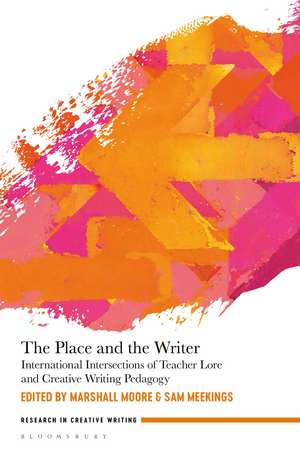
The Place and the Writer: International Intersections of Teacher Lore and Creative Writing Pedagogy: Research in Creative Writing
Editat de Dr Marshall Moore, Dr Sam Meekingsen Limba Engleză Paperback – 20 oct 2022
Marshall Moore and Sam Meekings challenge areas of perceived wisdom that persist in the field of creative writing, including aesthetics and politics in institutionalized creative writing; the process of workshopping; tuition and talent; anxiety in the classroom; unifying theory and lore; and teaching creative writing in languages other than English.


Preț: 220.92 lei
Preț vechi: 293.58 lei
-25%
Puncte Express: 331
Carte tipărită la comandă
Livrare economică 03-17 decembrie
Livrare prin curier în România Termenul estimat este afișat lângă disponibilitate.
Transport gratuit de la 400.00 lei Plată online sau ramburs, în funcție de opțiunile comenzii.
Retur gratuit în 14 zile Comandă securizată și suport în română.
Specificații
ISBN-13: 9781350213913
ISBN-10: 1350213918
Pagini: 266
Dimensiuni: 156 x 234 x 14 mm
Greutate: 0.38 kg
Editura: Bloomsbury Publishing
Colecția Bloomsbury Academic
Seria Research in Creative Writing
Locul publicării:London, United Kingdom
ISBN-10: 1350213918
Pagini: 266
Dimensiuni: 156 x 234 x 14 mm
Greutate: 0.38 kg
Editura: Bloomsbury Publishing
Colecția Bloomsbury Academic
Seria Research in Creative Writing
Locul publicării:London, United Kingdom
V-ar putea interesa
-
 How to Write a Damn Good ThrillerJames N. FreyPreț: 210.56 lei
 -
 Clemy's Pancake HouseKevin MooneyPreț: 75.69 lei
 -
 What We Hold in Our Hands: A Slow Road ReaderFrederick Blair FirstPreț: 116.86 lei
 -
 Preț: 109.76 lei
 -
 The Insider's Guide to Graduate Degrees in Creative WritingDr Seth Abramson-24%Preț: 199.37 lei261.93 lei
 -
 Collaborative Worldbuilding for Writers and GamersDr Trent Hergenrader-15%Preț: 178.07 lei210.44 lei
 -
 Critical Creative Writing: Essential Readings on the Writer's CraftDr Janelle Adsit-15%Preț: 222.32 lei262.24 lei
 -
 The Geek’s Guide to the Writing Life: An Instructional Memoir for Prose WritersProfessor Stephanie Vanderslice-22%Preț: 142.42 lei181.49 lei
 -
 -19%Preț: 183.88 lei228.12 lei
 -
 The Bloomsbury Introduction to Creative WritingDr Tara Mokhtari-20%Preț: 169.53 lei210.83 lei
 -
 Creative Writing Innovations: Breaking Boundaries in the ClassroomDr Michael Dean Clark-24%Preț: 264.44 lei347.06 lei
 -
 -24%Preț: 262.33 lei345.94 lei
 -
 Choice WordsRobert ReginaldPreț: 101.33 lei
 -
 Creative Writing in the Digital Age: Theory, Practice, and PedagogyDr Michael Dean Clark-16%Preț: 248.32 lei295.23 lei
 -
 -33%Preț: 52.50 lei78.53 lei
 -
 Preț: 81.76 lei
 -
 Divination MachineF. Daniel RzicznekPreț: 97.24 lei
 -
 Attitudes: Selected Prose and PoetryW. Ross WinterowdPreț: 151.16 lei
 -
 Basic WritingGeorge OttePreț: 212.40 lei
 -
 The Writing Skill Builder for College FreshmenJoy F. BeckfordPreț: 397.12 lei
 -
 Art & Craft of Writing Fiction: First Writer's ManualVictoria MixonPreț: 114.02 lei
 -
 Pulverizing Portraits: Lynn Emanuel's Poetry of BecomingCamelia EliasPreț: 153.61 lei
 -
 Creative Writing in Prose: Analytical and Policy PerspectivesMarjorie Oludhe MacgoyePreț: 229.36 lei
Cuprins
1. Foreword by Marshall Moore and Sam Meekings
2. Introduction by Graeme Harper (University of Oakland, USA)
3. Toward a Unified Field: The Complications of Lore and Global Context by Stephanie Vanderslice (University of Central Arkansas, USA)
4. Ukubhukuda: 1 Not Sinking in Language but Swimming by Bronwyn Law-Viljoen and Phillippa Yaa de Villiers (University of the Witwatersrand, South Africa)
5. Workshopping to Better Writing and Understanding by Dai Fan and Li Ling (Sun Yat-Sen University, China)
6. Protagonizing the L2: the Case for "Life Writing" in Creative Writing (SL) Contexts by Dan Disney (Sogang University, Korea)
7. From the Shadow of a Myth to an Academic Subject: Teaching Writing from a Cognitive Base by Nora Ekstrom (University of Jyväskylä, Finland)
8. Scenes of Judgement: Teaching Narrative Form in Literary Memoir by Jonathan Taylor (University of Leicester, UK)
9. Tuition and the Individual Talent by Ross Gibson (University of Canberra, Australia)
10. Creative Portfolios: Adapting AWP Goals for EFL Creative Writing Courses in Japan by Holly Thompson (Yokohama City University, Japan)
11. Through the Looking Glass and Back Again: Writing Reflectively in Creative Writing by Maria Taylor (De Montfort University, UK)
12. Teacher Lore and Pedagogy in Creative Writing Courses in Poland:A Brief History and Practices That Work by Hanna Sieja-Skrzypulec (Jagiellonian University, Poland)
13. Historical and Pedagogical Dimension of Creative Writing in Greece: From Conventional to Open and Distance-Learning Education by Triantafyllos Kotopoulos (University of Western Macedonia), Sophie Iakovidou (Democritus University of Thrace), and Iordanis Koumasidis (Hellenic Open University)
14. An American Walks into a Bar (with her British Creative Writing Students) by Lania Knight (University of Gloucestershire, UK)
15. Teaching Chinese-Language Creative Writing in Hong Kong: Three Case Studies by James Shea (Hong Kong Baptist University)
16. Playing Catch-Up: Finding a Voice for Creative Writing in Brazil by Bernardo Bueno (Pontifical Catholic University of Rio Grande do Sul, Brazil)
17. Teaching Creative Writing in a Threatened Language by Rúnar Vignisson (University of Iceland)
2. Introduction by Graeme Harper (University of Oakland, USA)
3. Toward a Unified Field: The Complications of Lore and Global Context by Stephanie Vanderslice (University of Central Arkansas, USA)
4. Ukubhukuda: 1 Not Sinking in Language but Swimming by Bronwyn Law-Viljoen and Phillippa Yaa de Villiers (University of the Witwatersrand, South Africa)
5. Workshopping to Better Writing and Understanding by Dai Fan and Li Ling (Sun Yat-Sen University, China)
6. Protagonizing the L2: the Case for "Life Writing" in Creative Writing (SL) Contexts by Dan Disney (Sogang University, Korea)
7. From the Shadow of a Myth to an Academic Subject: Teaching Writing from a Cognitive Base by Nora Ekstrom (University of Jyväskylä, Finland)
8. Scenes of Judgement: Teaching Narrative Form in Literary Memoir by Jonathan Taylor (University of Leicester, UK)
9. Tuition and the Individual Talent by Ross Gibson (University of Canberra, Australia)
10. Creative Portfolios: Adapting AWP Goals for EFL Creative Writing Courses in Japan by Holly Thompson (Yokohama City University, Japan)
11. Through the Looking Glass and Back Again: Writing Reflectively in Creative Writing by Maria Taylor (De Montfort University, UK)
12. Teacher Lore and Pedagogy in Creative Writing Courses in Poland:A Brief History and Practices That Work by Hanna Sieja-Skrzypulec (Jagiellonian University, Poland)
13. Historical and Pedagogical Dimension of Creative Writing in Greece: From Conventional to Open and Distance-Learning Education by Triantafyllos Kotopoulos (University of Western Macedonia), Sophie Iakovidou (Democritus University of Thrace), and Iordanis Koumasidis (Hellenic Open University)
14. An American Walks into a Bar (with her British Creative Writing Students) by Lania Knight (University of Gloucestershire, UK)
15. Teaching Chinese-Language Creative Writing in Hong Kong: Three Case Studies by James Shea (Hong Kong Baptist University)
16. Playing Catch-Up: Finding a Voice for Creative Writing in Brazil by Bernardo Bueno (Pontifical Catholic University of Rio Grande do Sul, Brazil)
17. Teaching Creative Writing in a Threatened Language by Rúnar Vignisson (University of Iceland)
Recenzii
Creative writing viewed as part of the higher education sector is often considered to be one of the newer disciplines, though those of us who work in the field trace a lineage back at least to Aristotle. It is true, though, that only in recent decades has a major corpus of writing has emerged about this discipline; and truer yet that the majority of that literature reads the creative writing discipline from a Euro-American perspective. This new volume returns to an enduring concern in the sector - that of lore - with an obvious attempt to break the patterns of colonisation, and ensure intersectionality of voice and perspective. Contributors to this volume include key scholars from across the globe, who richly evoke, engage and critique the meanings of 'lore' in their various contexts, in some cases puncturing the 'truths' that thread through our discourses, in other cases extending and enriching understandings. What they show is the diversity of tradition, thinking, language, narrative structures, and identities; while at the same time confirming what Graeme Harper terms the 'kinship in creative writing'. In all our differences, as Ross Gibson suggests, we creative writing teachers and scholars can still harmonize around the central tune being hummed by this difficult, compelling, lovely discipline.