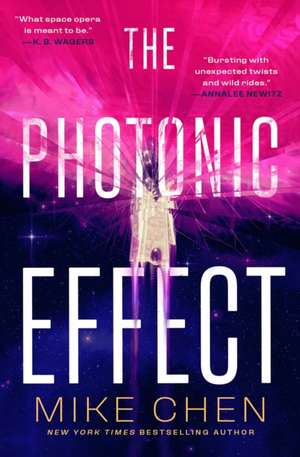
The Photonic Effect
Autor Mike Chenen Limba Engleză Paperback – 21 mai 2026
A starship captain and her crew face conspiracies and betrayals as they clash with various factions of a galactic civil war in a thrilling space adventure by New York Times bestselling author Mike Chen.
The starship Horizon’s crew spent ten years trapped across the expanse of space. Now they’re finally home—only it’s not the home they knew. The Cluster, once a peaceful coalition of planets, has fractured in the wake of civil war.
Captain Demora Kim wants nothing more than to protect her surviving crew. It’s what she owes them after years of instability and terror. But in times of war, no one is allowed neutrality.
After an attack on a mining station leaves thousands dead, Demi’s efforts become almost impossible. Every ship is needed on the frontline. Thrust deeper into a conflict she barely understands, Demi considers a bold choice—one that might keep her promises but tip the galaxy further into chaos.
“Mike Chen has done it again. The Photonic Effect is bursting with unexpected twists and wild rides, but most of all, it's full of heart.” —Annalee Newitz
“One of the strongest space operas I’ve read in recent years. A thrilling, emotionally grounded story about survival, leadership, and the true cost of command.” —Karen Osborne
Preț: 54.81 lei
Preț vechi: 65.87 lei
-17%
Puncte Express: 82
Carte disponibilă
Livrare economică 13-25 noiembrie
Livrare express 24-30 octombrie pentru 36.75 lei
Livrare prin curier în România Termenul estimat este afișat lângă disponibilitate.
Transport gratuit de la 400.00 lei Plată online sau ramburs, în funcție de opțiunile comenzii.
Retur gratuit în 14 zile Comandă securizată și suport în română.
Specificații
ISBN-13: 9781668083796
ISBN-10: 1668083795
Pagini: 448
Dimensiuni: 140 x 213 x 25 mm
Greutate: 0.34 kg
Editura: S&S/Saga Press
Colecția S&S/Saga Press
ISBN-10: 1668083795
Pagini: 448
Dimensiuni: 140 x 213 x 25 mm
Greutate: 0.34 kg
Editura: S&S/Saga Press
Colecția S&S/Saga Press
Notă biografică
Mike Chen is the New York Times bestselling author of The Photonic Effect, Star Wars: Brotherhood, Here and Now and Then, A Quantum Love Story, and other novels, as well as Star Trek: Deep Space Nine comics. He has covered geek culture for sites such as Nerdist and The Mary Sue, and in a different life, he's covered the NHL. A member of SFWA, Mike lives in the Bay Area with his wife, daughter, and many rescue animals.
Extras
Chapter 1: DemiCHAPTER 1
Captain Demora Kim never expected to be a mechanic on board her own ship. She didn’t have the qualifications—she wasn’t an engineer or a technician. She studied cartography at the Galactic Cluster Fleet Academy, which didn’t really apply to repairing hardware.
But things always broke on the GCF Starship Horizon, often leaving the closest person available to fix the problem.
In this case, she’d told the crew that she’d meet them down at the mess hall for ramen night soon. Classified war intel was coming through, and she just needed a minute. But a minute didn’t suffice, because the message wasn’t processing at her private station. So she’d walked down the hall from her quarters to the bridge, though at the path’s end, the elevator tempted her to just leave and go get ramen. However, she did the responsible thing—the captainly thing—and stepped forward.
Two doors slid open, revealing the large—and empty—bridge of the Horizon. Through the wide front window, a blanket of space and stars lay ahead. In front of that, a floating hologram of the ship’s statuses projected from the large square data table. Normally, she’d head right to the captain’s chair near the back of the rectangular space. But instead she turned immediately to the corner comms station. She knelt down to the access panel, a sheet of alloy covered in magnetic decals of rock bands spanning nearly three hundred years—a giveaway that Lieutenant Lynn Kohli was both the ship’s communications officer and resident music buff. Demi unlatched the panel and slid it off to expose wiring and hardware, then got onto her back for a look.
There it was.
Just as she’d suspected, the chip that drove routing of incoming classified messages had simply fallen loose. It happened every few months, like many other things on the Horizon, because parts wore down, got damaged, needed haphazard fixes. Ten years stuck in a mysterious gravity well would do that to hardware. Demi traced her finger along the edge of the chip until she got to the exact right angle to lock it in, then pushed.
It clicked into place. She sealed up the panel and stood up, then tapped the console to process the message right here on the bridge.
Stuck, then unstuck. Kind of like the Horizon itself.
And just like the Horizon, the chip saw war when it got unstuck—here, in the form of communications regarding the ongoing civil war with the Withdrawal Movement. Demi went to her seat and glanced at the clock, a reminder that her skeleton crew were down in the mess hall.
A captain and her crew of seventeen didn’t exactly fill a starship built for seventy-two. But when things actually worked, Demi found the empty ship a peaceful, almost stable environment for the greatest of scientific endeavors: to restore the photonic engine that brought them home. Such a project proved a blessing: scientific progress and a reason to stay far away from the front. None of them needed the turmoil of the war; they’d seen and lived worse.
Because those seventeen people down at ramen night were more than just crew members.
Getting trapped with no outside communication or support caused all sorts of things to claim the lives of their colleagues. And when other spacecraft got pulled into the well, distrust and sabotage took more of them until Demi forged truces between the often at-odds groups.
Then the well grew unstable, eventually imploding neighboring ships, and panic took over: skirmishes over supplies, emergency repairs that wouldn’t quite hold, and long, empty nights debating whether it was worth it to go on.
No, they weren’t just crew. Or friends. Or family.
They were survivors together.
Demi lingered on that when the wide holographic display shifted from ship status to an incoming classified message about a war she wanted no part of.
Or at least, it started to. CLASSIFIED—FOR YOUR EYES ONLY appeared before dissolving to the sight of Galactic Cluster Minister of Defense Cabell. Cabell opened his mouth before the image froze and a system warning appeared, along with a schematic of comm array hardware.
Primary classified decoder failing—rerouting to secondary array
This issue had nothing to do with a loose chip. It flashed several times before Rerouting successful appeared and the message played out.
“To all fleet captains. I apologize about the mass outreach, but it was the most efficient way to reach all of you given the rapidly unfolding situation. An incident occurred on the central mining station of the gas moon Ark Getru in the Nedotia System.” The image changed from Cabell to the station itself, a diamond-shaped conflux of alloys designed for mining gas and supporting a massive civilian community. “This is a select edit of security footage. I am warning you that this is not easy to see.”
It started out innocently enough, a view of a factory floor where staff stood lined at machines, holding pumps and nozzles. Then the image shook, the feed becoming blocks of colored and distorted pixels for a moment. Then everything moved—workers, equipment, hardware, safety helmets, all of it flew in a strange way, a sudden jolt that tossed everything toward the left side of the image.
It took Demi a second to realize what happened. The people didn’t fly horizontally; no, the station tilted. And the people dropped due to gravity.
Suddenly, ramen night seemed so very far away.
The footage changed to a courtyard view of a park near the station’s upper floor. Residents milled about, some walking along the gardens, some seated around a fountain with a picnic blanket, and others playing with pets or children.
Then the same thing happened—first, a massive shake, then everything lifted and flew to the left side of the image. Except this time, the yellow clouds of Ark Getru rotated nearly ninety degrees, as if someone turned the background sideways. And against those clouds, tiny dots began to trickle from background buildings and structures, a line of specks floating helplessly out of the station, like insects crawling out of a flooded rock face.
The image switched again, this time to a flying security vehicle hurtling toward the station. A nonhuman voice spoke, her words tinted by both concern and curiosity as a single explosion fired off near the station’s lower levels. Soon another bomb went off, and another and another, until the station’s multiple rings of stabilizers and magnetic repulsors—originally designed to work with Ark Getru’s significant magnetic fields—all exploded, a one-by-one line that created systematic rings of destruction around the station’s middle and bottom.
The repulsor tech that defined the very existence of the Ark Getru central mining operation simply vaporized. And with it, the gas planet’s natural gravity pulled at the superstructure, first causing it to tilt on its axis before a rapid descent into the whirling gaseous core of the planet below, leaving the security vehicle’s camera to stare at an empty location of puffy clouds and several blinking beacons.
Seconds ago, the pilot’s voice cried out. But now her vehicle hovered, the only noise the panicked radio chatter over her comms.
“Internal view. Surface view. External view,” Cabell said as he faded back in, his broken gaze betraying his otherwise stoic voice. “There is more recorded, of course, but it’s not necessary for our purposes.”
One explosion wouldn’t do it. A dozen well-placed bombs wouldn’t do it. This required a massive coordinated operation, and Demi guessed possibly seventy or eighty bombs were needed to take out the station, her mind racing through the logistics necessary to attack one of the Cluster’s most historically lauded resource stations.
And how the hell did someone get past security?
“Here are the facts of the event.” As Cabell spoke, text appeared across the hologram: Ark Getru population statistics, demographics, mining output. One line in particular was highlighted—Exports impact 15% of Cluster non-FTL propulsion.
Demi figured that in a war over resources, anything impacting Cluster-standard faster-than-light systems was probably pretty important. Though not as important as the bold words at the bottom of the hologram, a line of characters with the most harrowing, stark text any captain could ever see:
Estimated destruction rate: 100%
Estimated casualty rate: 100%
Just like what happened to ships in the gravity well. The damage was the same, the only difference being that in the well, implosion crushed people instead of tossing them into the atmosphere.
Demi thought she’d left that level of destruction behind. But in a way, it felt like it followed her home.
“Prime Minister Kentworthy put out a statement on behalf of the Withdrawal Movement neither confirming nor denying involvement. However, our intelligence believes this attack was in response to our last attempt at negotiation—specifically, the claim that the WM lacked the organization to produce coordinated efforts and should release territory as such. It is likely that similar large-scale, quick-strike attacks are in the works.” Cabell bit down on his lip, hesitating for several seconds, and during that span, a gnawing realization hit that, unlike what Demi witnessed in the gravity well, this was self-inflicted, a byproduct of hubris and stubbornness playing with risk.
The Cluster bluffed its position, thinking it might strong-arm the WM into concessions. The WM responded in the worst possible manner. And now an entire station was destroyed.
“We have instituted a Cluster-wide media blackout. Now”—the old man’s gaze narrowed, a tension coming to both his eyes and the bushy white brows above them—“the official story is that a severe and unexpected series of ecological events ignited a storage room of collected gas, setting off a chain reaction. Select footage will support this. And you, as fleet captains, hold a responsibility in maintaining that narrative.”
Demi realized her fingers were tightly pressed against her knees. She relaxed them, then a breath as well. Everything she’d known about the Cluster fractured. Impenetrable security of high-value resources. Truth, justice, honesty, and all the other supposed virtues of being in the fleet. Of course politics existed, but a cover-up of this scale? Mistakes of this scale?
“Word of this incident has spread much faster than anticipated. While it is known that WM attacks have always disregarded civilian safety, this escalation exposes the Cluster’s weakening security, cumulative loss of resources, and weakened bargaining posture. If those facts get out to the public, it will, at best, drain support for the war.
“At worst, it will give the WM a strategic advantage on all fronts—tactically, culturally, politically. We cannot allow the public, even rank-and-file crew, to know—”
Data stream halted displayed across the frozen image. Demi tapped the console on her chair again, this time to reroute enhancers for signal stability. The transmission stalled on Cabell’s mouth in mid-sentence. Which was kind of good, because as she waited for the system to recover, Demi really needed a moment to process the way that her government and its opposition both treated civilians as war fodder.
In the well, every single one of her decisions clawed back a little more stability, a little more life out of the impossible. Here, everything seemed to spiral in the opposite way.
Despite the violence, despite the death, Demi froze at a sudden thought: horrifying as it was, destructive as it was, maybe it all existed outside of the Horizon. Since they’d returned to Cluster space—raw, traumatized, lost—she’d pushed Command to keep the Horizon out of the war. The ship, the crew, they were all anomalies that just popped up in the middle of an ongoing conflict, one that threatened to swallow each of them whole.
With everything Cabell just revealed, that might have been the right decision all along. Her decade-old ship carrying a patchwork crew and their shattered emotions couldn’t shift the war in any way, not when the Cluster goaded the WM into more deadly attacks. All Demi could do was keep everything at bay long enough to…
Long enough for something better to happen. What that was, she wasn’t sure. But she owed it to her crew to find out.
It was the only thing she could control. She had to stick to it.
Demi took a breath, then told herself the next time she listened to classified war material, make sure her dog was around to help steady her racing pulse.
“—stage of the war,” Cabell continued, though the visuals remained paused. “As fleet captains, there is no doubt these discussions will reach at least some of your crew. Your orders are to—”
Suddenly, the entire holo disappeared, leaving only the front window and the vastness of space. On Demi’s console, the comm array schematic lit up with all types of unhappy flashing—plus a new message: Secondary support maximized. Attempt internal repair?
Demi hit an icon to start the Horizon’s self-repair processes and watched as an estimated completion time fluctuated between ten minutes and three hours. That was a good prompt for Demi to stand up from the captain’s chair. “Computer, reroute comm array status to the mess hall, primary display.”
Her crew expected her. If she didn’t show up, they’d suspect something. It was ramen night, after all.
Demi gave herself a few breaths to absorb the lies, the death, the chaos sent in a single message. Then she tamped it down. She had to. For one hour, because reality would come soon enough. Word of Ark Getru would surely trickle in from outside colleagues, from news broadcasts, from family and friends. And then Command’s orders to lie would kick in.
For that hour, she wanted to give everyone on board freedom from everything that was soon to come.
Including herself.
CHAPTER 1 ![]() DEMI
DEMI
Captain Demora Kim never expected to be a mechanic on board her own ship. She didn’t have the qualifications—she wasn’t an engineer or a technician. She studied cartography at the Galactic Cluster Fleet Academy, which didn’t really apply to repairing hardware.
But things always broke on the GCF Starship Horizon, often leaving the closest person available to fix the problem.
In this case, she’d told the crew that she’d meet them down at the mess hall for ramen night soon. Classified war intel was coming through, and she just needed a minute. But a minute didn’t suffice, because the message wasn’t processing at her private station. So she’d walked down the hall from her quarters to the bridge, though at the path’s end, the elevator tempted her to just leave and go get ramen. However, she did the responsible thing—the captainly thing—and stepped forward.
Two doors slid open, revealing the large—and empty—bridge of the Horizon. Through the wide front window, a blanket of space and stars lay ahead. In front of that, a floating hologram of the ship’s statuses projected from the large square data table. Normally, she’d head right to the captain’s chair near the back of the rectangular space. But instead she turned immediately to the corner comms station. She knelt down to the access panel, a sheet of alloy covered in magnetic decals of rock bands spanning nearly three hundred years—a giveaway that Lieutenant Lynn Kohli was both the ship’s communications officer and resident music buff. Demi unlatched the panel and slid it off to expose wiring and hardware, then got onto her back for a look.
There it was.
Just as she’d suspected, the chip that drove routing of incoming classified messages had simply fallen loose. It happened every few months, like many other things on the Horizon, because parts wore down, got damaged, needed haphazard fixes. Ten years stuck in a mysterious gravity well would do that to hardware. Demi traced her finger along the edge of the chip until she got to the exact right angle to lock it in, then pushed.
It clicked into place. She sealed up the panel and stood up, then tapped the console to process the message right here on the bridge.
Stuck, then unstuck. Kind of like the Horizon itself.
And just like the Horizon, the chip saw war when it got unstuck—here, in the form of communications regarding the ongoing civil war with the Withdrawal Movement. Demi went to her seat and glanced at the clock, a reminder that her skeleton crew were down in the mess hall.
A captain and her crew of seventeen didn’t exactly fill a starship built for seventy-two. But when things actually worked, Demi found the empty ship a peaceful, almost stable environment for the greatest of scientific endeavors: to restore the photonic engine that brought them home. Such a project proved a blessing: scientific progress and a reason to stay far away from the front. None of them needed the turmoil of the war; they’d seen and lived worse.
Because those seventeen people down at ramen night were more than just crew members.
Getting trapped with no outside communication or support caused all sorts of things to claim the lives of their colleagues. And when other spacecraft got pulled into the well, distrust and sabotage took more of them until Demi forged truces between the often at-odds groups.
Then the well grew unstable, eventually imploding neighboring ships, and panic took over: skirmishes over supplies, emergency repairs that wouldn’t quite hold, and long, empty nights debating whether it was worth it to go on.
No, they weren’t just crew. Or friends. Or family.
They were survivors together.
Demi lingered on that when the wide holographic display shifted from ship status to an incoming classified message about a war she wanted no part of.
Or at least, it started to. CLASSIFIED—FOR YOUR EYES ONLY appeared before dissolving to the sight of Galactic Cluster Minister of Defense Cabell. Cabell opened his mouth before the image froze and a system warning appeared, along with a schematic of comm array hardware.
Primary classified decoder failing—rerouting to secondary array
This issue had nothing to do with a loose chip. It flashed several times before Rerouting successful appeared and the message played out.
“To all fleet captains. I apologize about the mass outreach, but it was the most efficient way to reach all of you given the rapidly unfolding situation. An incident occurred on the central mining station of the gas moon Ark Getru in the Nedotia System.” The image changed from Cabell to the station itself, a diamond-shaped conflux of alloys designed for mining gas and supporting a massive civilian community. “This is a select edit of security footage. I am warning you that this is not easy to see.”
It started out innocently enough, a view of a factory floor where staff stood lined at machines, holding pumps and nozzles. Then the image shook, the feed becoming blocks of colored and distorted pixels for a moment. Then everything moved—workers, equipment, hardware, safety helmets, all of it flew in a strange way, a sudden jolt that tossed everything toward the left side of the image.
It took Demi a second to realize what happened. The people didn’t fly horizontally; no, the station tilted. And the people dropped due to gravity.
Suddenly, ramen night seemed so very far away.
The footage changed to a courtyard view of a park near the station’s upper floor. Residents milled about, some walking along the gardens, some seated around a fountain with a picnic blanket, and others playing with pets or children.
Then the same thing happened—first, a massive shake, then everything lifted and flew to the left side of the image. Except this time, the yellow clouds of Ark Getru rotated nearly ninety degrees, as if someone turned the background sideways. And against those clouds, tiny dots began to trickle from background buildings and structures, a line of specks floating helplessly out of the station, like insects crawling out of a flooded rock face.
The image switched again, this time to a flying security vehicle hurtling toward the station. A nonhuman voice spoke, her words tinted by both concern and curiosity as a single explosion fired off near the station’s lower levels. Soon another bomb went off, and another and another, until the station’s multiple rings of stabilizers and magnetic repulsors—originally designed to work with Ark Getru’s significant magnetic fields—all exploded, a one-by-one line that created systematic rings of destruction around the station’s middle and bottom.
The repulsor tech that defined the very existence of the Ark Getru central mining operation simply vaporized. And with it, the gas planet’s natural gravity pulled at the superstructure, first causing it to tilt on its axis before a rapid descent into the whirling gaseous core of the planet below, leaving the security vehicle’s camera to stare at an empty location of puffy clouds and several blinking beacons.
Seconds ago, the pilot’s voice cried out. But now her vehicle hovered, the only noise the panicked radio chatter over her comms.
“Internal view. Surface view. External view,” Cabell said as he faded back in, his broken gaze betraying his otherwise stoic voice. “There is more recorded, of course, but it’s not necessary for our purposes.”
One explosion wouldn’t do it. A dozen well-placed bombs wouldn’t do it. This required a massive coordinated operation, and Demi guessed possibly seventy or eighty bombs were needed to take out the station, her mind racing through the logistics necessary to attack one of the Cluster’s most historically lauded resource stations.
And how the hell did someone get past security?
“Here are the facts of the event.” As Cabell spoke, text appeared across the hologram: Ark Getru population statistics, demographics, mining output. One line in particular was highlighted—Exports impact 15% of Cluster non-FTL propulsion.
Demi figured that in a war over resources, anything impacting Cluster-standard faster-than-light systems was probably pretty important. Though not as important as the bold words at the bottom of the hologram, a line of characters with the most harrowing, stark text any captain could ever see:
Estimated destruction rate: 100%
Estimated casualty rate: 100%
Just like what happened to ships in the gravity well. The damage was the same, the only difference being that in the well, implosion crushed people instead of tossing them into the atmosphere.
Demi thought she’d left that level of destruction behind. But in a way, it felt like it followed her home.
“Prime Minister Kentworthy put out a statement on behalf of the Withdrawal Movement neither confirming nor denying involvement. However, our intelligence believes this attack was in response to our last attempt at negotiation—specifically, the claim that the WM lacked the organization to produce coordinated efforts and should release territory as such. It is likely that similar large-scale, quick-strike attacks are in the works.” Cabell bit down on his lip, hesitating for several seconds, and during that span, a gnawing realization hit that, unlike what Demi witnessed in the gravity well, this was self-inflicted, a byproduct of hubris and stubbornness playing with risk.
The Cluster bluffed its position, thinking it might strong-arm the WM into concessions. The WM responded in the worst possible manner. And now an entire station was destroyed.
“We have instituted a Cluster-wide media blackout. Now”—the old man’s gaze narrowed, a tension coming to both his eyes and the bushy white brows above them—“the official story is that a severe and unexpected series of ecological events ignited a storage room of collected gas, setting off a chain reaction. Select footage will support this. And you, as fleet captains, hold a responsibility in maintaining that narrative.”
Demi realized her fingers were tightly pressed against her knees. She relaxed them, then a breath as well. Everything she’d known about the Cluster fractured. Impenetrable security of high-value resources. Truth, justice, honesty, and all the other supposed virtues of being in the fleet. Of course politics existed, but a cover-up of this scale? Mistakes of this scale?
“Word of this incident has spread much faster than anticipated. While it is known that WM attacks have always disregarded civilian safety, this escalation exposes the Cluster’s weakening security, cumulative loss of resources, and weakened bargaining posture. If those facts get out to the public, it will, at best, drain support for the war.
“At worst, it will give the WM a strategic advantage on all fronts—tactically, culturally, politically. We cannot allow the public, even rank-and-file crew, to know—”
Data stream halted displayed across the frozen image. Demi tapped the console on her chair again, this time to reroute enhancers for signal stability. The transmission stalled on Cabell’s mouth in mid-sentence. Which was kind of good, because as she waited for the system to recover, Demi really needed a moment to process the way that her government and its opposition both treated civilians as war fodder.
In the well, every single one of her decisions clawed back a little more stability, a little more life out of the impossible. Here, everything seemed to spiral in the opposite way.
Despite the violence, despite the death, Demi froze at a sudden thought: horrifying as it was, destructive as it was, maybe it all existed outside of the Horizon. Since they’d returned to Cluster space—raw, traumatized, lost—she’d pushed Command to keep the Horizon out of the war. The ship, the crew, they were all anomalies that just popped up in the middle of an ongoing conflict, one that threatened to swallow each of them whole.
With everything Cabell just revealed, that might have been the right decision all along. Her decade-old ship carrying a patchwork crew and their shattered emotions couldn’t shift the war in any way, not when the Cluster goaded the WM into more deadly attacks. All Demi could do was keep everything at bay long enough to…
Long enough for something better to happen. What that was, she wasn’t sure. But she owed it to her crew to find out.
It was the only thing she could control. She had to stick to it.
Demi took a breath, then told herself the next time she listened to classified war material, make sure her dog was around to help steady her racing pulse.
“—stage of the war,” Cabell continued, though the visuals remained paused. “As fleet captains, there is no doubt these discussions will reach at least some of your crew. Your orders are to—”
Suddenly, the entire holo disappeared, leaving only the front window and the vastness of space. On Demi’s console, the comm array schematic lit up with all types of unhappy flashing—plus a new message: Secondary support maximized. Attempt internal repair?
Demi hit an icon to start the Horizon’s self-repair processes and watched as an estimated completion time fluctuated between ten minutes and three hours. That was a good prompt for Demi to stand up from the captain’s chair. “Computer, reroute comm array status to the mess hall, primary display.”
Her crew expected her. If she didn’t show up, they’d suspect something. It was ramen night, after all.
Demi gave herself a few breaths to absorb the lies, the death, the chaos sent in a single message. Then she tamped it down. She had to. For one hour, because reality would come soon enough. Word of Ark Getru would surely trickle in from outside colleagues, from news broadcasts, from family and friends. And then Command’s orders to lie would kick in.
For that hour, she wanted to give everyone on board freedom from everything that was soon to come.
Including herself.
Recenzii
“Mike Chen has done it again. He's turned theoretical physics inside-out to make you fall in love with a band of misfits from across the multiverse. The Photonic Effect is a delightful adventure bursting with unexpected twists and wild rides, but, most of all, it's full of heart.”
“A superb sci-fi story about 21st-century issues set in a futuristic space environment, featuring flawed but lovable characters doing their best with whatever challenges the galaxy presents.”
"What space opera is meant to be. The Photonic Effect is a brilliantly complex novel about love, loss, and war that's populated by characters so alive you can feel their hearts in each beat of your own."
"Mike Chen expertly combines the challenges of a First Contact story with creditable alien-y aliens, problem-solving under extreme pressure, and a romance. It’s brilliant!"
“I loved this book! One of the strongest space operas I’ve read in recent years, full of tasty political intrigue, impossible choices, and richly realized characters. Chen never loses sight of the real people caught in the crossfire of this galactic-scale war, delivering a thrilling, emotionally-grounded story about survival, leadership, and the true cost of command.”
“Found family goes multiverse and science is better than war in this rousing sci-fi adventure! Watching Chen's cast slam into the pointless cruelty of wartime bureaucracy, and fight for a better way, feels way too relatable in our times. Perfect for fans of Essa Hansen and Ren Hutchings.”
PRAISE FOR MIKE CHEN
A Beginning at the End offers an intimate, surprisingly gentle vision of post-disaster humanity, less concerned with how we might survive than with why—and for whom." —Alix E. Harrow, New York Times Bestselling author
Chen has a true gift for making the biggest of worlds center around the most complex workings of hearts, and his newest is compelling, realistic, and impossible to put down.” —Booklist, starred review on A Beginning at the End
"Chen does what the very best sci-fi writers do--he takes a fascinating concept and elevates it with brilliant execution and deeply heartfelt plot twists that make this story less about the (fun) conventions of the genre and more about the profound experience of being human."—Michael Moreci (Black Star Renegades, Star Wars) on Here and Now and Then
"Chen’s strength in writing poignant character arcs, especially within family dynamics, shines here, as does his ability to craft intriguing blends of literary and speculative fiction with compelling, character-driven plots.” –Library Journal on Light Years from Home
“A superb sci-fi story about 21st-century issues set in a futuristic space environment, featuring flawed but lovable characters doing their best with whatever challenges the galaxy presents.”
"What space opera is meant to be. The Photonic Effect is a brilliantly complex novel about love, loss, and war that's populated by characters so alive you can feel their hearts in each beat of your own."
"Mike Chen expertly combines the challenges of a First Contact story with creditable alien-y aliens, problem-solving under extreme pressure, and a romance. It’s brilliant!"
“I loved this book! One of the strongest space operas I’ve read in recent years, full of tasty political intrigue, impossible choices, and richly realized characters. Chen never loses sight of the real people caught in the crossfire of this galactic-scale war, delivering a thrilling, emotionally-grounded story about survival, leadership, and the true cost of command.”
“Found family goes multiverse and science is better than war in this rousing sci-fi adventure! Watching Chen's cast slam into the pointless cruelty of wartime bureaucracy, and fight for a better way, feels way too relatable in our times. Perfect for fans of Essa Hansen and Ren Hutchings.”
PRAISE FOR MIKE CHEN
A Beginning at the End offers an intimate, surprisingly gentle vision of post-disaster humanity, less concerned with how we might survive than with why—and for whom." —Alix E. Harrow, New York Times Bestselling author
Chen has a true gift for making the biggest of worlds center around the most complex workings of hearts, and his newest is compelling, realistic, and impossible to put down.” —Booklist, starred review on A Beginning at the End
"Chen does what the very best sci-fi writers do--he takes a fascinating concept and elevates it with brilliant execution and deeply heartfelt plot twists that make this story less about the (fun) conventions of the genre and more about the profound experience of being human."—Michael Moreci (Black Star Renegades, Star Wars) on Here and Now and Then
"Chen’s strength in writing poignant character arcs, especially within family dynamics, shines here, as does his ability to craft intriguing blends of literary and speculative fiction with compelling, character-driven plots.” –Library Journal on Light Years from Home
Descriere
From New York Times bestselling author Mike Chen comes a page-turning space opera in which a starship captain and her crew receive a distress signal and find themselves at odds with various factions of a galactic civil war—for fans of Alastair Reynolds and Adrian Tchaikovsky.