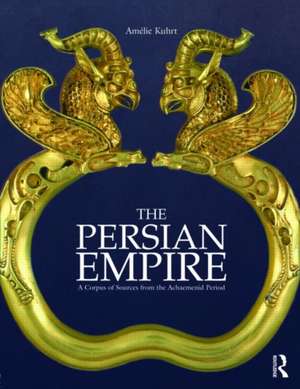
The Persian Empire: A Corpus of Sources from the Achaemenid Period
Autor Amélie Kuhrten Limba Engleză Paperback – sep 2009
The Achaemenid empire developed in the region of modern Fars (Islam) and expanded to unite territories stretching from the Segean and Egypt in the west to Central Asia and north-west India, which it ruled for over 200 years until its conquest by Alexander of Macedon.
Although all these regions had long since been in contact with each other, they had never been linked under a single regime. The Persian empire represents an important phase of transformation for its subjects, such as the Jews, as well as those living on its edges, such as the European Greeks.
Preț: 607.17 lei
Preț vechi: 659.96 lei
-8%
Puncte Express: 911
Carte indisponibilă temporar
Livrare prin curier în România Termenul estimat este afișat lângă disponibilitate.
Transport gratuit pentru acest produs Plată online sau ramburs, în funcție de opțiunile comenzii.
Retur gratuit în 14 zile Comandă securizată și suport în română.
Specificații
ISBN-13: 9780415552790
ISBN-10: 0415552796
Pagini: 1072
Dimensiuni: 189 x 246 x 54 mm
Greutate: 2.68 kg
Ediția:1
Editura: Taylor & Francis
Colecția Routledge
Locul publicării:Oxford, United Kingdom
ISBN-10: 0415552796
Pagini: 1072
Dimensiuni: 189 x 246 x 54 mm
Greutate: 2.68 kg
Ediția:1
Editura: Taylor & Francis
Colecția Routledge
Locul publicării:Oxford, United Kingdom
V-ar putea interesa
-
 Images of Women in AntiquityAveril CameronPreț: 424.63 lei
 -
 -18%Preț: 1253.77 lei1528.98 lei
 -
 Preț: 262.71 lei
 -
 The Politics of Food in Modern MoroccoStacy E. HoldenPreț: 182.85 lei
 -
 Atlas of Islamic HistoryPeter SluglettPreț: 432.76 lei
 -
 The Kurdish Spring: A New Map of the Middle EastDavid L. Phillips-18%Preț: 1114.12 lei1358.68 lei
 -
 Zeal for ZionShalom GoldmanPreț: 326.90 lei
 -
 -18%Preț: 1122.77 lei1369.23 lei
 -
 -18%Preț: 1122.50 lei1368.90 lei
 -
 -33%Preț: 837.16 lei1243.56 lei
 -
 Afghanistan: Identity, Society and Politics Since 1980Micheline Centlivres-Demont-33%Preț: 838.99 lei1244.68 lei
 -
 Life at the Court of the Early Qajar ShahsDr Eskandari-Qajar-24%Preț: 473.56 lei624.26 lei
 -
 Les Sceaux Byzantins Du Musee Archeologique D'IstanbulVera Bulgurlu-23%Preț: 929.29 lei1206.87 lei
Public țintă
Academic and PostgraduateCuprins
1. The Sources Part I. Prehistory and Formation of the Empire (c.750-520) 2. The Medes 3. Cyrus the Great 4. The Reign of Cambyses 5. From Cambyses to Darius I Part II. Achaemenid History and its Problems 6. The Empire under Darius I: Expansion, Revolt, Consolidation 7. The Reign of Xerxes 8. From Artaxerxes I to Darius II's Last Years 9. Artaxerxes II and Artaxerxes III 10. The Fall of the Achaemenid Empire Part III. Kings and Kingship 11. Images of Empire, Royal Ideology and the Cultic Framework 12. The Organisation of the Court 13. Mechanisms of Power Part IV. Achaemenid Imperial Organisation 14. Tribute, Tax, Imposts 15. Routes and Communication Networks 16. Bureaucracy, Production, Settlement 17. Unity and Diversity