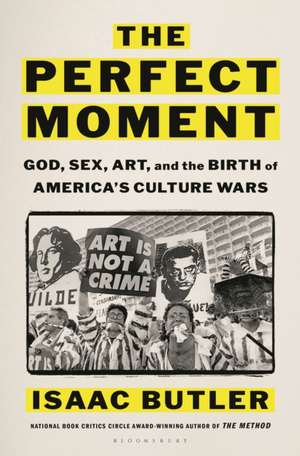
The Perfect Moment: God, Sex, Art, and the Birth of America's Culture Wars
Autor Isaac Butleren Limba Engleză Hardback – 31 dec 2026
The prize-winning author of The Method reveals the forgotten origins of America's culture wars-a story of late 20th century art vs. censorship, brimming with intense drama and fierce moral urgency.
It's 1988, the final year of the Reagan presidency, and the curtain is closing on the Cold War. In the absence of external adversaries, the American public is on the precipice of war with itself. The religious right, newly ascendant and emboldened, is determined to seize control of America's future. And the first battles will be fought over, of all things, contemporary art.
In The Perfect Moment, cultural historian Isaac Butler reexamines this pivotal, misunderstood American era. Archconservatives like Jesse Helms, Pat Buchanan, and Pat Robertson fixed their sights on artists including Andres Serrano, Robert Mapplethorpe, David Wojnarowicz, and Karen Finley, capitalizing on the provocative politics of their work to stir a nascent evangelical coalition into moral panic. It was at this moment, Butler argues, that the far right perfected the tactics it still uses today to whip its base into frenzy-from banning books and sanitizing American history, to spreading medical misinformation. All too relevant today, The Perfect Moment is an incisive and meticulously researched account of this crucial period and a stirring ode to the power of the creative spirit.
Preț: 198.96 lei
Nou
Puncte Express: 298
Carte disponibilă
Livrare economică 07-21 noiembrie
Livrare prin curier în România Termenul estimat este afișat lângă disponibilitate.
Transport gratuit de la 400.00 lei Plată online sau ramburs, în funcție de opțiunile comenzii.
Retur gratuit în 14 zile Comandă securizată și suport în română.
Specificații
ISBN-13: 9781639733491
ISBN-10: 1639733493
Pagini: 384
Ilustrații: B&W images throughout and one 8-page color insert
Dimensiuni: 156 x 235 x 38 mm
Greutate: 0.62 kg
Editura: Bloomsbury Publishing
Colecția Bloomsbury Publishing
Locul publicării:New York, United States
ISBN-10: 1639733493
Pagini: 384
Ilustrații: B&W images throughout and one 8-page color insert
Dimensiuni: 156 x 235 x 38 mm
Greutate: 0.62 kg
Editura: Bloomsbury Publishing
Colecția Bloomsbury Publishing
Locul publicării:New York, United States
Recenzii
Butler ignites an urgent signal flare, illuminating how decades of coordinated efforts to stifle free expression snowballed into our present moment. Scrupulously researched and blissfully told, this gonzo history of American art and attrition proves that Butler is one of the most exciting writers of non-fiction today.
The Perfect Moment excavates the late 20th century to show that the political playbook of the 2020s was perfected in earlier battles over paintings, photographs, and performance art . . . Butler doesn't need to belabor the contemporary parallels; this exhaustively investigated and deeply persuasive argument makes them crystal clear.
Critic and historian Butler offers a comprehensive overview of the religious right's targeting of artists and arts funding in the 1980s and '90s . . . Throughout, Butler incisively highlights the spiraling damage inflicted by the tepid responses of arts supporters like NEA chairman John Frohnmayer, who, desperate to protect the Endowment, agreed to diminish artists' freedom of expression, and of the liberal establishment as a whole, which squeamishly demurred from defending works . . . [The Perfect Moment] makes for a dramatic retelling of a sea change in American arts and politics.
An absorbing autopsy of America's first culture wars. . . Butler recasts the battles for artistic freedom of speech fought in the late-20th century, "the World War I of American arts and letters," as a sobering prelude to today's gloves-off assault on the arts. . . A richly detailed genealogy of the continuing battle for artistic freedom in the U.S.
Butler, director, podcaster, and author of The Method, traces this fraught era from a fight over textbooks in West Virginia in 1974 to the end of the twentieth century and beyond . . . Butler's insights into the end of the Cold War and the AIDS crisis, interviews with many of those involved, and excerpts from critical analysis of art pieces round out this freshly relevant exploration of a pivotal time for the arts in America.
In this lively history, Butler revisits the American culture wars that started in the late nineteen-eighties. . . Along the way, indelible scenes . . . lend the political history novelistic propulsion. The culture wars, Butler suggests, are less a closed chapter than a continuing conflict.
Tightly focused and purposive . . . the book is replete with striking details all the way through . . . [The Perfect Moment] brings together stories of art-worldpeople whose undertakings might be otherwise forgotten.
This country has always had culture wars, but 1988 was the year everything broke open. Isaac Butler's new book looks at an era of AIDS activism, artistic expression, and an ascendent religious right . . . The Perfect Moment ably and passionately underscores the legacy of the First Amendment, cornerstone of our Bill of Rights, besieged now as never before.
The Perfect Moment maps the history of the NEA, the largest arts funder in the US, and archconservatives like Jesse Helms and Pat Buchanan, who used provocative pieces of art to stir the right's base into a moral panic. Structured like both a two-act play and nonviolent military history, Butler builds a case for how the battle over American contemporary art laid the groundwork for our present moment. This history feels particularly urgent now.
Butler makes the case for how and why culture became a central political background and what was at stake. Reading it today-against the backdrop of the Second Culture War-evokes an uncanny déjà vu . . . His history unfold[s] with the pace of a courtroom drama . . . [The Perfect Moment] may also provide a model for how to approach the current moment: by paying close critical attention.
Isaac Butler is one of the pre-eminent writers covering pop cultural history right now. His latest book takes on an essential subject: the moment in the 1980s when art and politics collided in the U.S., changing the way both would be perceived in the decades that followed.
[A] fascinating, well-researched, well-reported cultural history, written with a sense of drive and suspense.
With his deft and thoughtful study, Butler demonstrates that the inorganic, often orchestrated battles that edgy works of art provoked could operate as a parable about Middle America's manipulation by the religious right-and the cowardice of institutional liberalism in standing up against these outrages . . . The Perfect Moment offers crucial insights into contemporary crises in American politics and much longer-standing cultural failures.
A new history of the conservative outrage machine . . . In the last quarter of the twentieth century, art became lashed to financial, religious, and political power in unprecedented ways . . . Butler smartly widens his lens to see this period as part of a larger throughline of right-wing Evangelical activism that started with comparatively small-bore protests.
Gripping and exhaustively researched.
As Isaac Butler enthusiastically recounts in The Perfect Moment, the debate over collective morals, values and aesthetics has its roots in the culture wars that exploded during the 1980s . . . Butler's comprehensive book details the congressional efforts to defund the National Endowment for the Arts, led by the bombastic North Carolina Sen. Jesse Helms amid the early years of the AIDS crisis . . . Butler leads readers on a meticulous tour through each successive controversy.
In an entertaining blend of courtroom drama and art history . . . [The Perfect Moment] explores nothing less than the struggle for cultural hegemony in the United States-specifically between a Christian nationalist and a left-liberal camp . . . Butler demonstrates just how diffuse and sometimes paradoxical the ideological boundaries in this struggle can be.
An engaging and deeply researched book that deftly maps the far right's attack on art and free speech in the 80s and 90s to the current day. The antagonistic players may have changed, but their tactics remain the same. Butler's storytelling is as strong as his reporting, showing us that while we can't undo the past, we can learn from it and reshape our future.
With dozens of incisive portraits wound within a swiftly moving central narrative, Isaac Butler illuminates one of the most important histories of the past sixty years: the struggles for meaning and identity in American culture and politics. It's essential reading for followers of art history, political history or cultural criticism. The Perfect Moment helps us understand the forces that roil our present fractured moment and why the arts remain essential in defining American society.
Isaac Butler is the Ernie Pyle of the 1980s culture wars, and The Perfect Moment is a clear-eyed chronicle of the skirmishes, sorties, and struggles that have made up the conservative movement's all-out war on art--and artists--in America.
[A]n incisive commentary on the dangers of censorship in a nation that proclaims freedom of speech as a fundamental constitutional right . . . The Perfect Moment underscores an urgent reality - that artists must find a way to sustain themselves through their work.
[A] timely reassessment of the culture wars is brought to you by someone raised on its front lines. . . [Butler] was inspired to write this book while watching the tides turn again in the 2020s: Where the left had once been the bastion of free expression, soon it was the right championing-and rebranding-'free speech' . . . Here history emerges a playbook for the new wave of culture wars ahead.
Isaac Butler has written a history of the controversies - dubbed the 'culture wars' - that arose in the United States around the arts and arts-adjacent fields from the mid-1980s to around 2000 . . . Butler tells a vivid story with good portraits of the artists whose work was at issue. He is especially good at defining the bind that National Endowment for the Arts chairs John Frohnmayer, and then Jane Alexander, found themselves in as they endeavored both to keep the NEA alive in the face of Congressional threats to kill it.
The Perfect Moment excavates the late 20th century to show that the political playbook of the 2020s was perfected in earlier battles over paintings, photographs, and performance art . . . Butler doesn't need to belabor the contemporary parallels; this exhaustively investigated and deeply persuasive argument makes them crystal clear.
Critic and historian Butler offers a comprehensive overview of the religious right's targeting of artists and arts funding in the 1980s and '90s . . . Throughout, Butler incisively highlights the spiraling damage inflicted by the tepid responses of arts supporters like NEA chairman John Frohnmayer, who, desperate to protect the Endowment, agreed to diminish artists' freedom of expression, and of the liberal establishment as a whole, which squeamishly demurred from defending works . . . [The Perfect Moment] makes for a dramatic retelling of a sea change in American arts and politics.
An absorbing autopsy of America's first culture wars. . . Butler recasts the battles for artistic freedom of speech fought in the late-20th century, "the World War I of American arts and letters," as a sobering prelude to today's gloves-off assault on the arts. . . A richly detailed genealogy of the continuing battle for artistic freedom in the U.S.
Butler, director, podcaster, and author of The Method, traces this fraught era from a fight over textbooks in West Virginia in 1974 to the end of the twentieth century and beyond . . . Butler's insights into the end of the Cold War and the AIDS crisis, interviews with many of those involved, and excerpts from critical analysis of art pieces round out this freshly relevant exploration of a pivotal time for the arts in America.
In this lively history, Butler revisits the American culture wars that started in the late nineteen-eighties. . . Along the way, indelible scenes . . . lend the political history novelistic propulsion. The culture wars, Butler suggests, are less a closed chapter than a continuing conflict.
Tightly focused and purposive . . . the book is replete with striking details all the way through . . . [The Perfect Moment] brings together stories of art-worldpeople whose undertakings might be otherwise forgotten.
This country has always had culture wars, but 1988 was the year everything broke open. Isaac Butler's new book looks at an era of AIDS activism, artistic expression, and an ascendent religious right . . . The Perfect Moment ably and passionately underscores the legacy of the First Amendment, cornerstone of our Bill of Rights, besieged now as never before.
The Perfect Moment maps the history of the NEA, the largest arts funder in the US, and archconservatives like Jesse Helms and Pat Buchanan, who used provocative pieces of art to stir the right's base into a moral panic. Structured like both a two-act play and nonviolent military history, Butler builds a case for how the battle over American contemporary art laid the groundwork for our present moment. This history feels particularly urgent now.
Butler makes the case for how and why culture became a central political background and what was at stake. Reading it today-against the backdrop of the Second Culture War-evokes an uncanny déjà vu . . . His history unfold[s] with the pace of a courtroom drama . . . [The Perfect Moment] may also provide a model for how to approach the current moment: by paying close critical attention.
Isaac Butler is one of the pre-eminent writers covering pop cultural history right now. His latest book takes on an essential subject: the moment in the 1980s when art and politics collided in the U.S., changing the way both would be perceived in the decades that followed.
[A] fascinating, well-researched, well-reported cultural history, written with a sense of drive and suspense.
With his deft and thoughtful study, Butler demonstrates that the inorganic, often orchestrated battles that edgy works of art provoked could operate as a parable about Middle America's manipulation by the religious right-and the cowardice of institutional liberalism in standing up against these outrages . . . The Perfect Moment offers crucial insights into contemporary crises in American politics and much longer-standing cultural failures.
A new history of the conservative outrage machine . . . In the last quarter of the twentieth century, art became lashed to financial, religious, and political power in unprecedented ways . . . Butler smartly widens his lens to see this period as part of a larger throughline of right-wing Evangelical activism that started with comparatively small-bore protests.
Gripping and exhaustively researched.
As Isaac Butler enthusiastically recounts in The Perfect Moment, the debate over collective morals, values and aesthetics has its roots in the culture wars that exploded during the 1980s . . . Butler's comprehensive book details the congressional efforts to defund the National Endowment for the Arts, led by the bombastic North Carolina Sen. Jesse Helms amid the early years of the AIDS crisis . . . Butler leads readers on a meticulous tour through each successive controversy.
In an entertaining blend of courtroom drama and art history . . . [The Perfect Moment] explores nothing less than the struggle for cultural hegemony in the United States-specifically between a Christian nationalist and a left-liberal camp . . . Butler demonstrates just how diffuse and sometimes paradoxical the ideological boundaries in this struggle can be.
An engaging and deeply researched book that deftly maps the far right's attack on art and free speech in the 80s and 90s to the current day. The antagonistic players may have changed, but their tactics remain the same. Butler's storytelling is as strong as his reporting, showing us that while we can't undo the past, we can learn from it and reshape our future.
With dozens of incisive portraits wound within a swiftly moving central narrative, Isaac Butler illuminates one of the most important histories of the past sixty years: the struggles for meaning and identity in American culture and politics. It's essential reading for followers of art history, political history or cultural criticism. The Perfect Moment helps us understand the forces that roil our present fractured moment and why the arts remain essential in defining American society.
Isaac Butler is the Ernie Pyle of the 1980s culture wars, and The Perfect Moment is a clear-eyed chronicle of the skirmishes, sorties, and struggles that have made up the conservative movement's all-out war on art--and artists--in America.
[A]n incisive commentary on the dangers of censorship in a nation that proclaims freedom of speech as a fundamental constitutional right . . . The Perfect Moment underscores an urgent reality - that artists must find a way to sustain themselves through their work.
[A] timely reassessment of the culture wars is brought to you by someone raised on its front lines. . . [Butler] was inspired to write this book while watching the tides turn again in the 2020s: Where the left had once been the bastion of free expression, soon it was the right championing-and rebranding-'free speech' . . . Here history emerges a playbook for the new wave of culture wars ahead.
Isaac Butler has written a history of the controversies - dubbed the 'culture wars' - that arose in the United States around the arts and arts-adjacent fields from the mid-1980s to around 2000 . . . Butler tells a vivid story with good portraits of the artists whose work was at issue. He is especially good at defining the bind that National Endowment for the Arts chairs John Frohnmayer, and then Jane Alexander, found themselves in as they endeavored both to keep the NEA alive in the face of Congressional threats to kill it.