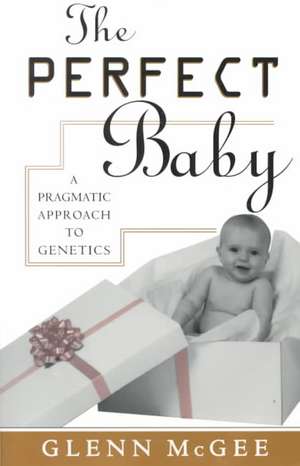
The Perfect Baby: A Pragmatic Approach to Genetics
Autor Glenn McGeeen Limba Engleză Paperback – 19 dec 1996
The Perfect Baby is a clarion call for a more realistic discussion of biotechnology. McGee challenges the common assumption that we are essentially determined by a genetic blueprint. He denies the necessity of a new "Genethics," arguing that the wisdom we need can be found in the everyday experience of parents. The Perfect Baby dramatically alters the terms of the moral debate for parents, policymakers, scientists, philosophers, theologians, and physicians.
Preț: 95.47 lei
Preț vechi: 113.46 lei
-16%
Puncte Express: 143
Carte tipărită la comandă
Livrare economică 09-23 noiembrie
Livrare prin curier în România Termenul estimat este afișat lângă disponibilitate.
Transport gratuit de la 400.00 lei Plată online sau ramburs, în funcție de opțiunile comenzii.
Retur gratuit în 14 zile Comandă securizată și suport în română.
Specificații
ISBN-13: 9780847683444
ISBN-10: 0847683443
Pagini: 184
Dimensiuni: 150 x 229 x 14 mm
Greutate: 0.28 kg
Ediția:New.
Editura: Bloomsbury Publishing
Colecția Rowman & Littlefield
Locul publicării:New York, United States
ISBN-10: 0847683443
Pagini: 184
Dimensiuni: 150 x 229 x 14 mm
Greutate: 0.28 kg
Ediția:New.
Editura: Bloomsbury Publishing
Colecția Rowman & Littlefield
Locul publicării:New York, United States
V-ar putea interesa
-
 Family-Making: Contemporary Ethical ChallengesFrançoise Baylis-31%Preț: 711.95 lei1031.73 lei
 -
 The Roots of Bioethics: Health, Progress, Technology, DeathDaniel Callahan-26%Preț: 677.83 lei915.76 lei
 -
 Questions Of Ethics In Counselling And TherapyCaroline Jones-29%Preț: 174.46 lei247.15 lei
 -
 A Question of TrustOnora O'Neill-5%Preț: 190.55 lei200.58 lei
 -
 -23%Preț: 278.53 lei362.28 lei
 -
 BioethicsStephen Holland-5%Preț: 209.65 lei220.68 lei
 -
 On Moral MedicineM. Therese Lysaught-5%Preț: 784.97 lei826.28 lei
 -
 Health Care Professionalism at a GlanceJill Thistlethwaite-5%Preț: 251.43 lei264.66 lei
 -
 Psychiatry Under the InfluenceR. Whitaker-15%Preț: 476.28 lei560.33 lei
 -
 -5%Preț: 440.91 lei464.12 lei
 -
 Cord Blood: Banks & Banking, Ethical Issues & Risks/BenefitsLisandra Vanostrand-23%Preț: 1044.15 lei1362.87 lei
 -
 -23%Preț: 1042.79 lei1362.00 lei
Cuprins
Chapter 1 The Landscape of Genetic Technology
Chapter 2 The Magic Answer? Hopes for Genetic Engineering
Chapter 3 Debunking the Myths
Chapter 4 Biology, Culture, and Methodical Social Change: A Pragmatic Approach to Genetics
Chapter 5 Genetic Approaches to Family and Public Health
Chapter 6 The Not-so-Deadly Sins of Genetic Enhancement
Chapter 2 The Magic Answer? Hopes for Genetic Engineering
Chapter 3 Debunking the Myths
Chapter 4 Biology, Culture, and Methodical Social Change: A Pragmatic Approach to Genetics
Chapter 5 Genetic Approaches to Family and Public Health
Chapter 6 The Not-so-Deadly Sins of Genetic Enhancement
Recenzii
A book for those perplexed by the philosophical and ethical conundrums of genetics in the 21st century.
Well-informed, balanced, and quite well written.
He combines a rich body of clinical material with informed pragmatic critique.
A pioneering, landmark work in pragmatic bioethics.
This captivating book offers balanced new insights for individual decisions and for public policy.
A welcome alternative to work that force fits the issues either to scholarly abstractions or to myths of popular culture.
A provocative account of this emerging, cutting-edge issue that will greatly profit future commentators and policymakers.
A useful road map as we enter the complex territory of genetic medicine in the 21st century.
A remarkably well-informed and sensitive exploration of the opportunities and challenges presented by the new science of genetics.
Extremely readable and provocative . . . succeeds at something that few scholars in Bioethics have even attempted: to speak in ordinary language and in a conversational voice about the nest of subtle issues that entangle new advances in human genetics.
McGee is one of the most energetic and inquisitive writers in the emerging 'next generation' of bioethicists . . . His work is interesting, important, and has the kind of self-reflective courage we need to face these issues squarely.
McGee's application of the pragmatic method to issues in bioethics is both timely and effective. McGee's excellent final chapters will give students of all levels a perspective that cannot be found in other books of the kind.
McGee's book breathes all the virtues of a pioneering work. it puts the issue of human genetic engineering in a fresh perspective, draws the attention to many valuable points, and raises a number of important questions.
McGee's well-written and intriguing new book adds little to the content . . . .he does offer a unique and much needed practical approach to the critical analysis of the relevant issues.
McGee's book is an excellent introduction to the issues and he provides especially good treatments of the nature/nurture debate and the relationship between genetics and allocation decisions. Many will find his views provocative. His work is breezy and fun to read.
So where do ordinary folk, faced with a life-or-death decision, get some useful information? This book might be a good starting ground.
The philosophical tradition of American pragmatism has had a fresh life in recent years. In McGee's hands it is richer, more suggestive . . . Not everyone will find The Perfect Baby acceptable, but McGee will give the opponents reason to pause. Weneed that kind of initiative, and McGee's book will provoke some useful, much needed debate.
Finally- a good book about genetics- that makes these fascinating issues understandable to the families who need to know.
. . . useful to just about everyone who must grapple with the new genetics.
The book is appropriately directed to a diverse audience and makes refreshing use of plain language to address relevant issues present in the choices we must now make in everyday life.
McGee develops a very powerful line of reasoning about genetic enhancement.
[McGee sees] the real task as helping ordinary families "who are trying to decide about genetic tests" so he explains them with humor and understanding. This is an important book in the continuing exploration of bioethics!
McGee's analysis leads, among other things, to some important proposals on health insurance policy and a probing, helpful discussion of genetic enhancement engineering. This is a lively and readable book, useful in both theological and philosophical discussions.
McGee provides a highly readable and informative account of current and future uses of genetic technology.
An excellent text with keen insights and salient overview of key issues.
Well-informed, balanced, and quite well written.
He combines a rich body of clinical material with informed pragmatic critique.
A pioneering, landmark work in pragmatic bioethics.
This captivating book offers balanced new insights for individual decisions and for public policy.
A welcome alternative to work that force fits the issues either to scholarly abstractions or to myths of popular culture.
A provocative account of this emerging, cutting-edge issue that will greatly profit future commentators and policymakers.
A useful road map as we enter the complex territory of genetic medicine in the 21st century.
A remarkably well-informed and sensitive exploration of the opportunities and challenges presented by the new science of genetics.
Extremely readable and provocative . . . succeeds at something that few scholars in Bioethics have even attempted: to speak in ordinary language and in a conversational voice about the nest of subtle issues that entangle new advances in human genetics.
McGee is one of the most energetic and inquisitive writers in the emerging 'next generation' of bioethicists . . . His work is interesting, important, and has the kind of self-reflective courage we need to face these issues squarely.
McGee's application of the pragmatic method to issues in bioethics is both timely and effective. McGee's excellent final chapters will give students of all levels a perspective that cannot be found in other books of the kind.
McGee's book breathes all the virtues of a pioneering work. it puts the issue of human genetic engineering in a fresh perspective, draws the attention to many valuable points, and raises a number of important questions.
McGee's well-written and intriguing new book adds little to the content . . . .he does offer a unique and much needed practical approach to the critical analysis of the relevant issues.
McGee's book is an excellent introduction to the issues and he provides especially good treatments of the nature/nurture debate and the relationship between genetics and allocation decisions. Many will find his views provocative. His work is breezy and fun to read.
So where do ordinary folk, faced with a life-or-death decision, get some useful information? This book might be a good starting ground.
The philosophical tradition of American pragmatism has had a fresh life in recent years. In McGee's hands it is richer, more suggestive . . . Not everyone will find The Perfect Baby acceptable, but McGee will give the opponents reason to pause. Weneed that kind of initiative, and McGee's book will provoke some useful, much needed debate.
Finally- a good book about genetics- that makes these fascinating issues understandable to the families who need to know.
. . . useful to just about everyone who must grapple with the new genetics.
The book is appropriately directed to a diverse audience and makes refreshing use of plain language to address relevant issues present in the choices we must now make in everyday life.
McGee develops a very powerful line of reasoning about genetic enhancement.
[McGee sees] the real task as helping ordinary families "who are trying to decide about genetic tests" so he explains them with humor and understanding. This is an important book in the continuing exploration of bioethics!
McGee's analysis leads, among other things, to some important proposals on health insurance policy and a probing, helpful discussion of genetic enhancement engineering. This is a lively and readable book, useful in both theological and philosophical discussions.
McGee provides a highly readable and informative account of current and future uses of genetic technology.
An excellent text with keen insights and salient overview of key issues.