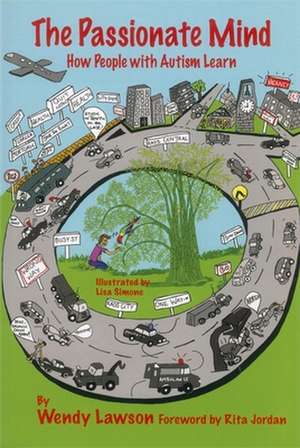
The Passionate Mind: How People with Autism Learn
Autor Wenn Lawson Ilustrat de Lisa Simoneen Limba Engleză Paperback – 15 sep 2010
She shows that whereas neurotypical people can easily shift their attention from one interest to another, those on the autism spectrum tend to focus on a single theme at any one time. This leads to a deep, intense attention. Wendy describes practical outcomes for individuals, families, educators and employers. She shows that when this unique learning style is understood, valued and accommodated, individuals on the autism spectrum can be empowered to achieve their fullest potential.
This is an essential read for anyone with a personal or professional interest in autism, including individuals on the spectrum and their families, educators, clinical practitioners, researchers, occupational therapists, and other professionals.
Preț: 140.68 lei
Preț vechi: 184.33 lei
-24%
Puncte Express: 211
Carte disponibilă
Livrare economică 17 noiembrie-01 decembrie
Livrare express 03-07 noiembrie pentru 59.15 lei
Livrare prin curier în România Termenul estimat este afișat lângă disponibilitate.
Transport gratuit de la 400.00 lei Plată online sau ramburs, în funcție de opțiunile comenzii.
Retur gratuit în 14 zile Comandă securizată și suport în română.
Specificații
ISBN-13: 9781849051217
ISBN-10: 1849051216
Pagini: 224
Ilustrații: 15 black and white drawings
Dimensiuni: 150 x 228 x 14 mm
Greutate: 0.33 kg
Editura: JESSICA KINGSLEY PUBLISHERS
Colecția Jessica Kingsley Publishers
Locul publicării:London, United Kingdom
ISBN-10: 1849051216
Pagini: 224
Ilustrații: 15 black and white drawings
Dimensiuni: 150 x 228 x 14 mm
Greutate: 0.33 kg
Editura: JESSICA KINGSLEY PUBLISHERS
Colecția Jessica Kingsley Publishers
Locul publicării:London, United Kingdom
V-ar putea interesa
-
 Attensity!The Friends of AttentionPreț: 146.13 lei
 -
 -26%Preț: 90.65 lei121.99 lei
 -
 Danny's PeopleVirginia BovellPreț: 137.33 lei
 -
 Normally Weird and Weirdly NormalRobin Ince-26%Preț: 106.89 lei144.95 lei
 -
 Focus: How to Study in an Increasingly Distracted WorldDr Emma Louth Als-10%Preț: 111.16 lei123.03 lei
 -
 Isaac and His Amazing Autism Superpowers!Melanie WalshPreț: 57.26 lei
 -
 Magnificent MindsSuzanne GohPreț: 122.49 lei
 -
 Understanding and Evaluating Autism TheoryNick Chown-24%Preț: 225.49 lei295.56 lei
 -
 -18%Preț: 64.81 lei79.33 lei
 -
 -16%Preț: 152.81 lei181.35 lei
 -
 -17%Preț: 177.81 lei215.32 lei
 -
 -26%Preț: 68.66 lei92.90 lei
 -
 The SignsTara SwartPreț: 121.10 lei
 -
 -20%Preț: 144.82 lei181.22 lei
 -
 A Mismatch of SalienceDamian Milton-5%Preț: 195.47 lei205.76 lei
 -
 Healthy Happy ADHDLisa DeePreț: 108.32 lei
 -
 Ten Things Your Student with Autism Wishes You KnewEllen Notbohm-57%Preț: 67.59 lei158.03 lei
 -
 The Way I See ItTemple Grandin-5%Preț: 139.06 lei146.38 lei
Recenzii
this book is a essential and accessible read for all interested in the field of autism studies, particularly psychologists, but also for other professionals, who are often presented with the theories so roundly criticised in this text. As an autistic researcher myself, this book is not only a welcome addition to the lexicon of work on the psychology of autism, but an inspiration for future research.
The Passionate Mind: How People With Autism Learn offers a fine survey and the author's own theory of Single Attention and Associated Cognition in Autism, an approach that explains how individuals with autism learn and perceive... Educators, employers and families receive keys to using this unique learning style to help autistic learners achieve their fullest potential. Highly recommended!
The Passionate Mind: How People With Autism Learn offers a fine survey and the author's own theory of Single Attention and Associated Cognition in Autism, an approach that explains how individuals with autism learn and perceive... Educators, employers and families receive keys to using this unique learning style to help autistic learners achieve their fullest potential. Highly recommended!
Cuprins
Acknowledgements. Foreword by Professor Rita Jordan. 1.Introduction. The reasons for writing this book. The power of words. Brain configuration. What to expect in this text. The role of attention and interest. 2. The Autism Spectrum: Where we are we now?. Introduction. What does autism spectrum look like? Gender. Autism spectrum strengths. Learning style. Sensory differences. 3. Cognitive theories of autism spectrum. Introduction. Cognition and cognitive theory. Considering theory in autism spectrum. Attention and interest. 4. Cognitive theory: Theory of mind. Introduction. Definition. Foundations for theory of mind. Components of theory of mind. Application to child development. Development of theory of mind. Difficulties with a rigid view of theory of mind development. The most noted test of theory of mind. Theory of mind research over time. Questions concerning theory of mind theory. Other potential questions. Summary. 5. Cognitive theory: Executive functioning. Introduction. Definition. Foundations for executive functioning. Components of executive functioning. Application to child development. Development of executive functioning. Research over time. Executive functioning and theory of mind. Questions concerning executive functioning and the autism spectrum. Other questions and limitations. Summary. 6. Cognitive theory: Weak central coherence. Introduction. Definition. Foundations for weak central coherence theory . Components of weak central coherence theory. Application in the neurotypical and autism spectrum population. Research over time. Limitations of weak central coherence theory. Summary. 7. Cognitive theory: Enhanced perceptual functioning. Introduction. Definition. Foundations for enhanced perceptual functioning theory. Components of enhanced perceptual functioning. Research over time. Comparison with other cognitive theories. Limitations of enhanced perceptual functioning theory. Summary. 8. An alternative cognitive theory: single attention and associated cognition in autism. Introduction. Definitions. Monotropism as a foundation for SAACA. Attention. Attention and Brain Configuration. Monotropism and the sensory system. Monotropism and interest. Attention, motivation and interest. Triad of impairments or product of monotropic attention? Processing style. Monotropism and learning style. Complex cognitive skills coupled with interest and attention. Cognitive components of SAACA. Monotropism and literality. Monotropism and thinking in closed concepts. Monotropism: context and scale. Monotropism: timing, sequencing and predicting. Monotropism and non social priorities. Summary. 9. The relevance of SAACA. Introduction. Everyday experiences for autism spectrum individuals. When things change. The concept of time. SAACA's explanation of why autism spectrum and neurotypical perception are different. Case studies. Autism spectrum comprehension. Problems with autism spectrum comprehension. (if using a neurotypical lens). What might it mean when an expectation is not fulfilled? Problem solving ideas using SAACA. Tom's story - An extended case study. Why does Tom have difficulties? Can we help Tom cope with change? When and how do we execute an intervention for Tom? What about generalising Tom's learning? Reasoning behind using IT, visuals and structure. Neurotypical parenting. Summary. 10. Looking to the future. A different learning style. Completing tasks. Normality. It's in everyone's interest. Experiments to refute or support SAACA. Limitations of SAACA. List of publications. References. Appendix A. Appendix B. Appendix C. Appendix D. Appendix E. Index.
Notă biografică
Dr Wenn B. Lawson PhD, CPsychol is a lecturer and author. Since being diagnosed with autism in 1994, Wenn is passionately committed to campaigning for the rights of people on the autism spectrum. In 2008 Wenn was awarded fourth place in the 'Victorian Australian of the Year' awards.