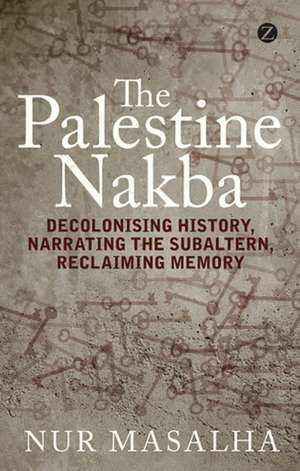
The Palestine Nakba: Decolonising History, Narrating the Subaltern, Reclaiming Memory
Autor Nur Masalhaen Limba Engleză Paperback – 9 feb 2012
This book is essential for understanding the place of the Palestine Nakba at the heart of the Israel-Palestine conflict and the vital role of memory in narratives of truth and reconciliation.
Preț: 172.77 lei
Preț vechi: 215.24 lei
-20%
Puncte Express: 259
Carte tipărită la comandă
Livrare economică 21 noiembrie-05 decembrie
Livrare express 17-23 octombrie pentru 70.13 lei
Livrare prin curier în România Termenul estimat este afișat lângă disponibilitate.
Transport gratuit de la 400.00 lei Plată online sau ramburs, în funcție de opțiunile comenzii.
Retur gratuit în 14 zile Comandă securizată și suport în română.
Specificații
ISBN-13: 9781848139701
ISBN-10: 1848139705
Pagini: 296
Dimensiuni: 135 x 214 x 20 mm
Greutate: 0.36 kg
Editura: Bloomsbury Publishing
Colecția Zed Books
Locul publicării:London, United Kingdom
ISBN-10: 1848139705
Pagini: 296
Dimensiuni: 135 x 214 x 20 mm
Greutate: 0.36 kg
Editura: Bloomsbury Publishing
Colecția Zed Books
Locul publicării:London, United Kingdom
Cuprins
Introduction
1. Zionism and European Settler-Colonialism
2. The Memoricide of the Nakba: Zionist-Hebrew Toponymy and the De-Arabisation of Palestine
3. Fashioning a European Landscape, Erasure and Amnesia: The Jewish National Fund, Afforestation, and Green-washing the Nakba
4. Appropriating History: The Looting of Palestinian Records, Archives and Library Collections (1948-2011)
5. New History, Post-Zionism, the Liberal Coloniser and Hegemonic Narratives: A Critique of the Israeli 'New Historians'
6. Decolonising History and Narrating the Subaltern: Palestinian Oral History, Indigenous and Gendered Memories
7. Resisting Memoricide and Reclaiming Memory: The Politics of Nakba Commemoration among Palestinians inside Israel
Epilogue: The Continuity of Trauma
1. Zionism and European Settler-Colonialism
2. The Memoricide of the Nakba: Zionist-Hebrew Toponymy and the De-Arabisation of Palestine
3. Fashioning a European Landscape, Erasure and Amnesia: The Jewish National Fund, Afforestation, and Green-washing the Nakba
4. Appropriating History: The Looting of Palestinian Records, Archives and Library Collections (1948-2011)
5. New History, Post-Zionism, the Liberal Coloniser and Hegemonic Narratives: A Critique of the Israeli 'New Historians'
6. Decolonising History and Narrating the Subaltern: Palestinian Oral History, Indigenous and Gendered Memories
7. Resisting Memoricide and Reclaiming Memory: The Politics of Nakba Commemoration among Palestinians inside Israel
Epilogue: The Continuity of Trauma
Recenzii
Nur Masalha has a distiguished and deserved reputation for scholarship on the Nakba and Palestinian refugees. Now, with his latest book, his searching analysis of past and present makes for a powerful combination of remembrance and resistance.
As a meticulous scholar, historian and above all Palestinian, Nur Masalha is eminently suited to write this excellent book. He has produced a marvellous history of the Nakba which should be essential reading for all those concerned with the origins of the conflict over Palestine.
This book is the most comprehensive and penetrating analysis available of the catastophe that befell Arab Palestine and its people in 1948, known as the Nakba. It shows how the expulsion and physical obliteration of the material traces of a people was followed by what Masalha calls 'memoricide': the effacement of their history, their archives, and their place-names, and a denial that they had ever existed.
Nur Masalha's 'The Palestinian Nakba' is a tour de force examining the process of transformation of Palestine over the last century. One outstanding feature of this study is the systematic manner in which it investigates the accumulated scholarship on the erasure of Palestinian society and culture, including a critical assessment of the work of the new historians. In what he calls 'reclaiming the memory' he goes on to survey and build on a an emergent narrative. Masalha's work is essential and crucial for any scholar seeking this alternate narrative.
As a meticulous scholar, historian and above all Palestinian, Nur Masalha is eminently suited to write this excellent book. He has produced a marvellous history of the Nakba which should be essential reading for all those concerned with the origins of the conflict over Palestine.
This book is the most comprehensive and penetrating analysis available of the catastophe that befell Arab Palestine and its people in 1948, known as the Nakba. It shows how the expulsion and physical obliteration of the material traces of a people was followed by what Masalha calls 'memoricide': the effacement of their history, their archives, and their place-names, and a denial that they had ever existed.
Nur Masalha's 'The Palestinian Nakba' is a tour de force examining the process of transformation of Palestine over the last century. One outstanding feature of this study is the systematic manner in which it investigates the accumulated scholarship on the erasure of Palestinian society and culture, including a critical assessment of the work of the new historians. In what he calls 'reclaiming the memory' he goes on to survey and build on a an emergent narrative. Masalha's work is essential and crucial for any scholar seeking this alternate narrative.