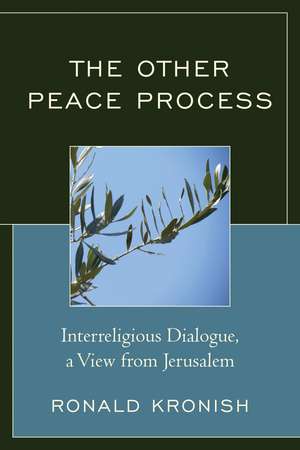
The Other Peace Process: Interreligious Dialogue, a View from Jerusalem
Autor Ronald Kronishen Limba Engleză Paperback – 10 aug 2017
Preț: 256.41 lei
Preț vechi: 350.42 lei
-27%
Puncte Express: 385
Carte tipărită la comandă
Livrare economică 26 noiembrie-10 decembrie
Livrare prin curier în România Termenul estimat este afișat lângă disponibilitate.
Transport gratuit de la 400.00 lei Plată online sau ramburs, în funcție de opțiunile comenzii.
Retur gratuit în 14 zile Comandă securizată și suport în română.
Specificații
ISBN-13: 9780761869337
ISBN-10: 0761869336
Pagini: 196
Ilustrații: 24 b/w illustrations
Dimensiuni: 151 x 230 x 13 mm
Greutate: 0.34 kg
Editura: Bloomsbury Publishing
Colecția Hamilton Books
Locul publicării:New York, United States
ISBN-10: 0761869336
Pagini: 196
Ilustrații: 24 b/w illustrations
Dimensiuni: 151 x 230 x 13 mm
Greutate: 0.34 kg
Editura: Bloomsbury Publishing
Colecția Hamilton Books
Locul publicării:New York, United States
V-ar putea interesa
-
 The Raven's SongLula CooperPreț: 126.70 lei
 -
 I'm ElmerElmer C. RaadPreț: 85.26 lei
 -
 This Is Not My LifeMichelle PetersonPreț: 65.71 lei
 -
 Take It Easy, MarthaBrenda BarionPreț: 65.80 lei
 -
 The Right to ReleaseCole HiggisonPreț: 76.23 lei
 -
 M 2 My Feeling...RemixPhyllis D. WilliamsPreț: 34.70 lei
 -
 Preț: 51.73 lei
 -
 Only Your Hairstylist Knows...Until NowJudy GagleardPreț: 73.07 lei
 -
 From Terror to TriumphTony SetonPreț: 77.48 lei
 -
 My Father's Final JourneyDavid L. GalbutPreț: 132.77 lei
 -
 Still RisingJanice L. SantosPreț: 55.84 lei
 -
 Wait Till I'm DeadEva M. CronePreț: 131.35 lei
 -
 Along for the RideKevin OpheimPreț: 136.33 lei
 -
 Once Upon a Time in Russia and the United StatesSerguei BlinovPreț: 279.51 lei
 -
 The Road from Harbour HillJim HayesPreț: 189.53 lei
 -
 A Funny Thing Happened on My Way to a CareerBill SaylorPreț: 89.51 lei
 -
 Retold TalesC. J. BarnesPreț: 58.29 lei
 -
 Eye of the StormJacqueline Buckley CD BaPreț: 122.82 lei
 -
 Losing MomCynthia RyanPreț: 153.15 lei
 -
 Out of My MindMartha B. WoodPreț: 81.19 lei
 -
 Nightlife in the House of the DeadGerald StanleyPreț: 156.79 lei
 -
 Preț: 128.02 lei
 -
 9 VoicesThe Wilson FamilyPreț: 156.61 lei
 -
 Learning to Like YellowK. E. WassPreț: 86.55 lei
 -
 A Walk Beside MeDeann HummelPreț: 130.16 lei
 -
 My LifeScott LudwigPreț: 198.62 lei
 -
 You Should Be So LuckyPhilip J. Reilly JrPreț: 190.82 lei
 -
 Alem Da AlmaGaston LevyPreț: 207.30 lei
Cuprins
Preface
Acknowledgements
Introduction: My Personal Journey
1. The Context-Peacemaking and Peacebuilding
2. Palestinian Arab Identity-Religious and Cultural Diversity
3. Engaging with the Vatican
4. Interreligious Dialogue in Israel as a Form of Peacebuilding-the Development of a New
5. On Interreligious Dialogue in Israel-Lessons Learned and Thoughts for the Future
Bibliography
Index
Acknowledgements
Introduction: My Personal Journey
1. The Context-Peacemaking and Peacebuilding
2. Palestinian Arab Identity-Religious and Cultural Diversity
3. Engaging with the Vatican
4. Interreligious Dialogue in Israel as a Form of Peacebuilding-the Development of a New
5. On Interreligious Dialogue in Israel-Lessons Learned and Thoughts for the Future
Bibliography
Index
Recenzii
The reader cannot but admire his faith, tenacity and dedication, and his refusal to let go of his quest for peaceful coexistence, despite what he describes as the despair among people on both sides of the Israeli-Palestinian conflict. 'My response to this - and the answer shared by many of my colleagues in Israel - is that we must not lose faith and give up!' he insists. Of the many great stories in this book, one of my favorites is his role in the historic visit of Pope John Paul II to Israel in 2000 at the peak of a revolution in Catholic-Jewish relations. His description of the pontiff's prayer at the Western Wall, touching the stones, and placing a note in a crack in which he asks God for forgiveness is incredibly moving. Kronish established good relationships with a wide range of religious figures - Jews, Christians and Muslims of many denominations, and others, including the Dalai Lama, whom he had the honor of hosting in Israel.
The Other Peace Process is a goldmine of practical information learned within Israel and from similar collaborative interreligous efforts in Northern Ireland and the global network Religions for Peace. But from the perspective of this newsletter, we especially value Rabbi Kronish's reporting on his work with AFR and International Abrahamic Network (IAN) colleagues like Jerusalem Professor Mohammed Dajani Daudi, founder of the Wasatia movement of centrist Islam, and Kadi Dr. Iyad Zahalka the chief judge of the Sharia courts of the State of Israel, whom we have met several times. He also cites the pioneering interreligious work of Jerusalem's Rabbi Michael Melchior, with whom we have also worked and may be the closest person to Jewish sainthood if there is such a thing. The Other Peace Process should be on the desk of every official and Track Two peacemaker for Israel-Palestine. It is a basic reference work for all of us.
[T]he richness and value of this narrative comes from his sharing the learnings about authentic and meaningful dialogue gained from his several decades of organizing interreligious encounters as director of the Interreligious Coordinating Council in Israel. He exhibits a contemporary understanding of how such encounters need to operate with his strong insistence on use of social media as part of their process.. Kronish presents a detailed and from my own experience a realistic assessment of the difficulties and pitfalls of generating lasting interreligious understanding and collaboration.. The volume also includes a very useful bibliography (including in the extensive footnotes). This bibliography can prove quite useful for anyone who wishes to go more in depth regarding the Israeli-Palestinian relationship.. I have profited greatly from my reading of this volume Others I believe who take it up will enjoy a similar experience.
When it comes to peace between Israel and Palestine and to relations among Jews, Muslim, and Christians, no one is more qualified than Dr. Ron Kronish to give us direction and-most important-to give us hope. Dr. Kronish has devoted his life to the proposition that leaders of the Abrahamic traditions can strengthen each other, inspire one another, and promote the values of love, justice, and peace that are common to each of our faiths. For more than 25 years, he has done the hard work of bringing Jews, Muslims, and Christians together, and encouraging us all to proclaim that we will not permit fanaticism to grow or prejudice to harden. His message, now more than ever, must be heeded: In Israel/Palestine, he tells us, and around the world, the children of Abraham must reclaim their common heritage and find a common path.
A seasoned dialogue-partner with Muslims and Christians, Rabbi Kronish here shares his experience building relations with Palestinian Arabs in Israel, East Jerusalem, and the Occupied Territories. This memoir of peace-building is also a program others can follow to supplement the high-profile politics of peace-making. The program centers on a four-step process of transformative dialogue, interreligious education, discussion of core issues and joint action. I know the process works, because Rabbi Kronish has been modelling it for years in my own interfaith friendship with him. This book will spread the peace further among Jews and Muslims, Arabs and Israelis, Palestinian and Jewish Israelis.
I can't imagine a more necessary reminder coming at this moment than Rabbi Ron Kronish's new book, The Other Peace Process. When legal, diplomatic and political interventions around the Israeli-Palestinian conflict are stalled, Rabbi Kronish lifts up examples where real people engage in interreligious dialogue, education and shared action to make change. From his own well-lived life, Kronish offers hope that though the work of justice and peace is a long game, it is worth it and will, in the end, succeed.
The Other Peace Process is a goldmine of practical information learned within Israel and from similar collaborative interreligous efforts in Northern Ireland and the global network Religions for Peace. But from the perspective of this newsletter, we especially value Rabbi Kronish's reporting on his work with AFR and International Abrahamic Network (IAN) colleagues like Jerusalem Professor Mohammed Dajani Daudi, founder of the Wasatia movement of centrist Islam, and Kadi Dr. Iyad Zahalka the chief judge of the Sharia courts of the State of Israel, whom we have met several times. He also cites the pioneering interreligious work of Jerusalem's Rabbi Michael Melchior, with whom we have also worked and may be the closest person to Jewish sainthood if there is such a thing. The Other Peace Process should be on the desk of every official and Track Two peacemaker for Israel-Palestine. It is a basic reference work for all of us.
[T]he richness and value of this narrative comes from his sharing the learnings about authentic and meaningful dialogue gained from his several decades of organizing interreligious encounters as director of the Interreligious Coordinating Council in Israel. He exhibits a contemporary understanding of how such encounters need to operate with his strong insistence on use of social media as part of their process.. Kronish presents a detailed and from my own experience a realistic assessment of the difficulties and pitfalls of generating lasting interreligious understanding and collaboration.. The volume also includes a very useful bibliography (including in the extensive footnotes). This bibliography can prove quite useful for anyone who wishes to go more in depth regarding the Israeli-Palestinian relationship.. I have profited greatly from my reading of this volume Others I believe who take it up will enjoy a similar experience.
When it comes to peace between Israel and Palestine and to relations among Jews, Muslim, and Christians, no one is more qualified than Dr. Ron Kronish to give us direction and-most important-to give us hope. Dr. Kronish has devoted his life to the proposition that leaders of the Abrahamic traditions can strengthen each other, inspire one another, and promote the values of love, justice, and peace that are common to each of our faiths. For more than 25 years, he has done the hard work of bringing Jews, Muslims, and Christians together, and encouraging us all to proclaim that we will not permit fanaticism to grow or prejudice to harden. His message, now more than ever, must be heeded: In Israel/Palestine, he tells us, and around the world, the children of Abraham must reclaim their common heritage and find a common path.
A seasoned dialogue-partner with Muslims and Christians, Rabbi Kronish here shares his experience building relations with Palestinian Arabs in Israel, East Jerusalem, and the Occupied Territories. This memoir of peace-building is also a program others can follow to supplement the high-profile politics of peace-making. The program centers on a four-step process of transformative dialogue, interreligious education, discussion of core issues and joint action. I know the process works, because Rabbi Kronish has been modelling it for years in my own interfaith friendship with him. This book will spread the peace further among Jews and Muslims, Arabs and Israelis, Palestinian and Jewish Israelis.
I can't imagine a more necessary reminder coming at this moment than Rabbi Ron Kronish's new book, The Other Peace Process. When legal, diplomatic and political interventions around the Israeli-Palestinian conflict are stalled, Rabbi Kronish lifts up examples where real people engage in interreligious dialogue, education and shared action to make change. From his own well-lived life, Kronish offers hope that though the work of justice and peace is a long game, it is worth it and will, in the end, succeed.