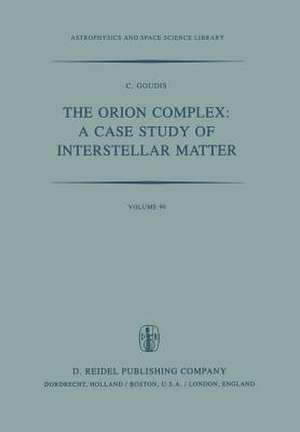
The Orion Complex: A Case Study of Interstellar Matter: Astrophysics and Space Science Library, cartea 90
Autor C. D. Goudisen Limba Engleză Paperback – 25 noi 2011
Din seria Astrophysics and Space Science Library
- 18%
 Preț: 761.26 lei
 -
 Preț: 387.27 lei
 - 15%
 Preț: 644.83 lei
 -
 Preț: 386.74 lei
 - 18%
 Preț: 921.43 lei
 -
 Preț: 400.17 lei
 - 18%
 Preț: 1177.62 lei
 - 18%
 Preț: 1783.90 lei
 -
 Preț: 388.91 lei
 - 18%
 Preț: 920.06 lei
 - 18%
 Preț: 926.82 lei
 -
 Preț: 387.03 lei
 -
 Preț: 379.14 lei
 -
 Preț: 403.07 lei
 -
 Preț: 405.77 lei
 - 18%
 Preț: 915.91 lei
 -
 Preț: 393.50 lei
 - 18%
 Preț: 923.78 lei
 -
 Preț: 392.60 lei
 - 18%
 Preț: 1187.11 lei
 - 18%
 Preț: 1177.32 lei
 -
 Preț: 393.21 lei
 - 15%
 Preț: 634.40 lei
 - 18%
 Preț: 1210.29 lei
 - 18%
 Preț: 924.33 lei
 - 18%
 Preț: 1783.20 lei
 - 18%
 Preț: 1190.93 lei
 - 18%
 Preț: 1199.62 lei
 -
 Preț: 400.91 lei
 - 18%
 Preț: 1190.02 lei
 - 15%
 Preț: 646.29 lei
 - 18%
 Preț: 1189.05 lei
 -
 Preț: 390.39 lei
 - 15%
 Preț: 644.87 lei
 -
 Preț: 381.30 lei
 - 18%
 Preț: 1185.01 lei
 - 18%
 Preț: 909.41 lei
 - 18%
 Preț: 1187.08 lei
 - 18%
 Preț: 1181.97 lei
 -
 Preț: 381.63 lei
 -
 Preț: 381.92 lei
Preț: 381.02 lei
Puncte Express: 572
Carte tipărită la comandă
Livrare economică 08-22 iunie
Specificații
ISBN-13: 9789400977143
ISBN-10: 940097714X
Pagini: 328
Ilustrații: 320 p.
Dimensiuni: 170 x 244 x 18 mm
Greutate: 0.57 kg
Ediția:Softcover reprint of the original 1st ed. 1982
Editura: Springer
Colecția Astrophysics and Space Science Library
Seria Astrophysics and Space Science Library
Locul publicării:Dordrecht, Netherlands
ISBN-10: 940097714X
Pagini: 328
Ilustrații: 320 p.
Dimensiuni: 170 x 244 x 18 mm
Greutate: 0.57 kg
Ediția:Softcover reprint of the original 1st ed. 1982
Editura: Springer
Colecția Astrophysics and Space Science Library
Seria Astrophysics and Space Science Library
Locul publicării:Dordrecht, Netherlands
V-ar putea interesa
-
 CP ViolationGustavo Castelo Branco-18%Preț: 489.24 lei593.59 lei
 -
 -14%Preț: 277.47 lei321.60 lei
 -
 -20%Preț: 69.31 lei86.19 lei
 -
 The 4 Percent UniverseRichard PanekPreț: 115.31 lei
 -
 The Noetics of NatureBruce V. FoltzPreț: 258.01 lei
 -
 Preț: 299.32 lei
 -
 An Introduction to Modern CosmologyAndrew LiddlePreț: 305.94 lei
 -
 A Universe from NothingLawrence M. KraussPreț: 101.44 lei
 -
 Just Six NumbersSir Martin Rees-29%Preț: 63.01 lei88.18 lei
 -
 Preț: 49.64 lei
 -
 Life in the UniverseMarshall Vian SummersPreț: 122.82 lei
 -
 Where Physics Went WrongBernard H. LavendaPreț: 196.00 lei
Public țintă
ResearchCuprins
1: Large Scale View of the Orion Region.- 1.1. General Morphology of Barnard’s Loop and the Neighbouring Region.- 1.2. Nature of Barnard’s Loop and the Associated Filamentary Structure.- 1.3. Origin of the I Orion OB Association.- 2: The H II Regions M42 and M43.- 2.1. Optical and Radio Structure.- 2.2. Physical Parameters Derived from Radio and Optical Observations.- 2.3. Ionized Stellar-Size Condensations (ISC) and Ionized Knots (IK) Associated with the Core of M42.- 2.4. Dust in the Orion Nebula (M42).- 3: The Orion Complex (M42/OMC1, M43/OMC2).- 3.1. Infrared Structure.- 3.2. Physical Parameters Derived from Infrared Observations.- 3.3. Structure and Physical Parameters of the Molecular Complex (OMC 1, OMC 2).- 3.4. Maser Sources.- 3.5. Magnetic Field in the Orion Complex.- 4: Empirical Models of the Orion Complex.- 4.1 Empirical Models.- 5: NGC2024 and the Associated Molecular Complex.- 5.1. Optical and Radio Structure of NGC2024.- 5.2. Infrared and Molecular Structure of the NGC2024/Molecular Complex.- 5.3. Excitation of NGC2024.- Appendices.- Appendix I: Radiative Transfer.- I. 1. The Various Forms of the Equation of Radiative Transfer.- Figure.- Appendix II: Physical Parameters of an H II Region.- II. 1. Physical Parameters Derived from Observations of the Radio Continuum Emission.- II. 2. Determination of Density from Optical Methods.- II. 3. Determination of Temperature from Optical and Radio Methods.- II. 4. Chemical Composition.- II. 5. Determination of Radial Velocity and Turbulence.- Tables.- Figures.- Appendix III: Physical Parameters of the Dust Associated With an H II Region.- III. 1. Visual Extinction Derived from the Comparison of Optical with Radio Data.- III. 2. Physical Parameters Derived from Observations of the Infrared Continuum.- Figures.-Appendix IV: Physical Parameters of a Molecular Cloud.- IV. 1. Physical Parameters Derived from Observations of Molecular Lines.- References.