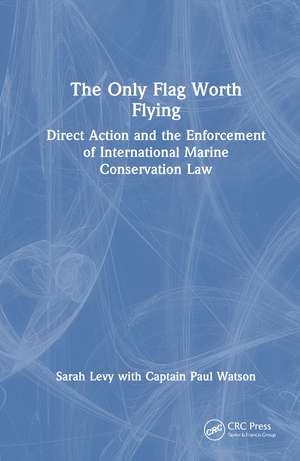
The Only Flag Worth Flying: Direct Action and the Enforcement of International Marine Conservation Law
Autor Sarah Levy, Paul Watsonen Limba Engleză Hardback – 10 dec 2025
The book unfolds in three parts, moving from Soundings, which explores the legal and historical foundations of marine conservation law, to Currents, which traces the emergence of direct-action enforcement and its necessity in instances where states lack the means, will, or jurisdiction to act, and finally to Horizons, which looks ahead to the emerging landscape of ocean governance beyond the state. In these later chapters, the book examines the increasing criminalization of environmental activism, the rise of Indigenous-led and decentralised enforcement models, and the plural legal imaginaries reshaping what legitimacy might mean in a post-sovereign world.
Grounded in bio- and ecocentric legal theory, and drawing on legal analysis, political critique, and detailed campaign case studies, the book challenges the assumption that enforcement is the sole domain of the nation-state. Instead, it argues that legitimacy may derive not from formal authority, but from the courage to uphold laws that institutions have abandoned. In doing so, this book reframes direct action as being essential to the law’s integrity: the upholding of a shared responsibility to conserve our oceans. For when legality becomes illusion, resistance may be the most just act of all. In this sea of fallen standards, the pirate flag may be the only one worth flying.
| Toate formatele și edițiile | Preț | Express |
|---|---|---|
| Paperback (1) | 401.40 lei 3-5 săpt. | +0.00 lei 7-13 zile |
| CRC Press – 10 dec 2025 | 401.40 lei 3-5 săpt. | +0.00 lei 7-13 zile |
| Hardback (1) | 808.37 lei 6-8 săpt. | |
| CRC Press – 10 dec 2025 | 808.37 lei 6-8 săpt. |
Preț: 808.37 lei
Preț vechi: 985.81 lei
-18% Nou
Puncte Express: 1213
Preț estimativ în valută:
143.16€ • 167.19$ • 124.36£
143.16€ • 167.19$ • 124.36£
Carte tipărită la comandă
Livrare economică 21 februarie-07 martie
Preluare comenzi: 021 569.72.76
Specificații
ISBN-13: 9781032882482
ISBN-10: 1032882484
Pagini: 220
Dimensiuni: 152 x 229 x 14 mm
Greutate: 0.57 kg
Ediția:1
Editura: CRC Press
Colecția CRC Press
ISBN-10: 1032882484
Pagini: 220
Dimensiuni: 152 x 229 x 14 mm
Greutate: 0.57 kg
Ediția:1
Editura: CRC Press
Colecția CRC Press
Public țintă
Academic, Postgraduate, and Professional ReferenceNotă biografică
Sarah Levy is a DPhil Candidate at Centre for Socio-Legal Studies, University of Oxford, United Kingdom.
Paul Watson is Founder of the Sea Shepherd Conservation Society and Captain Paul Watson Foundation, United States.
Paul Watson is Founder of the Sea Shepherd Conservation Society and Captain Paul Watson Foundation, United States.
Cuprins
Dedication. Acknowledgements. Foreword: The Virtues of the Pretty Red. List of Abbreviations. I Introduction. PART I SOUNDINGS: Charting the Historical and Legal Foundations of Marine Conservation. II The Nature and Foundations of Public International Law. III The Inception and Development of International Conservation Law. PART II CURRENTS: Exploring the Force and Protection of Direct Action. IV The Ethical, Tactical, and Legal Approaches of Direct-Action Groups. V The Role and Authority of Non-State Actors in Marine Conservation Enforcement. PART III HORIZONS: Navigating the Future of Ocean Governance Beyond the State. VI The Evolution and Emerging Challenges of Marine Conservation Groups. VII The Expanding Influence of Non-State Actors in Marine Governance. VIII Conclusion. About the Authors. Index.
Recenzii
This book is a rare achievement. It brings technical precision, sharp legal analysis of case studies, and political dynamics to the reality of marine law, which depends so much on international agreements and real action to protect the ocean. It tests international law at its edges — where enforcement collapses and NGOs must decide if they retreat or act. No movement has interrogated those limits as deeply as Captain Paul Watson and his founded NGOs Sea Shepherd and Captain Paul Watson Foundation, and no one has lived this paradox more intensely than Paul himself.
Laws are the last to be created — and the first to be ignored when political will collapses. They require courage and commitment from leaders to have any meaning in practice. The Only Flag Worth Flying reminds us, with a clarity that feels almost subversive, that states, boundaries, and laws are man-made fictions — fragile constructs that dissolve the moment sovereignty is used as a shield against international justice. Just as any man made concept, they can also be reimagined.
Ecology laws, by contrast, are created by no one. Life is a common right, and the ocean refuses to be domesticated by human rules. In this vacuum between legal rights and biological truths, a rare group of NGOs step into the breach. Our role is not only to fill the gaps governments leave open, but to push governments to close those gaps, to expose their inertia, and to insist that environmental law cannot live on paper.
The read also reminds us that regional and international NGOs can serve as defenders of life, also as allies — and amplifiers — of those who already defend it in their own terms: indigenous peoples who continue to embody the biocentric worldview modern society has abandoned. When indigenous guardians and direct-action organisations converge, the result goes beyond enforcing the law; it becomes the restoration of an ancient legal order, one rooted in reciprocity, responsibility, and the continuity of life.
The Only Flag Worth Flying is not a typical law book. It is a record of how one of the only actors willing to uphold nature’s law has forced the world to confront its own failures. It is another chapter in Paul Watson’s legacy: showing that when nations hesitate, the ocean still has defenders — and that legitimacy can come not from authority, but from the unwavering commitment for the defense of life itself.
Nathalie Gil, President of Sea Shepherd Brasil
Laws are the last to be created — and the first to be ignored when political will collapses. They require courage and commitment from leaders to have any meaning in practice. The Only Flag Worth Flying reminds us, with a clarity that feels almost subversive, that states, boundaries, and laws are man-made fictions — fragile constructs that dissolve the moment sovereignty is used as a shield against international justice. Just as any man made concept, they can also be reimagined.
Ecology laws, by contrast, are created by no one. Life is a common right, and the ocean refuses to be domesticated by human rules. In this vacuum between legal rights and biological truths, a rare group of NGOs step into the breach. Our role is not only to fill the gaps governments leave open, but to push governments to close those gaps, to expose their inertia, and to insist that environmental law cannot live on paper.
The read also reminds us that regional and international NGOs can serve as defenders of life, also as allies — and amplifiers — of those who already defend it in their own terms: indigenous peoples who continue to embody the biocentric worldview modern society has abandoned. When indigenous guardians and direct-action organisations converge, the result goes beyond enforcing the law; it becomes the restoration of an ancient legal order, one rooted in reciprocity, responsibility, and the continuity of life.
The Only Flag Worth Flying is not a typical law book. It is a record of how one of the only actors willing to uphold nature’s law has forced the world to confront its own failures. It is another chapter in Paul Watson’s legacy: showing that when nations hesitate, the ocean still has defenders — and that legitimacy can come not from authority, but from the unwavering commitment for the defense of life itself.
Nathalie Gil, President of Sea Shepherd Brasil
Descriere
This book examines the legitimacy and efficacy of international law through the lens of marine conservation, focusing on the Sea Shepherd Conservation Society (SSCS) and the Captain Paul Watson Foundation (CPWF), as non-state actors intervening directly to enforce international marine conservation laws.