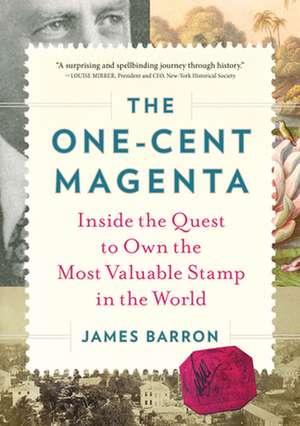
The One-Cent Magenta: Inside the Quest to Own the Most Valuable Stamp in the World
Autor James Barronen Limba Engleză Hardback – 7 mar 2017
When it was issued in 1856, it cost a penny. In 2014, this tiny square of faded red paper sold at Sotheby s for nearly $9.5 million, the largest amount ever paid for a postage stamp at auction. Through the stories of the eccentric characters who have bought, owned, and sold the one-cent magenta in the years in between, James Barron delivers a fascinating tale of global history and immense wealth, and of the human desire to collect.
One-cent magentas were provisional stamps, printed quickly in what was then British Guiana when a shipment of official stamps from London did not arrive. They were intended for periodicals, and most were thrown out with the newspapers. But one stamp survived. The singular one-cent magenta has had only nine owners since a twelve-year-old boy discovered it in 1873 as he sorted through papers in his uncle s house. He soon sold it for what would be $17 today. (That s been called the worst stamp deal in history.) Among later owners was a fabulously wealthy Frenchman who hid the stamp from almost everyone (even King George V of England couldn t get a peek); a businessman who traveled with the stamp in a briefcase he handcuffed to his wrist; and John E. du Pont, an heir to the chemical fortune, who died while serving a thirty-year sentence for the murder of Olympic wrestler Dave Schultz.
Recommended for fans of Nicholas A. Basbanes, Susan Orlean, and Simon Winchester, The One-Cent Magenta explores the intersection of obsessive pursuits and great affluence and asks why we want most what is most rare.
"
Preț: 105.47 lei
Preț vechi: 141.76 lei
-26%
Carte disponibilă
Livrare economică 14-28 noiembrie
Specificații
ISBN-10: 1616205180
Pagini: 224
Dimensiuni: 130 x 182 x 28 mm
Greutate: 0.32 kg
Editura: Little Brown
Colecția Algonquin Books
Locul publicării:London, United Kingdom
Descriere
An inside look at the obsessive, secretive, and often bizarre world of high-profile stamp collecting, told through the journey of the world s most sought-after stamp.
When it was issued in 1856, it cost a penny. In 2014, this tiny square of faded red paper sold at Sotheby s for nearly $9.5 million, the largest amount ever paid for a postage stamp at auction. Through the stories of the eccentric characters who have bought, owned, and sold the one-cent magenta in the years in between, James Barron delivers a fascinating tale of global history and immense wealth, and of the human desire to collect.
One-cent magentas were provisional stamps, printed quickly in what was then British Guiana when a shipment of official stamps from London did not arrive. They were intended for periodicals, and most were thrown out with the newspapers. But one stamp survived. The singular one-cent magenta has had only nine owners since a twelve-year-old boy discovered it in 1873 as he sorted through papers in his uncle s house. He soon sold it for what would be $17 today. (That s been called the worst stamp deal in history.) Among later owners was a fabulously wealthy Frenchman who hid the stamp from almost everyone (even King George V of England couldn t get a peek); a businessman who traveled with the stamp in a briefcase he handcuffed to his wrist; and John E. du Pont, an heir to the chemical fortune, who died while serving a thirty-year sentence for the murder of Olympic wrestler Dave Schultz.
Recommended for fans of Nicholas A. Basbanes, Susan Orlean, and Simon Winchester, The One-Cent Magenta explores the intersection of obsessive pursuits and great affluence and asks why we want most what is most rare.
"