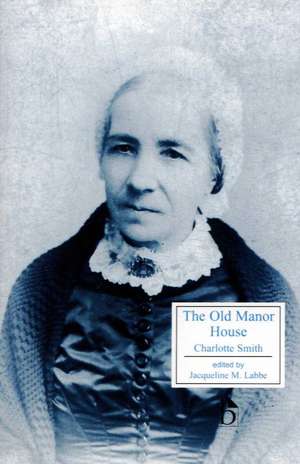
The Old Manor House
Autor Charlotte Smith Editat de Jacqueline M. Labbeen Limba Engleză Paperback – 19 sep 2002
Appendices in this edition include: contemporary responses; writings on the genre debate by Anna Letitia Barbauld, John Moore, and Walter Scott; and historical documents focusing on property laws as well as the American and French revolutions.
Preț: 242.95 lei
Preț vechi: 307.23 lei
-21%
Puncte Express: 364
Carte disponibilă
Livrare economică 09-23 noiembrie
Livrare express 23-29 octombrie pentru 116.76 lei
Livrare prin curier în România Termenul estimat este afișat lângă disponibilitate.
Transport gratuit de la 400.00 lei Plată online sau ramburs, în funcție de opțiunile comenzii.
Retur gratuit în 14 zile Comandă securizată și suport în română.
Specificații
ISBN-13: 9781551112138
ISBN-10: 1551112132
Pagini: 587
Dimensiuni: 140 x 216 x 22 mm
Greutate: 0.75 kg
Editura: BROADVIEW PR
Colecția Broadview Press
Locul publicării:Peterborough, Canada
ISBN-10: 1551112132
Pagini: 587
Dimensiuni: 140 x 216 x 22 mm
Greutate: 0.75 kg
Editura: BROADVIEW PR
Colecția Broadview Press
Locul publicării:Peterborough, Canada
V-ar putea interesa
-
 Fear of FlyingErica JongPreț: 124.74 lei
 -
 A Sentimental Journey and Other WritingsLaurence Sterne-17%Preț: 42.34 lei51.16 lei
 -
 Love, Love Me DoMark Haysom-25%Preț: 60.17 lei80.16 lei
 -
 The Autobiography of My MotherJamaica KincaidPreț: 96.31 lei
 -
 Gun Dealers' DaughterGina ApostolPreț: 92.86 lei
 -
 Memory and Memorials, 1789-1914: Literary and Cultural PerspectivesMatthew Campbell-18%Preț: 1112.03 lei1356.13 lei
 -
 Vintage Munro: Nobel Prize EditionAlice MunroPreț: 67.90 lei
 -
 A Falling StarChantel AcevedoPreț: 127.22 lei
 -
 The Ice GardenMoira CronePreț: 107.78 lei
 -
 When Dreams TouchRosemary HanrahanPreț: 133.91 lei
 -
 SpartaRoxana RobinsonPreț: 148.04 lei
 -
 The Testament of MaryColm ToibinPreț: 91.23 lei
 -
 RiversMichael Farris SmithPreț: 122.41 lei
 -
 Snow HuntersPaul YoonPreț: 100.92 lei
 -
 The History of Miss Betsy ThoughtlessEliza Haywood-21%Preț: 233.18 lei294.37 lei
 -
 A Tale for the Time BeingRuth OzekiPreț: 205.77 lei
 -
 Life After LifeJill MccorklePreț: 132.27 lei
 -
 Preț: 127.43 lei
 -
 Romantic Localities: Europe Writes PlaceChristoph Bode-18%Preț: 1256.91 lei1532.82 lei
Recenzii
In The Old Manor House (1794), Charlotte Smith combines elements of the romance, the Gothic, recent history, and culture to produce both a social document and a compelling novel. A “property romance,” the love story of Orlando and Monimia revolves around the Manor House as inheritable property. In situating their romance as dependent on the whims of property owners, Smith critiques a society in love with money at the expense of its most vulnerable members, the dispossessed.
Appendices in this edition include: contemporary responses; writings on the genre debate by Anna Letitia Barbauld, John Moore, and Walter Scott; and historical documents focusing on property laws as well as the American and French revolutions.
“Labbe’s celebratory introduction to The Old Manor House emphasizes Charlotte Smith’s literary modernity; the notes and appendices amplify Smith’s references to property law, revolutionary politics, and warfare. By implication, Smith’s novel is revealed as an extension of—rather than a mere reflection of—the contemporaneous debates that are so well represented in the scholarly apparatus. This is another excellent Broadview edition.” — Angela Keane, University of Sheffield
“Masquerading as a romance set in the 1770s, The Old Manor House satirizes characters who invoke feudal codes to mark the despotic authority of property over those who lack it but can imagine no other mode of genteel existence. Jacqueline Labbe’s new edition creates a valuable array of supplementary documents for reading the subtle politics of this novel and its negotiations with the terms of fictional romance.” — Theresa M. Kelley, University of Wisconsin-Madison
Appendices in this edition include: contemporary responses; writings on the genre debate by Anna Letitia Barbauld, John Moore, and Walter Scott; and historical documents focusing on property laws as well as the American and French revolutions.
“Labbe’s celebratory introduction to The Old Manor House emphasizes Charlotte Smith’s literary modernity; the notes and appendices amplify Smith’s references to property law, revolutionary politics, and warfare. By implication, Smith’s novel is revealed as an extension of—rather than a mere reflection of—the contemporaneous debates that are so well represented in the scholarly apparatus. This is another excellent Broadview edition.” — Angela Keane, University of Sheffield
“Masquerading as a romance set in the 1770s, The Old Manor House satirizes characters who invoke feudal codes to mark the despotic authority of property over those who lack it but can imagine no other mode of genteel existence. Jacqueline Labbe’s new edition creates a valuable array of supplementary documents for reading the subtle politics of this novel and its negotiations with the terms of fictional romance.” — Theresa M. Kelley, University of Wisconsin-Madison
Cuprins
Acknowledgements
Introduction
Charlotte Turner Smith: A Brief Chronology
A Note on the Text
The Old Manor House
Appendix A: Reviews and Notices of The Old Manor House
Introduction
Charlotte Turner Smith: A Brief Chronology
A Note on the Text
The Old Manor House
Appendix A: Reviews and Notices of The Old Manor House
- The Analytical Review (1793)
- The Critical Review (1793)
- The Monthly Review (1793)
- Walter Scott, “Charlotte Smith,” Miscellaneous Prose Works (1834)
- Anna Letitia Barbauld, “An Enquiry into Those Kinds of Distress which Excite Agreeable Sensations,” MiscellaneousPieces in Prose (1773)
- John Moore, “A View of the Commencement and Progress of Romance” (1797)
- Walter Scott, “Romance,” Miscellaneous Prose Works (1834)
- “The Rights of Things,” Commentaries on the Laws of England (1766)
- Poetic Responses
- From Charlotte Smith, The Emigrants (1793)
- William Wordsworth, “The Discharged Soldier” (1798)
- The American Revolution
- The Repeal Act (1766)
- The Declaratory Act (1766)
- The American Prohibitory Act (1775)
- Speech by General John Burgoyne (1777)
- Letter from John Adams (1775)
- A Speech to the Six Confederate Nations (1775)
- The French Revolution
- The Analytical Review (1789)
- James Mackintosh, Vindiciae Gallicae: Defence of the French Revolution, and its English Admirers, against the accusations of The Right Hon. E. Burke (1791)
- Royal Proclamation Against Seditious Writings (1792)