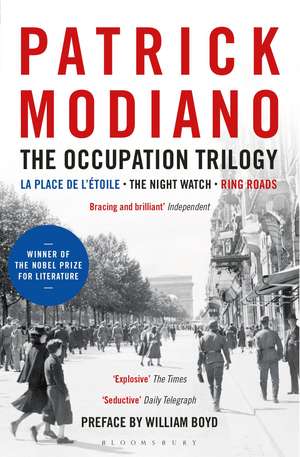
The Occupation Trilogy: La Place de l'Étoile – The Night Watch – Ring Roads
Autor Patrick Modianoen Limba Engleză Paperback – 18 mai 2017
When Patrick Modiano was awarded the 2014 Nobel Prize for Literature he was praised for using the 'art of memory' to bring to life the Occupation of Paris during the Second World War. Born in 1945, Modiano's brilliant, angry writings burst onto the Parisian literary scene and caused a storm.
His first, ferociously satirical novel, La Place de l'Étoile, was remarkable in seriously questioning both Nazi collaboration in France and the myths of the Gaullist era. The Night Watch tells the story of a man caught between his work for the French Gestapo and for a Resistance cell. Ring Roads recounts a son's search for his Jewish father, who disappeared ten years previously.
These brilliant, almost hallucinatory, evocations of the Occupation attempt to exorcise the past by exploring the morally ambiguous worlds of collaboration and resistance.
Preț: 88.21 lei
Preț vechi: 121.09 lei
-27%
Puncte Express: 132
Carte disponibilă
Livrare economică 03-17 noiembrie
Livrare express 20-24 octombrie pentru 54.29 lei
Livrare prin curier în România Termenul estimat este afișat lângă disponibilitate.
Transport gratuit de la 400.00 lei Plată online sau ramburs, în funcție de opțiunile comenzii.
Retur gratuit în 14 zile Comandă securizată și suport în română.
Specificații
ISBN-13: 9781408867884
ISBN-10: 1408867885
Pagini: 352
Dimensiuni: 130 x 194 x 26 mm
Greutate: 0.24 kg
Editura: Bloomsbury Publishing
Colecția Bloomsbury Paperbacks
Locul publicării:London, United Kingdom
ISBN-10: 1408867885
Pagini: 352
Dimensiuni: 130 x 194 x 26 mm
Greutate: 0.24 kg
Editura: Bloomsbury Publishing
Colecția Bloomsbury Paperbacks
Locul publicării:London, United Kingdom
V-ar putea interesa
-
 All the Light We Cannot SeeAnthony DoerrPreț: 74.23 lei
 -
 All the Light We Cannot See. Film Tie-InAnthony DoerrPreț: 74.29 lei
 -
 MURDER IN PARIS EXAIIE PBMatthew BlakePreț: 118.22 lei
 -
 Missing PersonPatrick Modiano-27%Preț: 56.32 lei77.30 lei
 -
 Suspended Sentences: Three NovellasPatrick ModianoPreț: 96.28 lei
 -
 Family RecordPatrick ModianoPreț: 94.66 lei
 -
 -26%Preț: 58.14 lei78.99 lei
 -
 PedigreePatrick Modiano-29%Preț: 54.23 lei76.23 lei
 -
 Suite FrancaiseIrene NemirovskyPreț: 101.89 lei
 -
 The Night WatchPatrick Modiano-28%Preț: 45.51 lei62.93 lei
 -
 -25%Preț: 53.97 lei72.21 lei
 -
 -25%Preț: 54.60 lei72.46 lei
 -
 Under OccupationAlan Furst-27%Preț: 56.60 lei77.51 lei
 -
 The UnworthyRoy Jacobsen-27%Preț: 115.02 lei156.64 lei
 -
 The Search WarrantPatrick Modiano-22%Preț: 52.81 lei67.38 lei
 -
 -18%Preț: 71.31 lei86.98 lei
 -
 Villa TristePatrick ModianoPreț: 71.00 lei
Recenzii
A swirling cacophony of characters in the tense, nervily hysterical world of the shady near-criminal types who stayed behind in Paris after the Nazis arrived . Powerfully Pinteresque, as characters bristle with menace and barely-contained violence
Like a cartoon strip in prose, caricatural and explosive . A disturbing evocation of the terror and treachery of the Occupation, and a mordant reminder of the tense relationship between Jewishness and Frenchness
Self-consciously outrageous ... Conventions and pieties are torn to pieces in a manner befitting a book published in Paris in 1968 . The more Modiano you read, the more seductive his work becomes ... Hypnotic and compulsive
Brisk, smart, witty, elliptical ... Recalls the directors of the New Wave - Godard, Truffaut, Louis Malle - as much as the opaque narrators of the nouveau roman . Frank Wynne captures this scattergun savagery with formidable bite . Bracing and brilliant ... Deepens the twilit mood of 1940s film noir or mid-period Graham Greene with an immersive intensity
A Marcel Proust of our time
Modiano is a pure original
Modiano is the poet of the Occupation and a spokesman for the disappeared, and I am thrilled that the Swedish Academy has recognised him
Europe's home-grown divisions haunt the edgy, atmospheric Parisian fictions of 2014 Nobel laureate Patrick Modiano: sample the three early novels of The Occupation Trilogy
Usually when we think of French novels or films about Vichy France we think of the heroism of the Resistance. Modiano has a much darker subject: the grey zone of French collaboration. He is drawn to the murky worlds of gangsters, informers, collaborators and black marketeers . This is Modiano's world as it was in the time of his father in wartime Paris . La Place de l'Étoile is very unusual for Modiano. It's a shocking, almost hysterical rant by a French, Jewish anti-Semite, Raphael Schlemilovitch. It is nasty, brutish and short. It's a very knowing, literary work with references to French writers, Jewish and anti-Semitic alike, from Proust and Sartre to the notorious Jew-hater Brasillach . Schlemilovitch constantly changes his identity. Few of Modiano's characters are sympathetic but Schlemilovitch is easily the least likeable . The Night Watch marks Modiano's breakthrough . The real change is in style. The narrative moves between a hazy, imprecise world where things are 'blurred' and 'fogged' to a precise world where everything is described in minute detail. Above all, there is a sense of mystery . By the end of Ring Roads, Modiano had found his voice and was on his way to becoming one of France's most fascinating contemporary writers
Like a cartoon strip in prose, caricatural and explosive . A disturbing evocation of the terror and treachery of the Occupation, and a mordant reminder of the tense relationship between Jewishness and Frenchness
Self-consciously outrageous ... Conventions and pieties are torn to pieces in a manner befitting a book published in Paris in 1968 . The more Modiano you read, the more seductive his work becomes ... Hypnotic and compulsive
Brisk, smart, witty, elliptical ... Recalls the directors of the New Wave - Godard, Truffaut, Louis Malle - as much as the opaque narrators of the nouveau roman . Frank Wynne captures this scattergun savagery with formidable bite . Bracing and brilliant ... Deepens the twilit mood of 1940s film noir or mid-period Graham Greene with an immersive intensity
A Marcel Proust of our time
Modiano is a pure original
Modiano is the poet of the Occupation and a spokesman for the disappeared, and I am thrilled that the Swedish Academy has recognised him
Europe's home-grown divisions haunt the edgy, atmospheric Parisian fictions of 2014 Nobel laureate Patrick Modiano: sample the three early novels of The Occupation Trilogy
Usually when we think of French novels or films about Vichy France we think of the heroism of the Resistance. Modiano has a much darker subject: the grey zone of French collaboration. He is drawn to the murky worlds of gangsters, informers, collaborators and black marketeers . This is Modiano's world as it was in the time of his father in wartime Paris . La Place de l'Étoile is very unusual for Modiano. It's a shocking, almost hysterical rant by a French, Jewish anti-Semite, Raphael Schlemilovitch. It is nasty, brutish and short. It's a very knowing, literary work with references to French writers, Jewish and anti-Semitic alike, from Proust and Sartre to the notorious Jew-hater Brasillach . Schlemilovitch constantly changes his identity. Few of Modiano's characters are sympathetic but Schlemilovitch is easily the least likeable . The Night Watch marks Modiano's breakthrough . The real change is in style. The narrative moves between a hazy, imprecise world where things are 'blurred' and 'fogged' to a precise world where everything is described in minute detail. Above all, there is a sense of mystery . By the end of Ring Roads, Modiano had found his voice and was on his way to becoming one of France's most fascinating contemporary writers