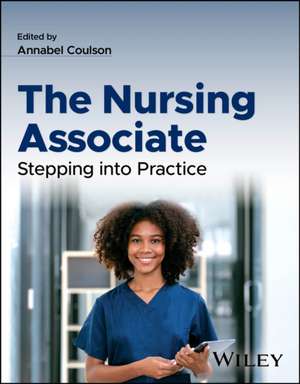
The Nursing Associate
Editat de Annabel Coulsonen Limba Engleză Paperback – 17 apr 2025
Observăm că The Nursing Associate, coordonat de Annabel Coulson, se poziționează ca un manual de referință fundamental pentru această nouă categorie profesională, fiind comparabil cu The Nursing Associate at a Glance de Ian Peate, dar oferind o explorare mult mai analitică a tranziției către practica înregistrată. În timp ce volumul lui Peate mizează pe o sinteză vizuală rapidă, lucrarea de față, publicată de John Wiley & Sons, Inc., detaliază mecanismele de responsabilitate și etică necesare asistentului asociat conform standardelor NMC din 2018. Suntem de părere că rigoarea clinică a acestui text este susținută de modul în care fundamentează abilitățile de comunicare și abordarea centrată pe pacient în momente critice, precum admiterea în unitățile medicale. Spre deosebire de Team Working and Professional Practice for Nursing Associates de Safina Bibi, care se concentrează strict pe dinamica de grup, volumul editat de Coulson integrează competențele tehnice cu dezvoltarea identității profesionale. Analizăm o structură logică, unde fiecare capitol pornește de la cerințele de competență și evoluează spre aplicații practice, facilitând înțelegerea conceptelor de „duty of care” și candoare. Apreciem în mod deosebit secțiunile dedicate practicii bazate pe dovezi, un element esențial care ridică rolul asistentului asociat de la simpla execuție la participarea activă în procesul decizional clinic. Textul nu se limitează la teorie, ci oferă un cadru de referință pentru asistenții aflați în pragul obținerii dreptului de liberă practică, explicând clar schimbările de nivel în răspunderea legală și profesională.
Preț: 272.69 lei
Preț vechi: 287.05 lei
-5%
Carte disponibilă
Livrare economică 12-26 octombrie
Livrare express 26 septembrie-02 octombrie pentru 37.31 lei
Specificații
ISBN-10: 1119698561
Pagini: 208
Dimensiuni: 217 x 276 x 17 mm
Greutate: 0.59 kg
Ediția:1
Editura: John Wiley & Sons, Inc.
V-ar putea interesa
-
 Successful Studying for Nursing StudentsMelanie Hayward-33%Preț: 189.08 lei281.34 lei
 -
 Learning to Care: The Nursing AssociateIan Peate-29%Preț: 187.08 lei264.02 lei
 -
 Oh's Intensive Care ManualJonathan M. Handy-29%Preț: 675.87 lei955.68 leiRecomandat
 -
 Successful Clinical Placements in NursingNatalie Elliott-33%Preț: 186.40 lei279.56 lei
 -
 Medicine at a Glance: Core Cases 2eAlex Pitcher-5%Preț: 238.56 lei251.12 lei
 -
 -5%Preț: 269.62 lei283.80 lei
 -
 The Nursing Associate at a GlanceIan Peate-5%Preț: 237.58 lei250.08 lei
 -
 Fundamentals of Nursing Models, Theories and Pract ice 3rd EditionDominika Vrbnjak-5%Preț: 311.74 lei328.15 lei
 -
 Fundamentals of Caring for the Older PersonClaire Pryor-5%Preț: 349.96 lei368.38 lei
 -
 Physical Examination of the Newborn at a Glance, 2 nd EditionDenise Campbell-5%Preț: 271.20 lei285.47 lei
 -
 Oncology At A GlanceGraham G Dark-5%Preț: 262.27 lei276.08 lei
 -
 Nurse PractitionerSara L Gleasman-Desimone-5%Preț: 198.11 lei208.54 lei
 -
 Nursing Theories and Nursing PracticeMarlaine C. Smith-5%Preț: 575.06 lei605.33 lei
 -
 The New Leadership ChallengeAbby Garlock-5%Preț: 442.16 lei465.43 lei
 -
 Clinical Pocket Reference for Nursing AssociatesCharlotte Craig-5%Preț: 149.51 lei157.38 lei
 -
 A Handbook for Trainee Nursing AssociatesDavid Matthews-5%Preț: 132.11 lei139.06 lei
 -
 Marino's The ICU BookPaul L Marino MD, PhD-25%Preț: 524.62 lei701.71 leiRecomandat
 -
 -19%Preț: 342.00 lei422.80 lei
De ce să citești această carte
Recomandăm această carte asistenților asociați aflați în formare sau celor care fac tranziția către practica clinică autonomă. Este un ghid esențial pentru a înțelege limitele și oportunitățile noului rol profesional, oferind instrumentele necesare pentru a îndeplini standardele NMC 2018. Cititorul câștigă o bază solidă în luarea deciziilor clinice și în comunicarea eficientă, elemente vitale pentru îmbunătățirea rezultatelor pacienților în medii de terapie intensivă sau medicină generală.
Descriere
Notă biografică
Cuprins
Acknowledgements xvii
Introduction xix
1 Understanding Your Apprenticeship 1
Annabel Coulson
Introduction 1
Aims of This Chapter 1
The History of Nurse Education and the Apprenticeship Model 2
What Is an Apprenticeship? 4
The Apprenticeship Standards for Nursing Associates (ST0827) 5
'On-the-Job' Time 5
'Off- the-Job' Learning 6
Getting the Right Balance 8
Postregistration Opportunities 9
Preceptorship 9
What Are Postregistration Opportunities? 9
Chapter Summary 11
References. 11
2 Embedding the Nursing Associate in Practice 12
Jacqueline Elton
Introduction 12
Aims of This Chapter 12
Related NMC Standards. 12
Why the Need for a New Role? 13
Is the NA a Reinvention of the SEN? 15
Potential Difficulties with the Introduction of New Roles. 17
Understanding of the Role 18
The Reality of the NA Role 18
Annabel - Programme Lead 18
Jenny - Senior Nurse Manager Acute Hospital Inpatient Setting 20
Claire and Amanda - Community NAs 21
Louise - Trainee Nurse Associate Acute Inpatient Trust 22
Steph and Sonal - Nursing Associates Supporting and Developing Other Nurse Associates 23
Chapter Summary 24
References 25
3 Being a Professional: The Importance of Scope of Practice 27
Claire Agnew van Asch
Introduction 27
Aims of This Chapter 27
Related NMC Standards 28
Being a Professional 28
Modern Nursing Origins 28
Defining a 'Profession' 28
Professional Regulation 28
Being a Nursing Associate 30
Advocacy 30
Barriers to Effective Advocacy 31
Advocacy Skills 31
Empathy 33
Active Listening 33
Professional Autonomy and Working within Your Scope of Practice. 35
What Is Scope of Practice? 35
Practise Effectively 36
Preserve Safety 36
Ensuring You Are within Scope of Practice 36
Clinical Competence 37
Professional Judgement and Clinical Decision Making 37
Clinical Decision Making 37
Critical Thinking and Using the Evidence 39
Using Evidence-based Practice 39
Foundations for the Nursing Associate Role 40
The Nurse-Patient Relationship 40
Requirements for a Successful Nurse-Patient Relationship 41
Prioritise People 41
Promote Professionalism and Trust 42
How Do You Build a Nurse-Patient Relationship? 42
Holistic Nursing Care 43
The Unpopular Patient. 43
The Nursing Process 44
What Is the Nursing Process? 44
Practise Effectively 47
NMC Proficiencies 47
Chapter Summary 47
Suggested Answers for Advocacy Scenarios 48
References 49
Further Reading 50
4 Applying Person-centred Approaches to Care 51
Leigh-Ann Cowell
Introduction 51
Aims of This Chapter 51
Related NMC Standards 52
What Is Person-centred Care? 52
Nursing Theories and Models 55
Popular Nursing Models 56
Orem (1980) 56
Peplau's Theory of Nursing (1991) 56
Roper, Logan and Tierney (2000) 57
Recovery Star 57
The Nursing Process. 58
Patient and Family-centred Care 59
Person-centred Care at End of Life 61
Supporting Person-centred Care with Cultural Competence 62
Cultural Awareness 63
Cultural Knowledge 63
Cultural Skill 63
Cultural Encounters 63
Cultural Desire 63
Chapter Summary 64
References 64
Further Reading 65
5 Effective Communication for the Nursing Associate 67
Michelle Richardson
Introduction 67
Aims of This Chapter 67
Related to NMC Standards 67
The Importance of 'Good' Communication 68
Underpinning Theories 68
Understanding Ourselves and How We Develop Our Own Communication 69
Developing an Effective Therapeutic Relationship 72
Using Communication to Engage and Develop Care 74
Heron's (2001) Six-stage Interventional Analysis 74
Recognised Barriers to Effective Communication 75
Communicating with Children 76
Tools to Aid Communication 76
Cultural Awareness 77
Questions to Consider when Developing an Effective Nurse-Patient Relationship 78
Barriers to Supporting Cultural Awareness 79
Sensory and Altered Perceptions 80
Physical Causes of Communication Barriers 82
Challenging Conversations - Breaking Bad News and Emotionally Charged Situations 84
Spikes 85
Setting Up the Interview 86
Perception (Assessing the Patient's Perception) 86
Invitation (Obtaining the Patient Invitation) 86
Knowledge (Giving Knowledge and Information to the Patient) 86
Emotions (Addressing the Patient's Emotions with Empathetic Responses) 87
Strategy and Summary 87
Conflict and Challenging Behaviour 87
Application to Practice 89
Professional and Team Communication 90
Resources 90
Chapter Summary 91
References 91
Further Reading 92
6 The Nursing Associate and Duty of Care, Candour, Equality and Diversity 93
Marie Knight
Introduction 93
Aims of This Chapter 93
Related NMC Standards 94
Duty of Care 94
Prioritise People 94
Professional Competence 95
Effective Communication 96
Advocacy 96
Ethical Practice 97
Continuous Improvement 97
Duty of Candour 99
Disclosure of Adverse Events. 99
Supporting the Patient 100
Documentation and Reporting 100
Mental Capacity 100
Equality and Diversity 102
Chapter Summary 104
References 104
Further Reading 105
7 The Team Around the Patient 106
Colette Orton
Introduction 106
Aims of the Chapter 107
Related NMC Standards 107
Teams 107
Barriers to Team Development 109
Changing Roles 109
Changing Settings. 110
Instability of Teams. 110
Communication in Teams. 110
Critical Thinking, Problem Solving and Decision Making 112
Critical Thinking. 113
Problem Solving. 113
Incidents and Accidents: Patient Safety Incident Response Framework (PSIRF). 114
Culture 117
Leadership, Psychological Safety, Learning Environments, Change and Improvements 119
Autocratic 120
Democratic 120
Laissez Faire 120
Chapter Summary 121
References 122
Further Reading 123
8 Nursing Associates and the Importance of Being Curious 124
Rose Webster
Introduction 124
Aims of This Chapter 124
Related NMC Standards 125
What Is Evidence-based Practice? 126
Historical Context of Evidence-based Practice 126
Evidence-based Nursing Practice 127
Using Evidence in Practice. 129
Being Aware of the Evidence Underpinning your Practice 129
Finding Evidence to Support your Practice 129
Evaluating the Available Evidence 129
Finding New Evidence 130
Translating Evidence into Practice 130
Monitoring Evidence-based Practice 130
What Is the Evidence Base for Practice? 130
Finding the Evidence for Practice 131
Clinical Policies and Guidelines as a Source of Evidence for Practice 131
Reviewing the Literature to Find Evidence for Practice 133
What Published Evidence Should I Look At? 134
Finding Evidence Collated by Others 135
Searching the Published Literature 135
Evaluating the Evidence That You Find 136
Finding New Evidence for Practice 136
Evidence from Systematic Enquiry through Research 137
Research Methods 137
Quantitative Methods 137
Qualitative Methods 139
Limitations of Systematic Research as a Source of Evidence to Inform Practice 140
Evidence from Clinical Expertise 140
Evidence from Patient or Service User Experience, Preference and Values 141
Translating Evidence into Practice 142
Clinical Decision Making 143
Monitoring Evidence in Practice 144
Service Evaluation 144
Clinical Audit 144
Chapter Summary 145
References 145
Further Reading 147
Evidence-based practice 147
Research methods 147
Use of clinical guidelines in practice. 147
Patients as sources of evidence for practice 147
Factors influencing the translation of evidence into nursing practice 148
Clinical decision making 148
Clinical audit 148
Service evaluation 148
Hand hygiene 148
Wound dressings and wound care 148
Prevention of pressure ulcers 149
MMR vaccine uptake 149
The nursing associate role 149
9 Supporting Learners: The Role of the Nursing Associate 150
Annabel Coulson
Introduction 150
Aims of This Chapter 151
Related NMC Standards. 151
Platform 4. 151
NMC Standards of Student Support and Supervision 151
Experiences of Student Nursing Associates: Lessons Learnt 153
The Learning Environment 154
SLOT Analysis of a Learning Environment 155
Learning in Practice 156
Learning Cultures 157
Supporting Learners 158
Importance of Your Learners' Experience 159
Optimising the Learning Experience 159
Teachable Moments: Creating Opportunities to Learn in Practice 160
Using Delegation to Support Learning 161
Barriers to Delegation 162
Impact of Good Delegation 163
Impact of Ineffective Delegation 163
Providing Effective Feedback 164
Struggling Learners 165
Chapter Summary 166
References 166
Further Reading 167
Index 169