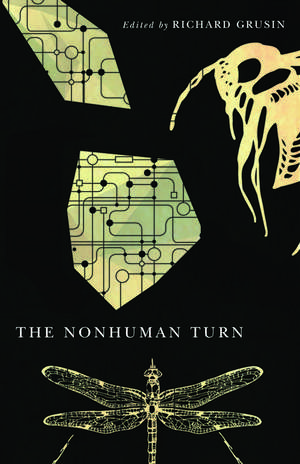
The Nonhuman Turn: 21st Century Studies
Editat de Richard Grusinen Limba Engleză Paperback – 9 mar 2015
Observăm în mediul academic contemporan o reorientare radicală a științelor umaniste, iar volumul The Nonhuman Turn, coordonat de Richard Grusin, se instalează ca textul fundamental care cartografiază și legitimează acest curent. Publicat de University of Minnesota Press în cadrul seriei 21st Century Studies, volumul reușește să sintetizeze direcții teoretice diverse — de la teoria afectului și noile media, până la ecologia politică și ontologia orientată pe obiect — sub o umbrelă conceptuală comună. Spre deosebire de After the Human de Sherryl Vint, care explorează postumanismul ca pe o etapă succesoare condiției umane, lucrarea de față propune o teză mai provocatoare: ideea că omul nu a fost niciodată o entitate autonomă, ci a existat mereu într-o stare de indistincție și coevoluție cu tehnologia, sistemele geofizice și alte forme de viață.
Structura volumului este una riguroasă, debutând cu o introducere programatică de Richard Grusin care definește mizele politice și filosofice ale „virajului non-uman”. Suntem de părere că progresia capitolelor oferă o acoperire exhaustivă a disciplinelor implicate: Brian Massumi analizează animalitatea, Timothy Morton abordează prezența obiectelor, iar Jane Bennett face legătura între materialismul vital și ontologie. Cartea acoperă o arie tematică similară cu Deleuze and the Non/Human, însă se distinge printr-o abordare mai sistemică, încercând să creeze o platformă unitară pentru cercetarea viitoare în științele sociale, depășind analiza unui singur autor filosofic.
Din seria 21st Century Studies
-
 Preț: 143.97 lei
 -
 Preț: 207.88 lei
 -
 Preț: 189.16 lei
 -
 Preț: 186.77 lei
 - 23%
 Preț: 490.03 lei
 -
 Preț: 236.76 lei
 -
 Preț: 241.03 lei
Preț: 190.24 lei
Carte disponibilă
Livrare economică 27 octombrie-10 noiembrie
Livrare express 13-17 octombrie pentru 25.63 lei
Specificații
ISBN-10: 0816694672
Pagini: 288
Ilustrații: 11
Dimensiuni: 140 x 216 x 23 mm
Greutate: 0.34 kg
Ediția:1
Editura: University of Minnesota Press
Colecția Univ Of Minnesota Press
Seria 21st Century Studies
De ce să citești această carte
Este o resursă indispensabilă pentru cercetătorii și studenții la filosofie, studii culturale sau ecologie politică. Cititorul câștigă o înțelegere clară a modului în care agenția non-umană (tehnologie, climă, animale) modelează societatea. Recomandăm această carte pentru capacitatea sa unică de a reuni cele mai influente voci ale teoriei critice actuale într-un singur volum coerent care redefinește ce înseamnă „umanul” în prezent.
Despre autor
Richard Grusin este profesor de engleză la Wayne State University și o figură centrală în studiile media și culturale contemporane. Este recunoscut la nivel internațional pentru volumul „Remediation: Understanding New Media”, scris împreună cu Jay David Bolter, o lucrare de referință în teoria comunicării. În proiectele sale editoriale recente, precum Anthropocene Feminism sau The Long 2020, acesta continuă să exploreze intersecția dintre cultură, tehnologie și crizele ecologice, menținând un interes constant pentru modul în care instituțiile și mediile de comunicare ne modelează identitatea colectivă.
Notă biografică
Cuprins
Introduction
Richard Grusin
1. The Supernormal Animal
Brian Massumi
2. Consequences of Panpsychism
Steven Shaviro
3. Artfulness
Erin Manning
4.The Aesthetics of Philosophical Carpentry
Ian Bogost
5. Our Predictive Condition; or, Prediction in the Wild
Mark B. N. Hansen
6. Crisis, Crisis, Crisis; or, the Temporality of Networks
Wendy Hui Kyong Chun
7. They Are Here
Timothy Morton
8. Form / Matter / Chora: Object-Oriented Ontology and Feminist New Materialism
Rebekah Sheldon
9. Systems and Things: On Vital Materialism and Object-Oriented Philosophy
Jane Bennett
Acknowledgments
Contributors
Index
Recenzii
"A good overview of the various strands of thinking that have contributed to thought on the Anthropocene in relation to media."—The Year’s Work in Critical and Cultural Theory
"A fascinating, daring and challenging read that deserves to fuel discussion and raises some interesting challenges to anthropocentric critical discourse."—The Anthropocene Review Blog
"Presents rich, compelling interdisciplinary work that pushes the boundary of how we understand the human and the nonhuman, relationality, art, sympathy, and literary critical writing."—Configurations
Descriere
The nonhuman turn in twenty-first-century studies can be traced to multiple intellectual and theoretical developments from the last decades of the twentieth century: actor-network theory, affect theory, animal studies, assemblage theory, cognitive sciences, new materialism, new media theory, speculative realism, and systems theory. Such varied analytical and theoretical formations obviously diverge and disagree in many of their assumptions, objects, and methodologies. However, they all take up aspects of the nonhuman as critical to the future of twenty-first-century studies in the arts, humanities, and social sciences.
Unlike the posthuman turn, the nonhuman turn does not make a claim about teleology or progress in which we begin with the human and see a transformation from the human to the posthuman. Rather, the nonhuman turn insists (paraphrasing Bruno Latour) that “we have never been human,” that the human has always coevolved, coexisted, or collaborated with the nonhuman—and that the human is identified precisely by this indistinction from the nonhuman.
Contributors: Jane Bennett, Johns Hopkins U; Ian Bogost, Georgia Institute of Technology; Wendy Hui Kyong Chun, Brown U; Mark B. N. Hansen, Duke U; Erin Manning, Concordia U, Montreal; Brian Massumi, U of Montreal; Timothy Morton, Rice U; Steven Shaviro, Wayne State U; Rebekah Sheldon, Indiana U.