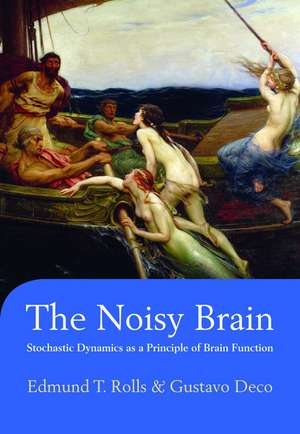
The Noisy Brain: Stochastic Dynamics as a Principle of Brain Function
Autor Edmund T. Rolls, Gustavo Decoen Limba Engleză Hardback – 28 ian 2010
În literatura academică dedicată neuroștiințelor, variabilitatea activității neuronale a fost mult timp tratată ca un simplu zgomot de fundal, un reziduu ce trebuie filtrat pentru a înțelege semnalul util. Descoperim în The Noisy Brain o schimbare radicală de paradigmă: Edmund T. Rolls și Gustavo Deco demonstrează că această natură stocastică este, de fapt, un principiu de funcționare esențial. Volumul completează o lacună majoră, oferind un model computațional care explică modul în care descărcările neuronale aparent aleatorii permit creierului să fie flexibil, să ia decizii probabilistice și să manifeste creativitate.
Considerăm că forța acestui text rezidă în capacitatea de a unifica niveluri diferite de analiză. Autorii pornesc de la proprietățile sinaptice și ajung la fenomene complexe precum atenția și memoria pe termen scurt, folosind modele de tip 'integrate-and-fire' și analize de câmp mediu ('mean-field') derivate din fizica teoretică. Remarcăm totodată relevanța clinică a lucrării; autorii explorează cum instabilitatea acestor dinamici stocastice poate contribui la înțelegerea schizofreniei sau a tulburării obsesiv-compulsive.
Comparabil cu Neuronal Noise de Alain Destexhe în rigoarea analizei zgomotului sinaptic, acest volum este actualizat pentru a include corelații directe cu neuroimagistica funcțională și datele comportamentale. În contextul operei lui Edmund T. Rolls, lucrarea rafinează conceptele din Memory, Attention, and Decision-Making, oferind fundamentul matematic pentru mecanismele descrise anterior și extinzând aria de investigație către îmbătrânirea normală și neuroeconomie. Textul este structurat modular, facilitând utilizarea sa în curriculumul universitar avansat.
Preț: 607.34 lei
Preț vechi: 875.98 lei
-31%
Carte tipărită la comandă
Livrare economică 30 octombrie-04 noiembrie
Specificații
ISBN-10: 0199587868
Pagini: 314
Ilustrații: Illus.
Dimensiuni: 177 x 253 x 20 mm
Greutate: 0.79 kg
Editura: OUP OXFORD
Colecția OUP Oxford
Locul publicării:Oxford, United Kingdom
V-ar putea interesa
-
 Matter of Mind: A Neurologist's View of Brain-Behavior RelationshipsKenneth M. Heilman-21%Preț: 414.15 lei525.24 lei
 -
 The Development of Social Engagement: Neurobiological PerspectivesPeter J. Marshall-28%Preț: 536.09 lei745.80 lei
 -
 A Brief History of the Mind: From Apes to Intellect and BeyondWilliam H. Calvin-16%Preț: 102.18 lei121.05 lei
 -
 The Pleasure Center: Trust Your Animal InstinctsMorten L. Kringelbach-20%Preț: 260.78 lei326.13 lei
 -
 Creating Modern Neuroscience: The Revolutionary 1950sGordon M Shepherd MD, DPhil-32%Preț: 528.62 lei780.13 lei
 -
 -38%Preț: 1045.30 lei1687.01 lei
 -
 -25%Preț: 623.78 lei832.39 lei
 -
 Computational Neuroscience of VisionEdmund Rolls-33%Preț: 709.46 lei1060.86 lei
 -
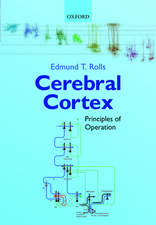 Cerebral Cortex: Principles of OperationEdmund T. Rolls-26%Preț: 419.35 lei568.74 lei
 -
 -32%Preț: 936.58 lei1374.49 lei
 -
 Law and Neuroscience: Current Legal Issues Volume 13Michael Freeman-34%Preț: 671.94 lei1013.09 lei
 -
 A Survey of Medical NeuroscienceRobert M. BecksteadPreț: 424.56 lei
 -
 -20%Preț: 496.37 lei620.46 lei
 -
 Cognitive Neuroscience of Attention: A Developmental PerspectiveJohn E. Richards-18%Preț: 1126.71 lei1374.04 lei
 -
 Apoptosis in NeurobiologyYusuf A. Hannun-5%Preț: 1230.92 lei1295.70 lei
 -
 Reclaiming CognitionRafael NunezPreț: 159.93 lei
 -
 Information DynamicsGustavo Deco-20%Preț: 322.41 lei403.01 lei
 -
 -19%Preț: 540.69 lei667.52 lei
 -
 The Neuronal Ceroid Lipofuscinoses (Batten Disease)H. H. Goebel-19%Preț: 642.09 lei792.71 lei
 -
 Idea of Consciousness: Synapses and the MindMax R. Bennett-15%Preț: 516.19 lei607.28 lei
De ce să citești această carte
Recomandăm această carte cercetătorilor și studenților de la nivel postuniversitar care doresc să înțeleagă fundamentul matematic al funcțiilor cognitive. Cititorul câștigă o perspectivă integrată asupra modului în care procesele stocastice influențează sănătatea mintală și performanța cognitivă. Este un instrument esențial pentru cei care studiază neuroștiința computațională, oferind atât teorie riguroasă, cât și aplicații practice în psihiatrie și psihologie experimentală.
Despre autor
Edmund T. Rolls este profesor de psihologie experimentală la Universitatea din Oxford și cercetător de renume în cadrul Corpus Christi College. Cu o formare inițială în medicină preclinică la Cambridge, cercetările sale actuale de la Oxford creează o punte între neurofiziologie, modele computaționale și neuroimagistica funcțională umană. Este autorul unor lucrări fundamentale precum The Brain and Emotion și Cerebral Cortex, activitatea sa fiind dedicată înțelegerii bazelor fundamentale ale funcționării creierului uman și ale tulburărilor sale neuropsihologice.