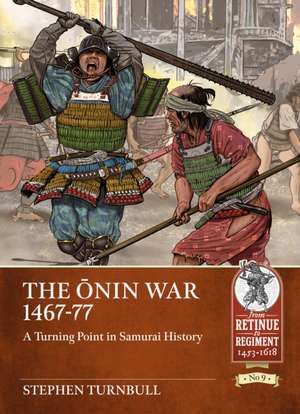
The Ōnin War 1467-77
Autor Stephen Turnbullen Limba Engleză Paperback – 4 noi 2021
Within decades all that he had achieved seemed to have been lost. In 1441 the reigning shogun Yoshinori, Yoshimitsu's son, had been murdered by a jealous rival. The Bakufu (shogunate) had somehow survived, but Yoshinori was succeeded first by a son who never reached manhood and then by another young son called Yoshimasa. He was to reign for 49 years in a turbulent age. Not only did Yoshimasa have to face up to his background of family tragedy; unprecedented waves of rioting by farmers shook the ruling classes as much as any wars could have done, and all this happened to a background of famines, droughts and floods that killed more people than any of the battles ever did. Yoshimasa had several armed conflicts to contend with, which culminated in a succession dispute over his own choice of heir. This launched the Ōnin War.
There had been conflicts before, but what made the Ōnin War unique was the fierce street-fighting that went on within Kyoto itself. The battles were conducted from fortified mansions, which were surrounded by stout wooden walls and ditches and sported tall observation towers. In one such fight in the summer of 1467 eight cart-loads of heads were taken as trophies, but within months the conflict deteriorated into a stalemate where night raids were launched and large stones were flung by catapult. At the same time huge areas of Kyoto were needlessly burned out by careless attacks from irregular troops called ashigaru, whose looting and destruction went far beyond the enemy positions and took in temples, mansions and commoners' dwellings.
The greatest loss of all was the disappearance of loyalty to the shogun. Instead his former deputies in the provinces seized power in their local areas. This was the beginning of the Sengoku Period: Japan's 'Age of Warring States'. The book ends with one of these sengoku daimyo (lords of the warring states) called Hōjō Sōun, whose family would control much of Eastern Japan for the next century, owing nothing to the authority of the shogun, whose powers had been taken away by the terrible Ōnin War.
Preț: 140.57 lei
Puncte Express: 211
Carte disponibilă
Livrare economică 02-16 noiembrie
Livrare express 17-23 octombrie pentru 26.36 lei
Livrare prin curier în România Termenul estimat este afișat lângă disponibilitate.
Transport gratuit de la 400.00 lei Plată online sau ramburs, în funcție de opțiunile comenzii.
Retur gratuit în 14 zile Comandă securizată și suport în română.
Specificații
ISBN-13: 9781914059674
ISBN-10: 1914059670
Pagini: 128
Dimensiuni: 175 x 243 x 8 mm
Greutate: 0.36 kg
Editura: HELION & COMPANY
ISBN-10: 1914059670
Pagini: 128
Dimensiuni: 175 x 243 x 8 mm
Greutate: 0.36 kg
Editura: HELION & COMPANY
Notă biografică
Stephen Turnbull took his first degree at Cambridge and has two MAs (in Theology and Military History) from Leeds University. In 1996 he received a PhD from Leeds for his thesis on Japan's 'Hidden Christians'. In its published form the work won the Japan Festival Literary Award in 1998. Having lectured widely in East Asian Studies and Theology he is now retired and holds the honorary positions of Lecturer Emeritus at Leeds University, Research Associate at SOAS and Visiting Professor of Japanese Studies at Akita International University. His expertise, including an extensive picture library, has helped with numerous media projects including the award-winning computer strategy game Shogun Total War, and in 2010 he acted as Historical Adviser to Universal Pictures for the movie 47 Ronin.