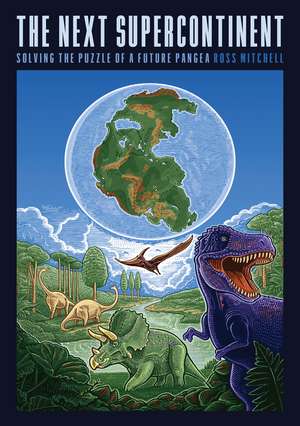
The Next Supercontinent: Solving the Puzzle of a Future Pangea
Autor Ross Mitchellen Limba Engleză Hardback – 24 mai 2023
În capitolul dedicat „Arhaicului Necunoscut”, Ross Mitchell stabilește miza centrală a volumului: înțelegerea modului în care dinamica profundă a planetei guvernează viitorul geografic al umanității. Observăm o abordare care transcende simpla descriere a derivei continentelor, autorul invitându-ne în expediții geologice în regiuni izolate pentru a identifica dovezile fizice ale unor mase continentale ancestrale precum Rodinia sau Columbia. Această perspectivă transformă The Next Supercontinent dintr-un tratat teoretic într-o narațiune de explorare științifică, unde geofizica devine un instrument de descifrare a unui puzzle global.
Structura volumului este riguros organizată pe etapele ciclului supercontinental. Primele trei capitole analizează succesiv Pangea, Rodinia și Columbia, oferind cititorului contextul istoric necesar pentru a înțelege capitolul central, „The Next Supercontinent”. Aici, Mitchell prezintă argumentele pentru formarea Amasiei, viitorul supercontinent ce va rezulta din coliziunea Americii de Nord cu Asia, proces explicat prin fluxurile termice din mantaua terestră. Lucrarea extinde cadrul propus de Supercontinent de Ted Nield cu date noi din cercetările recente asupra dinamicii mantalei și oferă o alternativă mai riguros ancorată în geofizică față de teoriile prezentate în The Vestige of a Beginning, the Prospect of an End.
Notăm cu interes modul în care Mitchell reușește să explice teoria tectonicii plăcilor fără a recurge la un limbaj excesiv de tehnic, menținând totodată precizia academică specifică University of Chicago Press. Epilogul, „Surviving Amasia”, ridică întrebări esențiale despre supraviețuirea speciilor pe o scară de timp de 200 de milioane de ani, oferind o încheiere speculativă, dar fundamentată științific, asupra destinului pe termen lung al Pământului.
Preț: 175.60 lei
Carte disponibilă
Livrare economică 16-30 noiembrie
Livrare express 31 octombrie-06 noiembrie pentru 81.39 lei
Specificații
ISBN-10: 0226824918
Pagini: 304
Ilustrații: 56 halftones
Dimensiuni: 140 x 216 x 25 mm
Greutate: 0.48 kg
Ediția:First Edition
Editura: University of Chicago Press
Colecția University of Chicago Press
V-ar putea interesa
-
 The Long MarsTerry PratchettPreț: 63.86 lei
 -
 The Universe WithinNeil ShubinPreț: 92.60 lei
 -
 Preț: 187.52 lei
 -
 How the Earth Works: Discover How Plate Tectonics Shapes Our PlanetLucia Dr Perez Diaz-16%Preț: 106.35 lei126.35 lei
 -
 -11%Preț: 224.95 lei252.56 lei
 -
 A Little History of the EarthJamie WoodwardPreț: 151.60 lei
 -
 The Whispers of Rock: Stories from the EarthAnjana Khatwa-25%Preț: 91.92 lei123.29 lei
 -
 Annals of the Former WorldJohn McPheePreț: 205.33 lei
 -
 Preț: 53.72 lei
 -
 Preț: 53.72 lei
 -
 The Wake of HMS ChallengerGillen D'Arcy WoodPreț: 171.07 lei
 -
 The Next 100 YearsGeorge Friedman-18%Preț: 77.63 lei94.46 lei
 -
 OriginsRon RedfernPreț: 355.07 lei
 -
 Ends of the EarthNeil ShubinPreț: 158.97 lei
 -
 Our StoryColin Butfield-21%Preț: 133.36 lei168.13 lei
 -
 -19%Preț: 77.23 lei94.99 lei
 -
 AmnionStephanie Sy-QuiaPreț: 77.21 lei
 -
 Seven Worlds One PlanetJonny Keeling-17%Preț: 235.44 lei283.74 lei
 -
 In Search of GemsKenneth StevenPreț: 63.29 lei
 -
 The Road to GondwanaBill MorrisPreț: 156.39 lei
De ce să citești această carte
Această lucrare este esențială pentru cititorii pasionați de geologie și științele pământului care doresc să înțeleagă nu doar trecutul planetei, ci și configurația sa viitoare. Ross Mitchell oferă o perspectivă clară asupra ciclului supercontinentelor, explicând cum mișcările profunde ale mantalei ne vor modela lumea. Veți câștiga o înțelegere profundă a modului în care se formează Amasia, totul printr-o scriitură ce îmbină rigoarea academică cu experiența directă de pe teren.
Despre autor
Ross Mitchell este un geofizician de renume internațional, recunoscut pentru contribuțiile sale majore în studiul paleomagnetismului și al tectonicii plăcilor. Expert în ciclul supercontinentelor, Mitchell a efectuat numeroase cercetări de teren în locații geologice strategice pentru a colecta date despre configurațiile continentale preistorice. Activitatea sa academică se concentrează pe corelarea proceselor geodinamice din interiorul Terrei cu schimbările majore de la suprafața scoarței, fiind unul dintre principalii promotori ai teoriei formării viitorului supercontinent, Amasia. Această expertiză îi permite să traducă concepte geofizice complexe într-o formă accesibilă publicului larg.
Descriere scurtă
You’ve heard of Pangea, the single landmass that broke apart some 175 million years ago to give us our current continents, but what about its predecessors, Rodinia or Columbia? These “supercontinents” from Earth’s past provide evidence that land repeatedly joins and separates. While scientists debate what that next supercontinent will look like—and what to name it—they all agree: one is coming.
In this engaging work, geophysicist Ross Mitchell invites readers to remote (and sometimes treacherous) lands for evidence of past supercontinents, delves into the phenomena that will birth the next, and presents the case for the future supercontinent of Amasia, defined by the merging of North America and Asia. Introducing readers to plate tectonic theory through fieldwork adventures and accessible scientific descriptions, Mitchell considers flows deep in the Earth’s mantle to explain Amasia’s future formation and shows how this developing theory can illuminate other planetary mysteries. He then poses the inevitable question: how can humanity survive the intervening 200 million years necessary to see Amasia?
An expert on the supercontinent cycle, Mitchell offers readers a front-row seat to a slow-motion mystery and an ongoing scientific debate.
Notă biografică
Extras
In this book, I will layout the leading contenders for the geography of the next supercontinent, explore the modern mysteries that still surround plate tectonics, and explain the science behind predicting how continents move. Alas, predicting the next supercontinent is not as simple as understanding today’s movements and pressing fast-forward. Tectonic plates move slowly, at about the same speed that our fingernails grow. But GPS is now precise enough to detect this slow motion. And residents of Pompeii, San Francisco, and Fukushima can tell you that the effects of those movements are hard to perceive—until they are devastating. Volcanoes, earthquakes, and tsunamis are evidence of plate tectonics’ power. So is geography—just look at the abrupt bend, or kink, in the chain of the Hawaiian Islands. These islands formed a straight chain of semicontinuous volcanic activity for about 30 million years, until a sudden pivot occurred over the course of a few million years or less. The bend is a record of that pivot. Why did this happen? The tectonic plates are all interconnected, so any change in the movement of one plate causes adjustments in them all. Thirty million years ago, Australia broke away from Antarctica and started its current path north across the Pacific Ocean. Whereas the Pacific plate had been moving directly north before the bend, Australia’s breakaway in the western Pacific caused the motion of the Pacific plate to deflect toward the northwest after the bend. No plate is moving alone and each plate interacts with its neighbors along their shared boundaries. Plate tectonics is the dance of all plates and the seven major continents (or eight, depending on how you define them) they carry, constituting a global choreography, with dozens of smaller plates in between.
The earliest understanding of plate movement was the sixteenth-century idea of “continental drift”—that the continents migrated like rafts slowly into their current position, floating on an imperceptible layer within the earth. But this theory was largely written off because it was not clear what sort of mysterious substratum the continental rafts would be floating on. By the beginning of the last century, we still knew very little about the interior of the earth. Eventually, as seismology— the study of inner Earth using the vibrations generated from earthquakes— developed and submarines were put to good use after World War II to map the seafloor, the hypothesis of plate tectonics changed geology forever. Breaking Earth’s seemingly rigid surface into an interlocking mosaic of different plates that pushed and pulled each other provided a unified explanation for the origin of many of Earth’s great geological features, such as mountains, volcanoes, earthquakes, and oceans. But as exciting as the early plate tectonic revolution was, it didn’t have all the answers. For example, the hot interior of the earth was likely convecting, in a movement driven by temperature changes, just like the circulation of air in the atmosphere; but how these deep convective cells related to the push and pull of the plates at Earth’s surface would remain elusive for decades—and the details of this interaction are still unsolved.
Cuprins
Introduction
1. Pangea
2. Rodinia
3. Columbia
4. The Unknown Archean
5. The Next Supercontinent
Epilogue: Surviving Amasia
Acknowledgments
Notes
Index