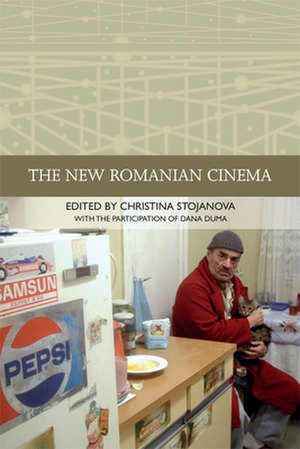
The New Romanian Cinema: Traditions in World Cinema
Editat de Christina Stojanovaen Limba Engleză Paperback – 5 feb 2021
With its thorough bibliographic and filmographic references, and a comprehensive historical overview, the anthology represents a systematic guide to New Romanian Cinema as a consolidated cinematic movement, and highlights its potential as a rich interdisciplinary field of study.
Din seria Traditions in World Cinema
- 17%
 Preț: 198.73 lei
 - 26%
 Preț: 568.56 lei
 - 16%
 Preț: 207.66 lei
 - 16%
 Preț: 208.72 lei
 - 15%
 Preț: 216.41 lei
 - 15%
 Preț: 180.14 lei
 - 16%
 Preț: 210.59 lei
 - 25%
 Preț: 564.57 lei
 - 11%
 Preț: 155.60 lei
 -
 Preț: 151.20 lei
 - 17%
 Preț: 629.59 lei
 - 9%
 Preț: 143.97 lei
 - 16%
 Preț: 598.73 lei
 - 16%
 Preț: 207.27 lei
 - 17%
 Preț: 197.92 lei
 - 14%
 Preț: 650.53 lei
Preț: 204.06 lei
Preț vechi: 241.68 lei
-16%
Puncte Express: 306
Carte disponibilă
Livrare economică 30 octombrie-13 noiembrie
Livrare express 16-22 octombrie pentru 74.01 lei
Livrare prin curier în România Termenul estimat este afișat lângă disponibilitate.
Transport gratuit de la 400.00 lei Plată online sau ramburs, în funcție de opțiunile comenzii.
Retur gratuit în 14 zile Comandă securizată și suport în română.
Specificații
ISBN-13: 9781474477734
ISBN-10: 1474477739
Pagini: 344
Ilustrații: 36 B/W illustrations
Dimensiuni: 234 x 157 x 22 mm
Greutate: 0.54 kg
Editura: EDINBURGH UNIVERSITY PRESS
Colecția Traditions in World Cinema
Seria Traditions in World Cinema
ISBN-10: 1474477739
Pagini: 344
Ilustrații: 36 B/W illustrations
Dimensiuni: 234 x 157 x 22 mm
Greutate: 0.54 kg
Editura: EDINBURGH UNIVERSITY PRESS
Colecția Traditions in World Cinema
Seria Traditions in World Cinema
V-ar putea interesa
-
 -18%Preț: 1250.28 lei1524.74 lei
 -
 History of European Drama and TheatreErika Fischer-LichtePreț: 418.71 lei
 -
 Drama/Theatre/PerformanceSimon ShepherdPreț: 215.57 lei
 -
 The Routledge Companion to Research in the ArtsMichael Biggs-15%Preț: 444.16 lei522.53 lei
 -
 The Cambridge Companion to Theatre HistoryDavid WilesPreț: 248.54 lei
 -
 The Spell of the SensuousDavid AbramPreț: 105.19 lei
 -
 Research Methods for Cultural StudiesMichael Pickering-17%Preț: 180.55 lei217.12 lei
 -
 -17%Preț: 233.68 lei281.45 lei
 -
 Research Methods in Theatre and PerformanceBaz Kershaw-16%Preț: 207.74 lei247.51 lei
 -
 Research Methods for English StudiesGabriele Griffin-16%Preț: 208.29 lei248.80 lei
 -
 Preț: 426.72 lei
 -
 The SAGE Handbook of Qualitative ResearchNorman K. Denzin-27%Preț: 943.18 lei1292.02 lei
 -
 The Viewpoints BookAnne BogartPreț: 107.98 lei
Descriere
Descriere de la o altă ediție sau format:
Covering more than forty films made since 2001 including 'The Death of Mr. Lazarescu, 'The Paper will be Blue', 'Police', Adjective' and 'Beyond the Hills' this pioneering collection of essays on New Romanian Cinema is the first to contextualise it aesthetically, theoretically and historically.
Covering more than forty films made since 2001 including 'The Death of Mr. Lazarescu, 'The Paper will be Blue', 'Police', Adjective' and 'Beyond the Hills' this pioneering collection of essays on New Romanian Cinema is the first to contextualise it aesthetically, theoretically and historically.