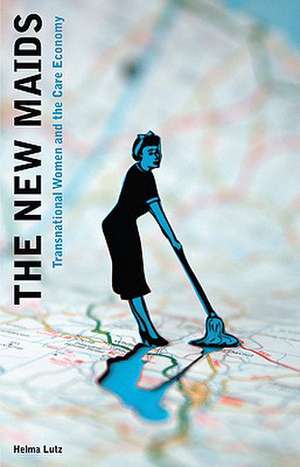
The New Maids: Transnational Women and the Care Economy
Autor Professor Helma Lutzen Limba Engleză Hardback – 11 aug 2011
Using a central ethnographic study of immigrant domestic workers and their German employees as its starting point, The New Maids uses the voices of such women themselves to provide unique conceptual and evidential support for this vital new approach argument. This exciting book will not only enhance the reader's understanding of the new care-economy, it also sets standards for feminist global methodology.
| Toate formatele și edițiile | Preț | Express |
|---|---|---|
| Paperback (1) | 163.49 lei 43-57 zile | |
| Bloomsbury Publishing – 11 aug 2011 | 163.49 lei 43-57 zile | |
| Hardback (1) | 468.60 lei 47-59 zile | |
| Bloomsbury Publishing – 11 aug 2011 | 468.60 lei 47-59 zile |
Preț: 468.60 lei
Preț vechi: 753.82 lei
-38%
Puncte Express: 703
Preț estimativ în valută:
82.96€ • 96.60$ • 72.07£
82.96€ • 96.60$ • 72.07£
Carte tipărită la comandă
Livrare economică 27 februarie-11 martie
Preluare comenzi: 021 569.72.76
Specificații
ISBN-13: 9781848132870
ISBN-10: 1848132875
Pagini: 256
Dimensiuni: 138 x 216 x 28 mm
Greutate: 0.45 kg
Editura: Bloomsbury Publishing
Colecția Zed Books
Locul publicării:London, United Kingdom
ISBN-10: 1848132875
Pagini: 256
Dimensiuni: 138 x 216 x 28 mm
Greutate: 0.45 kg
Editura: Bloomsbury Publishing
Colecția Zed Books
Locul publicării:London, United Kingdom
Cuprins
1: The New Division of Domestic Labour
2: The Household as a Global Market for Women's Labour
3: Domestic Work and Lifestyles: Methods and First Results
4: Domestic Work - A Perfectly Normal Job?
5: Exploitation or Alliance of Trust? Relationship Work in the Household
6: Transnational Motherhood
7: Being Illegal
8: Migrant Women in the Globalization Trap?
2: The Household as a Global Market for Women's Labour
3: Domestic Work and Lifestyles: Methods and First Results
4: Domestic Work - A Perfectly Normal Job?
5: Exploitation or Alliance of Trust? Relationship Work in the Household
6: Transnational Motherhood
7: Being Illegal
8: Migrant Women in the Globalization Trap?
Recenzii
In this nuanced, important, big-picture book, Lutz tells us that "old maids" --serving tea, say, in a bourgeois Berlin in 1900 home -- might be an 18 year old from a nearby rural town. In the frightening l930's, she might have been one of 100,000 women the Nazis forcibly moved from the nations it conquered placed in German homes as maids. By contrast, the "new maid" is a willing volunteer of global capitalism. Compared to maids of the past, she is often older, a mother, and a migrant from the educated middle classes of the flagging economies of the Ukraine, Poland, Belorussia. As their harrowing stories reveal, however, the new maid often balances long-distance mothering with fears of being deported as an "illegal," uncertain living circumstances, and the unpredictable hearts of marginal men. A must read.
Through compelling ethnographic portraits and astute theory, 'The New Maids' takes us beyond narratives of exploitation or empowerment to capture mutual dependences, transnational motherhood, and intimate labor under shifting gender, migration, and welfare regimes. It moves the scholarship on paid domestic work under globalization to new heights!
This is an absorbing analysis of migrant domestic and care work in Germany. Based on intensive interviews with both household employers and employees, Lutz sensitively unfolds the complex, interlocking but deeply asymmetrical employment relationship. This is a major case study of intersectionality in action. The poignant and moving biographies of transnational mother-workers are interspersed with constant analytical insights which make this book essential reading for anyone researching or working in the field of migration and care.
With insight and conviction, Helma Lutz takes us inside the world of the foreign domestic work. She shares poignant narratives that reveal the paradoxical lives of today's maids as one of simultaneous professionalism and personalism at work, distance and proximity in the family, and the unrecognized dependency on their labor by the state. This is an important book that should be read by policy makers and scholars alike.
The insights from Helma Lutz's rich ethnographic research bring a new dimension to the growing literature on women, migration and care work. In this brilliant synthesis, Lutz shows how the household becomes a 'global market for women's labour,' one in which active players 'do ethnicity' as they negotiate care and domestic work. While the focus is on Europe, The New Maids adds to our understanding of transnational women across the globe. As she did with Migration and Domestic Work, Lutz once again raises scholarship on women, migration and work to a new level.
Through compelling ethnographic portraits and astute theory, 'The New Maids' takes us beyond narratives of exploitation or empowerment to capture mutual dependences, transnational motherhood, and intimate labor under shifting gender, migration, and welfare regimes. It moves the scholarship on paid domestic work under globalization to new heights!
This is an absorbing analysis of migrant domestic and care work in Germany. Based on intensive interviews with both household employers and employees, Lutz sensitively unfolds the complex, interlocking but deeply asymmetrical employment relationship. This is a major case study of intersectionality in action. The poignant and moving biographies of transnational mother-workers are interspersed with constant analytical insights which make this book essential reading for anyone researching or working in the field of migration and care.
With insight and conviction, Helma Lutz takes us inside the world of the foreign domestic work. She shares poignant narratives that reveal the paradoxical lives of today's maids as one of simultaneous professionalism and personalism at work, distance and proximity in the family, and the unrecognized dependency on their labor by the state. This is an important book that should be read by policy makers and scholars alike.
The insights from Helma Lutz's rich ethnographic research bring a new dimension to the growing literature on women, migration and care work. In this brilliant synthesis, Lutz shows how the household becomes a 'global market for women's labour,' one in which active players 'do ethnicity' as they negotiate care and domestic work. While the focus is on Europe, The New Maids adds to our understanding of transnational women across the globe. As she did with Migration and Domestic Work, Lutz once again raises scholarship on women, migration and work to a new level.