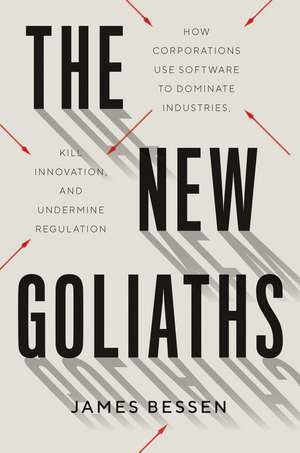
The New Goliaths: How Corporations Use Software to Dominate Industries, Kill Innovation, and Undermine Regulation
Autor James Bessenen Limba Engleză Hardback – 7 iun 2022
Problema centrală pe care o rezolvă The New Goliaths este paralizia inovației într-o economie dominată de platforme software care nu mai pot fi concurate prin metodele clasice ale capitalismului. Observăm că, în ultimele două decenii, giganți precum Amazon sau Google nu mai sunt amenințați de 'distrugerea creativă' deoarece controlează infrastructura digitală prin sisteme proprietare complexe. James Bessen argumentează autoritar că fragmentarea acestor companii (soluția standard de antitrust) este ineficientă; în schimb, el propune un model de acces deschis la date și tehnologie.
Abordarea diferă de The Myth of Capitalism de Jonathan Tepper prin pragmatismul soluțiilor — în timp ce Tepper se concentrează pe descrierea dispariției piețelor libere, Bessen oferă un cadru de reglementare bazat pe interoperabilitate. Este o perspectivă mai puțin abstractă și mai mult aplicabilă în politici publice, evidențiind cum software-ul a devenit o barieră de intrare pe piață mai dură decât capitalul financiar. Merită menționat că autorul continuă linia critică începută în Patent Failure – How Judges, Bureaucrats, and Lawyers Put Innovators at Risk. Dacă în lucrarea anterioară analiza cum sistemul juridic sufocă inventatorii, aici extinde analiza către modul în care algoritmii și datele masive sunt folosite pentru a evada reglementările guvernamentale și pentru a adânci diviziunea socială. Apreciem rigoarea cu care Bessen, fost CEO în industria software, demontează mitul conform căruia mărimea acestor corporații este doar rezultatul eficienței lor superioare.
Preț: 177.57 lei
Carte disponibilă
Livrare economică 31 octombrie-14 noiembrie
Livrare express 17-23 octombrie pentru 33.54 lei
Specificații
ISBN-10: 0300255047
Pagini: 272
Ilustrații: 8 b-w illus.
Dimensiuni: 156 x 235 x 28 mm
Greutate: 0.54 kg
Editura: Yale University Press
Colecția Yale University Press
V-ar putea interesa
-
 The New Geography of InnovationMehran GulPreț: 123.61 lei
 -
 The Business of PlatformsAnnabelle GawerPreț: 156.54 lei
 -
 People, Power, and ProfitsJoseph Stiglitz-30%Preț: 65.59 lei93.82 lei
 -
 Don't Be EvilRana Foroohar-18%Preț: 65.52 lei79.82 lei
 -
 -21%Preț: 92.10 lei115.93 lei
 -
 The Infinite AlphabetCésar A. HidalgoPreț: 191.23 lei
 -
 Tech MonopolyHerbert Hovenkamp-17%Preț: 90.02 lei108.64 lei
 -
 The Master SwitchTim WuPreț: 137.44 lei
 -
 Access RulesViktor Mayer-SchönbergerPreț: 166.19 lei
 -
 The Myth of CapitalismJonathan TepperPreț: 123.22 lei
 -
 -37%Preț: 127.78 lei201.66 lei
 -
 The Republic of InnovationAndrea Lorenzo CapusselaPreț: 138.67 lei
 -
 The Internet ConCory DoctorowPreț: 84.06 lei
 -
 Cybernetic Circulation ComplexNick Dyer-WithefordPreț: 129.05 lei
 -
 How Silicon Valley Unleashed Techno-feudalismCédric DurandPreț: 99.37 lei
 -
 The Curse of BignessTim Wu-19%Preț: 56.71 lei70.44 lei
 -
 -19%Preț: 98.15 lei120.78 lei
 -
 Chokepoint CapitalismRebecca GiblinPreț: 79.41 lei
 -
 Preț: 218.79 lei
De ce să citești această carte
Recomandăm această carte liderilor de business și analiștilor politici care vor să înțeleagă de ce mecanismele tradiționale de piață nu mai funcționează în era digitală. Cititorul va câștiga o înțelegere profundă a modului în care software-ul proprietar dictează regulile jocului economic. Este un argument solid pentru o nouă formă de reglementare, axată pe democratizarea accesului la tehnologie pentru a restabili dinamismul economic.
Despre autor
James Bessen este un cercetător și autor care îmbină experiența practică de fost dezvoltator de software și CEO cu rigoarea academică, fiind în prezent lector la Boston University School of Law. Expertiza sa se concentrează pe intersecția dintre inovația tehnologică, dreptul proprietății intelectuale și economie. Prin lucrările sale, Bessen a devenit o voce influentă în dezbaterea despre modul în care sistemele de brevete și tehnologiile informaționale afectează productivitatea și inegalitatea salarială în economia modernă, oferind o perspectivă rară, venită din interiorul industriei tehnologice.
Descriere scurtă
“Bessen is a master of unpacking the nuances of a complex array of interrelated trends to build a coherent story of how the promise of the democratized Internet ended up under the control of just a few. Read The New Goliaths to see how the forest came to have only room for a few tall trees with the rest of us in the undergrowth.”—Joshua Gans, coauthor of Prediction Machines: The Simple Economics of Artificial Intelligence
Historically, competition has powered progress under capitalism. Companies with productive new products rise to the top, but sooner or later, competitors come along with better innovations and disrupt the threat of monopoly. Dominant firms like Walmart, Amazon, and Google argue that this process of “creative destruction” prevents them from becoming too powerful or entrenched.
But the threat of competition has sharply decreased over the past twenty years, and today’s corporate giants have come to power by using proprietary information technologies to create a tilted playing field. This development has increased economic inequality and social division, slowed innovation, and allowed dominant firms to evade government regulation. In the face of increasing calls to break up the largest companies, James Bessen argues that a better way to restore competitive balance and dynamism is to encourage or compel these companies to share technology, data, and knowledge.
Recenzii
“Makes a compelling case. . . . The New Goliaths is an important book.”—David Warsh, EconomicPrincipals.com
“Bessen is a master of unpacking the nuances of a complex array of interrelated trends to build a coherent story of how the promise of the democratized Internet ended up under the control of just a few. Read The New Goliaths to see how the forest came to have only room for a few tall trees with the rest of us in the undergrowth.”—Joshua Gans, coauthor of Prediction Machines: The Simple Economics of Artificial Intelligence
“Information technologies—from the early bar code to cloud computing and artificial intelligence—are transforming our economy. Do firms use these technologies for the greater good or do they take advantage of lax oversight to increase their power and harm workers, consumers, and citizens? How should we regulate the New Goliaths of the digital age? Jim Bessen uses his broad experience and deep knowledge to shed light on these fundamental and contentious issues.”—Thomas Philippon, author of The Great Reversal
“Jim Bessen offers the first detailed account of how concretely the IT revolution ended up discouraging growth and creative destruction in the overall economy while dramatically increasing market concentration and income inequality. This book is an absolute must-read for scholars, policy makers, and anyone interested in the history of growth, innovation, and technological revolutions.”—Philippe Aghion, coauthor of The Power of Creative Destruction
“The New Goliaths is a deeply researched and innovative interpretation of how software innovation has produced more concentrated markets, higher inequality, and slower innovation, productivity growth, and new firm formation.”—Yochai Benkler, author of The Wealth of Networks: How Social Production Transforms Markets and Freedom