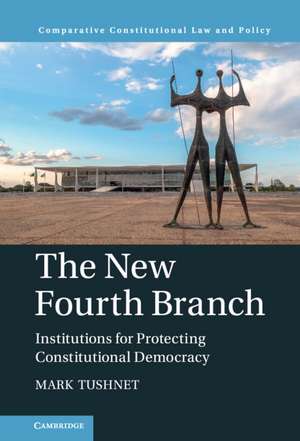
The New Fourth Branch
Autor Mark Tushneten Limba Engleză Paperback – 2 sep 2021
Preț: 295.07 lei
Puncte Express: 443
Carte tipărită la comandă
Livrare economică 16-30 noiembrie
Livrare express 10-16 octombrie pentru 28.93 lei
Livrare prin curier în România Termenul estimat este afișat lângă disponibilitate.
Transport gratuit de la 400.00 lei Plată online sau ramburs, în funcție de opțiunile comenzii.
Retur gratuit în 14 zile Comandă securizată și suport în română.
Specificații
ISBN-13: 9781009048491
ISBN-10: 100904849X
Pagini: 198
Dimensiuni: 152 x 229 x 11 mm
Greutate: 0.3 kg
Ediția:Nouă
Editura: Cambridge University Press
Locul publicării:Cambridge, United Kingdom
ISBN-10: 100904849X
Pagini: 198
Dimensiuni: 152 x 229 x 11 mm
Greutate: 0.3 kg
Ediția:Nouă
Editura: Cambridge University Press
Locul publicării:Cambridge, United Kingdom
Cuprins
1. Introduction; 2. Why a fourth branch – the structural logic; 3. Why a fourth branch – the functional logic; 4. Design issues in general; 5. Design principles in practice – a survey; 6. Anticorruption investigations – case studies from Brazil and South Africa; 7. Electoral commissions – case studies from India, the United States, and South Korea; 8. Audit agencies; 9. Conclusion.
Recenzii
'In an age when integrity and democracy are under unprecedented pressure, Mark Tushnet's description of emerging constitutional 'best practice' worldwide – systematic, realistic, and unemotional – helps to launch a new debate on whether, and how, the civic virtues that underpin good governance might be better institutionalized for all.' A. J. Brown, Professor of Public Policy & Law, Griffith University; Board Member, Transparency International
'For a discipline that has inexplicably remained focused on the role of apex courts for much of its existence, comparative constitutional studies should welcome Mark Tushnet's new book on the fourth branch as a sorely necessary intervention in the field. Mark captures the intuition that there is something distinctive about this new category of constitutional actors, increasingly popular with constitution makers, with characteristic insight and scholarly rigour. His characterization of the fourth branch as comprising 'institutions to protect constitutional democracy' will no doubt encourage other theoretical attempts to find an appropriate conceptual substitute for the numerical placeholder for this branch. This book is an essential read for anyone interested in understanding constitutions, their functions, and their limits.' Tarunabh Khaitan, Professor of Public Law and Legal Theory & Hackney Fellow in Law, Wadham College, University of Oxford
'In this already indispensable work on the theory and practice of designing innovative government structures to protect constitutional democracy, Tushnet brilliantly and carefully appraises existing 'fourth branch' institutions. A scholarly provocation favoring decentralized structures and remedies with more face-to-face interactions, the book demands reading by all serious scholars of constitutional government.' Vicki C. Jackson, Laurence H. Tribe Professor of Constitutional Law, Harvard Law School
'For a discipline that has inexplicably remained focused on the role of apex courts for much of its existence, comparative constitutional studies should welcome Mark Tushnet's new book on the fourth branch as a sorely necessary intervention in the field. Mark captures the intuition that there is something distinctive about this new category of constitutional actors, increasingly popular with constitution makers, with characteristic insight and scholarly rigour. His characterization of the fourth branch as comprising 'institutions to protect constitutional democracy' will no doubt encourage other theoretical attempts to find an appropriate conceptual substitute for the numerical placeholder for this branch. This book is an essential read for anyone interested in understanding constitutions, their functions, and their limits.' Tarunabh Khaitan, Professor of Public Law and Legal Theory & Hackney Fellow in Law, Wadham College, University of Oxford
'In this already indispensable work on the theory and practice of designing innovative government structures to protect constitutional democracy, Tushnet brilliantly and carefully appraises existing 'fourth branch' institutions. A scholarly provocation favoring decentralized structures and remedies with more face-to-face interactions, the book demands reading by all serious scholars of constitutional government.' Vicki C. Jackson, Laurence H. Tribe Professor of Constitutional Law, Harvard Law School
Descriere
Analyses why constitution-designers have come to establish institutions protecting constitutional democracy in modern constitutions.