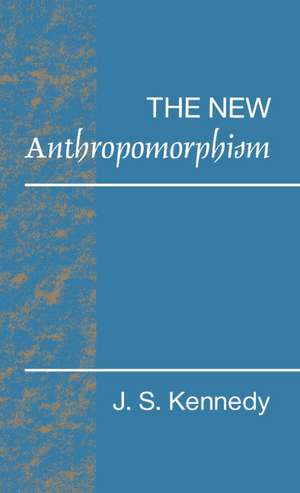
The New Anthropomorphism
Autor John S. Kennedyen Limba Engleză Paperback – 8 mar 2003
Preț: 436.98 lei
Puncte Express: 655
Carte tipărită la comandă
Livrare economică 05-19 decembrie
Livrare prin curier în România Termenul estimat este afișat lângă disponibilitate.
Transport gratuit pentru acest produs Plată online sau ramburs, în funcție de opțiunile comenzii.
Retur gratuit în 14 zile Comandă securizată și suport în română.
Specificații
ISBN-13: 9780521422673
ISBN-10: 0521422671
Pagini: 208
Ilustrații: 7 b/w illus.
Dimensiuni: 140 x 216 x 12 mm
Greutate: 0.3 kg
Ediția:New.
Editura: Cambridge University Press
Locul publicării:Cambridge, United Kingdom
ISBN-10: 0521422671
Pagini: 208
Ilustrații: 7 b/w illus.
Dimensiuni: 140 x 216 x 12 mm
Greutate: 0.3 kg
Ediția:New.
Editura: Cambridge University Press
Locul publicării:Cambridge, United Kingdom
V-ar putea interesa
-
 On AggressionKonrad LorenzPreț: 176.41 lei
 -
 Animal HomosexualityAldo PoianiPreț: 482.76 lei
 -
 An Introduction to Animal BehaviourAubrey ManningPreț: 436.16 lei
 -
 Tinbergen's LegacySimon VerhulstPreț: 443.43 lei
 -
 Social BehaviourTamás Székely-5%Preț: 470.16 lei494.90 lei
 -
 Animal Communications NetworksP. K McGregor-14%Preț: 1140.24 lei1325.86 lei
 -
 The Behavior of Animals: Mechanisms, Function And EvolutionJohan J. Bolhuis-23%Preț: 815.69 lei1059.34 lei
 -
 Essential Animal BehaviorGraham ScottPreț: 443.64 lei
 -
 Sexual ConflictGöran Arnqvist-19%Preț: 552.24 lei681.77 lei
 -
 Preț: 104.36 lei
 -
 Play, Playfulness, Creativity and InnovationPatrick Bateson-5%Preț: 302.13 lei318.04 lei
 -
 -29%Preț: 208.75 lei293.34 lei
Cuprins
1. Introduction; 2. Anthropomorphism and teleology, explicit anthropomorphism, behaviourist taboo, uniqueness of Man, consciousness, unconsciousness, compulsive anthropomorphism; 3. Instinct, nest-building, search images, language, imitation, functions as causes, imbalance; 4. Migration, purpose and goal, efference copy, motivation; 5. Intentionality, cognition, self-awareness, suffering; 6. Hierarchy, displacement, inhibition, trail-following; 7. Illusions, indulgence, neoanthropomorphism, prescription; Bibliography.
Recenzii
'Anyone interested in animal welfare should read this book.' P. J. B. Slater, Animal Welfare
'This is an important book that will encourage a more scientific study of animal behaviour.' Robert Barrass, Journal of Biological Education
'This is an important book that will encourage a more scientific study of animal behaviour.' Robert Barrass, Journal of Biological Education
Descriere
This 1992 book provides evidence that anthropomorphism (the assumption that animals think and feel as we do) still haunts the study of animal behaviour.