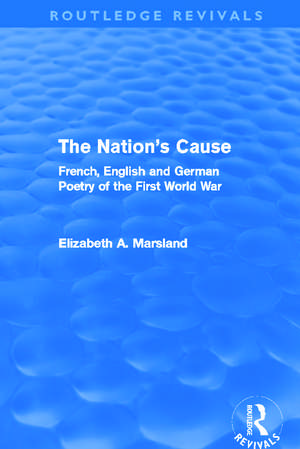
The Nation's Cause: French, English and German Poetry of the First World War: Routledge Revivals
Autor Elizabeth A. Marslanden Limba Engleză Paperback – 19 noi 2012
As well as locating the work of well-known French, English and German war poets in a European context, Elizabeth Marsland discusses lesser-known poetry of the war years, including poems by women and the neglected tradition of civilian protest through poetry. Identifying shared characteristics as well as the unique features of each nation’s poetry, The Nation’s Cause affords new insight into the relationship between nationalism and the social attitudes that determined the conduct of war.
Din seria Routledge Revivals
-
 Preț: 314.42 lei
 - 9%
 Preț: 1201.65 lei
 - 9%
 Preț: 1332.92 lei
 -
 Preț: 305.99 lei
 - 9%
 Preț: 1239.49 lei
 -
 Preț: 305.71 lei
 -
 Preț: 302.67 lei
 - 11%
 Preț: 380.39 lei
 - 9%
 Preț: 1238.95 lei
 - 9%
 Preț: 1550.67 lei
 - 9%
 Preț: 1551.75 lei
 - 9%
 Preț: 1240.14 lei
 -
 Preț: 323.78 lei
 - 14%
 Preț: 681.78 lei
 -
 Preț: 295.70 lei
 -
 Preț: 295.44 lei
 -
 Preț: 303.34 lei
 - 8%
 Preț: 440.13 lei
 -
 Preț: 230.84 lei
 - 9%
 Preț: 929.41 lei
 - 9%
 Preț: 1200.70 lei
 - 9%
 Preț: 1239.28 lei
 -
 Preț: 358.39 lei
 - 9%
 Preț: 6731.18 lei
 -
 Preț: 433.24 lei
 -
 Preț: 315.76 lei
 - 9%
 Preț: 1330.45 lei
 -
 Preț: 304.62 lei
 -
 Preț: 436.02 lei
 -
 Preț: 332.93 lei
 -
 Preț: 303.96 lei
 -
 Preț: 290.60 lei
 - 5%
 Preț: 288.05 lei
 -
 Preț: 386.04 lei
 -
 Preț: 302.85 lei
 -
 Preț: 297.57 lei
 -
 Preț: 304.27 lei
 - 14%
 Preț: 629.74 lei
 - 9%
 Preț: 970.14 lei
 - 14%
 Preț: 966.57 lei
 - 9%
 Preț: 1471.56 lei
 -
 Preț: 314.98 lei
 - 9%
 Preț: 1240.46 lei
 -
 Preț: 355.46 lei
 - 18%
 Preț: 913.42 lei
 -
 Preț: 311.44 lei
 -
 Preț: 409.52 lei
 - 9%
 Preț: 1278.19 lei
 - 9%
 Preț: 1238.95 lei
 - 9%
 Preț: 3523.24 lei
Preț: 238.07 lei
Preț vechi: 459.06 lei
-48%
Puncte Express: 357
Carte indisponibilă temporar
Doresc să fiu notificat când acest titlu va fi disponibil:
Se trimite...
Specificații
ISBN-13: 9780415696364
ISBN-10: 0415696364
Pagini: 300
Dimensiuni: 156 x 234 x 20 mm
Greutate: 0.56 kg
Ediția:1
Editura: Taylor & Francis
Colecția Routledge
Seria Routledge Revivals
Locul publicării:Oxford, United Kingdom
ISBN-10: 0415696364
Pagini: 300
Dimensiuni: 156 x 234 x 20 mm
Greutate: 0.56 kg
Ediția:1
Editura: Taylor & Francis
Colecția Routledge
Seria Routledge Revivals
Locul publicării:Oxford, United Kingdom
Cuprins
1. They all write poetry: The Poems and their Context 2. Heilig Vaterland: Nationalism and National Image 3. We Serve You Best: The Promoting of Mass Heroism 4. Cruel Thy Sword: The War Against Words 5. Laissez-les Donce Dormir: Protest Against the Heroic Ethic 6. A Few Alone: Readers, Non-Readers and Protest 7. Men Would Gather Sense: Non-Propagandist Poetry of Combatants 8. Relics for the Present: Poems and History
Descriere
As we approach the centenary of the outbreak of the First World War, this timely reissue, first published in 1991, evaluates the function of poetry in wartime Europe, arguing that war poetry must be understood as a social as well as a literary phenomenon.