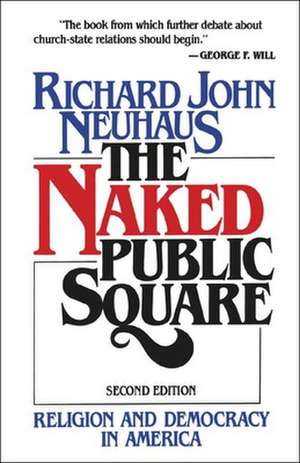
The Naked Public Square
Autor Richard John Neuhausen Limba Engleză Paperback – 2 mai 1996
Preț: 195.99 lei
Puncte Express: 294
Carte disponibilă
Livrare economică 02-16 noiembrie
Livrare prin curier în România Termenul estimat este afișat lângă disponibilitate.
Transport gratuit de la 400.00 lei Plată online sau ramburs, în funcție de opțiunile comenzii.
Retur gratuit în 14 zile Comandă securizată și suport în română.
Specificații
ISBN-13: 9780802800800
ISBN-10: 0802800807
Pagini: 296
Dimensiuni: 152 x 229 x 18 mm
Greutate: 0.48 kg
Ediția:2. Auflage
Editura: EERDMANS
Locul publicării:United States
ISBN-10: 0802800807
Pagini: 296
Dimensiuni: 152 x 229 x 18 mm
Greutate: 0.48 kg
Ediția:2. Auflage
Editura: EERDMANS
Locul publicării:United States
V-ar putea interesa
-
 Death on a Friday Afternoon Meditations on the Last Words of Jesus from the CrossRichard John NeuhausPreț: 109.99 lei
 -
 Ain't Too Proud to BegTelford WorkPreț: 179.41 lei
 -
 God, Freedom, and EvilAlvin PlantingaPreț: 90.66 lei
 -
 After Our LikenessMiroslav VolfPreț: 218.71 lei
 -
 Losing Our VirtueDavid F WellsPreț: 147.93 lei
 -
 At the Scent of WaterJ. Gerald JanzenPreț: 110.37 lei
 -
 The Melody of FaithVigen GuroianPreț: 168.26 lei
 -
 Appointment in Rome The Church in America AwakeningRichard John NeuhausPreț: 127.74 lei
 -
 UnbelievableMalcolm DuncanPreț: 71.34 lei
 -
 Unwrapping the Greatest GiftAnn VoskampPreț: 202.53 lei
Textul de pe ultima copertă
Underlying the many crises in American life, writes Richard John Neuhaus, is a crisis of faith. It is not enough that more people should believe or that those who believe should believe more strongly. Rather, the faith of persons and communities must be more compellingly related to the public arena. bThe naked public squareb--which results from the exclusion of popular values from the public forum--will almost certainly result in the death of democracy. The great challenge, says Neuhaus, is the reconstruction of a public philosophy that can undergird American life and Americabs ambiguous place in the world. To be truly democratic and to endure, such a public philosophy must be grounded in values that are based on Judeo-Christian religion. The remedy begins with recognizing that democratic theory and practice, which have in the past often been indifferent or hostile to religion, must now be legitimated in terms compatible with biblical faith.
Neuhaus explores the strengths and weaknesses of various sectors of American religion in pursuing this task of critical legitimation. Arguing that America is now engaged in an historic moment of testing, he draws upon Protestant, Catholic, and Jewish thinkers who have in other moments of testing seen that the stakes are very high--for America, for the promise of democratic freedom elsewhere, and possibly for Godbs purpose in the world.
An honest analysis of the situation, says Neuhaus, shatters false polarizations between left and right, liberal and conservative. In a democratic culture, the believerbs respect for nonbelievers is not a compromise but a requirement of the believerbs faith. Similarly, the democratic rights of those outsidethe communities of religious faith can be assured only by the inclusion of religiously-grounded values in the common life.
"The Naked Public Square" does not offer yet another partisan program for political of social change. Rather, it offers a deeply disturbing, but finally hopeful, examination of Abraham Lincolnbs century-old question--whether this nation or any nation so conceived and so dedicated can long endure.
Neuhaus explores the strengths and weaknesses of various sectors of American religion in pursuing this task of critical legitimation. Arguing that America is now engaged in an historic moment of testing, he draws upon Protestant, Catholic, and Jewish thinkers who have in other moments of testing seen that the stakes are very high--for America, for the promise of democratic freedom elsewhere, and possibly for Godbs purpose in the world.
An honest analysis of the situation, says Neuhaus, shatters false polarizations between left and right, liberal and conservative. In a democratic culture, the believerbs respect for nonbelievers is not a compromise but a requirement of the believerbs faith. Similarly, the democratic rights of those outsidethe communities of religious faith can be assured only by the inclusion of religiously-grounded values in the common life.
"The Naked Public Square" does not offer yet another partisan program for political of social change. Rather, it offers a deeply disturbing, but finally hopeful, examination of Abraham Lincolnbs century-old question--whether this nation or any nation so conceived and so dedicated can long endure.