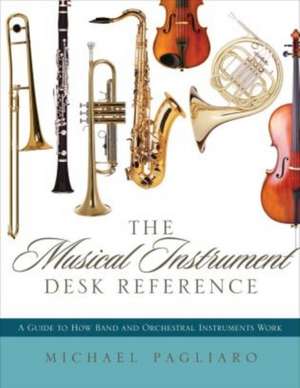
The Musical Instrument Desk Reference: A Guide to How Band and Orchestral Instruments Work
Autor Michael J. Pagliaroen Limba Engleză Hardback – 16 aug 2012
Preț: 549.57 lei
Preț vechi: 819.18 lei
-33%
Puncte Express: 824
Carte tipărită la comandă
Livrare economică 20 noiembrie-04 decembrie
Livrare prin curier în România Termenul estimat este afișat lângă disponibilitate.
Transport gratuit pentru acest produs Plată online sau ramburs, în funcție de opțiunile comenzii.
Retur gratuit în 14 zile Comandă securizată și suport în română.
Specificații
ISBN-13: 9780810882706
ISBN-10: 0810882701
Pagini: 189
Ilustrații: 93 b/w illustrations; 173 b/w photos
Dimensiuni: 226 x 290 x 17 mm
Greutate: 0.74 kg
Editura: Bloomsbury Publishing
Colecția Scarecrow Press
Locul publicării:New York, United States
ISBN-10: 0810882701
Pagini: 189
Ilustrații: 93 b/w illustrations; 173 b/w photos
Dimensiuni: 226 x 290 x 17 mm
Greutate: 0.74 kg
Editura: Bloomsbury Publishing
Colecția Scarecrow Press
Locul publicării:New York, United States
Descriere
In The Musical Instrument Desk Reference, Michael Pagliaro, musical instrument authority extraordinaire, provides the one-stop shop for those in need of a quick, visually-rich reference guide to band and orchestral instruments. Descriptions and illustrations of everything from the physics of sound to detailed discussions of each orchestra and band instrument make this work the ideal desktop reference tool for the working musician. Through its Quick Start and In Depth features, readers can quickly decide how deeply they want to delve into the instrument at hand. Following a contemporary format designed to facilitate what any musician or music instructor needs to know, The Musical Instrument Desk Reference eliminates the need to leaf through multiple method books or trawl through websites to find information.
The Musical Instrument Desk Reference includes general information on fingering, the anatomy of musical instruments, sound production, amplification, and control, as well as the science of sound. Readers will find individual chapters on woodwinds, brass instruments, non-fretted string instruments, and percussion instruments. In each category, Pagliaro delves deeper, describing for woodwinds such things as tuning, key systems, fingerings, sound production, tone holes, assembly, materials, embouchures, and reed use; for brass instruments such matters as valve systems, fingering patterns, French horn types, mouthpiece selection, and intonation; for non-fretted string instruments such issues as tuning and fingering, playing position, bowing technique, instrument parts, and materials; and for percussion instruments such elements as instrument types and their classifications, tuning procedures, and accessories.
The Musical Instrument Desk Reference is the perfect guide for anyone interested in or responsible for working with varieties of instruments and their players. Teachers, students, teachers in training, music instructors, instrument technicians, and musicians can quickly locate any specific detail related to any band or orchestral instrument.
The Musical Instrument Desk Reference includes general information on fingering, the anatomy of musical instruments, sound production, amplification, and control, as well as the science of sound. Readers will find individual chapters on woodwinds, brass instruments, non-fretted string instruments, and percussion instruments. In each category, Pagliaro delves deeper, describing for woodwinds such things as tuning, key systems, fingerings, sound production, tone holes, assembly, materials, embouchures, and reed use; for brass instruments such matters as valve systems, fingering patterns, French horn types, mouthpiece selection, and intonation; for non-fretted string instruments such issues as tuning and fingering, playing position, bowing technique, instrument parts, and materials; and for percussion instruments such elements as instrument types and their classifications, tuning procedures, and accessories.
The Musical Instrument Desk Reference is the perfect guide for anyone interested in or responsible for working with varieties of instruments and their players. Teachers, students, teachers in training, music instructors, instrument technicians, and musicians can quickly locate any specific detail related to any band or orchestral instrument.
Recenzii
At first glance, this relatively short book would appear likely to attract only a small audience, chiefly K-12 music educators who have a need for broad-based knowledge of instruments-in particular, how to maintain and repair them. And certainly they will find this book indispensable. But because, as the author states in his preface, "this manual provides important information for teachers, students, and technicians who work with musical instruments on which they are not accomplished performers," it will likely appeal to a wide variety of musical practitioners outside of those fortunate few who can make their living on performance. Pagliaro's (Everything You Should Know About Musical Instruments But Didn't Have Time To Learn) first chapter contains a layman's review of the physics of sound. Subsequent chapters cover woodwind, brass, non-fretted string instruments, and percussion. Each section begins with an "Easy Reference Quick Start" that provides illustrated information that may be needed during a lesson. This is followed by in-depth information on each instrument including illustrations and diagrams of its major parts and an analysis of how it produces sound. Also included are basic fingering charts, tuning procedures, and discussions of the various materials used to construct instruments. VERDICT This excellent title will appeal to everyone from amateur enthusiasts to veteran teachers.
It is a pleasure to read a comprehensive book on the subject of musical instruments, especially when written by an expert on the subject. Michael Pagliaro is a professor of instrumental music, founder of the Counsel of Ardsley Musical Instrument Service, and director of research and development for Contemporary Music Laboratories. His book describes in detail the anatomy of musical instruments, sound production, amplification, the finger of instruments, and the science of sound..... I highly recommend this volume to all musicologists (world music, ethno), curators of musical instruments, and instrumental performers. The volume should be housed in the reference division of all university/college libraries.
This practical guide will be of interest to music, band, and orchestra teachers or anyone else interested in learning about the operation of musical instruments. It begins with an "easy-reference quick start" section on woodwinds, followed by more in-depth chapters on the flute, clarinet, saxophone, oboe, and the bassoon. For the brass instruments, there are fingering charts, an expanded in-depth study chapter, and a chapter on functioning. Nonfretted string instruments (violin, viola, cello, and double bass) are also given a chapter on producing sound and an expanded in-depth study chapter. The final chapter consists of an overview of percussion instruments. Diagrams, photographs, and charts accent the clearly written text. Recommended for all libraries.
Today's music teachers and technicians must teach and service a wide variety of instruments: woodwind, brass, string, and percussion. Pagliaro (formerly, Marymount College/Concordia College) offers a succinct source, provides basic fingering charts, and presents basic terminology and structure for the instruments of the band or orchestra. These include assembly procedures, embouchure hints, tuning, sound production, and playing positions....Conductors of basic ensembles, particularly those in secondary schools, will find the woodwind and brass fingering charts, explanations of stringed instrument positions, and information on basic bowing useful. For more difficult alternate and chromatic fingerings, users will need to locate material in the method books for each instrument. ... Summing Up: Recommended. Libraries supporting music education departments; upper-division undergraduates and professionals/practitioners.
The book is likely to be bought by schools and colleges which specialize in music and musical performance, and by music teachers interested in having a clear and simple introduction to musical instruments - woodwind and brass, strings and percussion. ... It is useful to cover all these instruments like this, in particular for music teachers dealing with general groups of players and non-players who wonder how such instruments are played and how they produce sound.
It is a pleasure to read a comprehensive book on the subject of musical instruments, especially when written by an expert on the subject. Michael Pagliaro is a professor of instrumental music, founder of the Counsel of Ardsley Musical Instrument Service, and director of research and development for Contemporary Music Laboratories. His book describes in detail the anatomy of musical instruments, sound production, amplification, the finger of instruments, and the science of sound..... I highly recommend this volume to all musicologists (world music, ethno), curators of musical instruments, and instrumental performers. The volume should be housed in the reference division of all university/college libraries.
This practical guide will be of interest to music, band, and orchestra teachers or anyone else interested in learning about the operation of musical instruments. It begins with an "easy-reference quick start" section on woodwinds, followed by more in-depth chapters on the flute, clarinet, saxophone, oboe, and the bassoon. For the brass instruments, there are fingering charts, an expanded in-depth study chapter, and a chapter on functioning. Nonfretted string instruments (violin, viola, cello, and double bass) are also given a chapter on producing sound and an expanded in-depth study chapter. The final chapter consists of an overview of percussion instruments. Diagrams, photographs, and charts accent the clearly written text. Recommended for all libraries.
Today's music teachers and technicians must teach and service a wide variety of instruments: woodwind, brass, string, and percussion. Pagliaro (formerly, Marymount College/Concordia College) offers a succinct source, provides basic fingering charts, and presents basic terminology and structure for the instruments of the band or orchestra. These include assembly procedures, embouchure hints, tuning, sound production, and playing positions....Conductors of basic ensembles, particularly those in secondary schools, will find the woodwind and brass fingering charts, explanations of stringed instrument positions, and information on basic bowing useful. For more difficult alternate and chromatic fingerings, users will need to locate material in the method books for each instrument. ... Summing Up: Recommended. Libraries supporting music education departments; upper-division undergraduates and professionals/practitioners.
The book is likely to be bought by schools and colleges which specialize in music and musical performance, and by music teachers interested in having a clear and simple introduction to musical instruments - woodwind and brass, strings and percussion. ... It is useful to cover all these instruments like this, in particular for music teachers dealing with general groups of players and non-players who wonder how such instruments are played and how they produce sound.
Notă biografică
Michael J. Pagliaro is certified by the New York State Department of Education as a Teacher of Music (grades K-12), Supervisor of Secondary Education, Secondary School Principal, and by the New York City Board of Education as a Teacher of Orchestral Music. He holds the degrees of B.S. in Music, M.A. in Music Education, M.S. in School Administration and Supervision, and Sc.D. in Musical Instrument Technology, and has devoted over seven decade to teaching music, music education, and the technology and science of acoustic orchestral and band instruments to all levels.