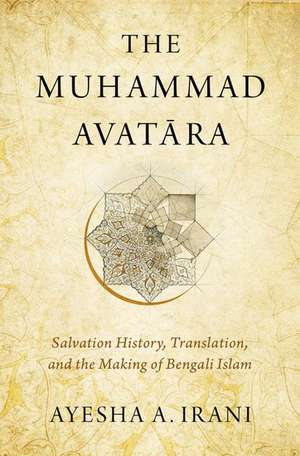
The Muhammad Avatāra: Salvation History, Translation, and the Making of Bengali Islam
Autor Ayesha A. Iranien Limba Engleză Hardback – 31 mar 2021
Preț: 730.32 lei
Preț vechi: 849.22 lei
-14%
Puncte Express: 1095
Carte disponibilă
Livrare economică 05-11 noiembrie
Livrare prin curier în România Termenul estimat este afișat lângă disponibilitate.
Transport gratuit pentru acest produs Plată online sau ramburs, în funcție de opțiunile comenzii.
Retur gratuit în 14 zile Comandă securizată și suport în română.
Specificații
ISBN-13: 9780190089221
ISBN-10: 0190089229
Pagini: 456
Dimensiuni: 236 x 157 x 33 mm
Greutate: 0.78 kg
Editura: Oxford University Press
Colecția OUP USA
Locul publicării:New York, United States
ISBN-10: 0190089229
Pagini: 456
Dimensiuni: 236 x 157 x 33 mm
Greutate: 0.78 kg
Editura: Oxford University Press
Colecția OUP USA
Locul publicării:New York, United States
Recenzii
Ayesha Irani's carefully researched study shows how a monumental Bengali epic, Saiyad Sultan's Nabīvaṃśa, became canonical for Bengali Muslims between the mid-1600s and the late 1800s, just when that community was becoming consolidated. Exploring how the epic subtly co-opted Hindu culture while simultaneously adapting the Qur'an to the culture of Bengal's rural masses, this book will be essential reading for students of both religious studies and South Asian history.
Saiyad Sultān's seventeenth century Nabīvaṃśa is the first major work in Bangla to tell the life of Muhammad as the Prophet. In a display of marvelous hermeneutic virtuosity, Irani unpacks the text's hagiographical function as a larger exercise in 'conversion history.' Sensitively utilizing an array of literary critical tools that converge in translation and polysystem theory—and tracing with unerring accuracy the text's Arabic, Persian, Sanskrit, Hindavi, and Bangla antecedents —Irani gently unravels the text's rhetorical and theological strategies. She argues that Saiyad Sultān appropriated hinduāni Bengal's religious world in order to write Bengal and Bengalis into Islamic history, making conversion a naturalizing process grounded in story, not a radical break with the past.
I have waited for a work like this for a long time. In the immense panorama of South Asian Islam, the study of Bengal has loomed as a vast territory only explored by a few intrepid scholars. The Nabīvaṃśa is clearly one of the most important textual monuments in this field, yet nonspecialists have not had any extended access to the text until now. This study presents an absorbing, detailed, and sophisticated picture of this rich literary creation and its role in the Islamization of East Bengal.
Much recommended for scholars across Religious studies, Islamic studies, South Asian studies, South-East Asian studies, Indian Ocean history, and early modern global history.
Saiyad Sultān's seventeenth century Nabīvaṃśa is the first major work in Bangla to tell the life of Muhammad as the Prophet. In a display of marvelous hermeneutic virtuosity, Irani unpacks the text's hagiographical function as a larger exercise in 'conversion history.' Sensitively utilizing an array of literary critical tools that converge in translation and polysystem theory—and tracing with unerring accuracy the text's Arabic, Persian, Sanskrit, Hindavi, and Bangla antecedents —Irani gently unravels the text's rhetorical and theological strategies. She argues that Saiyad Sultān appropriated hinduāni Bengal's religious world in order to write Bengal and Bengalis into Islamic history, making conversion a naturalizing process grounded in story, not a radical break with the past.
I have waited for a work like this for a long time. In the immense panorama of South Asian Islam, the study of Bengal has loomed as a vast territory only explored by a few intrepid scholars. The Nabīvaṃśa is clearly one of the most important textual monuments in this field, yet nonspecialists have not had any extended access to the text until now. This study presents an absorbing, detailed, and sophisticated picture of this rich literary creation and its role in the Islamization of East Bengal.
Much recommended for scholars across Religious studies, Islamic studies, South Asian studies, South-East Asian studies, Indian Ocean history, and early modern global history.
Notă biografică
Ayesha A. Irani is Associate Professor of Asian Studies at the University of Massachusetts Boston
Cuprins
- Acknowledgments
- A Note on Transliteration and Other Conventions
- A Map of Medieval Bengal and Arakan
- 1. The Prophet of Light and Love: N¿r Muhammad in Bengal's Mirror
- A Historical Overview of Cä¿agr¿ma
- Islamic Bangla Literature and Islamization
- Literary Portraits of the Author
- Inscribing Islam in the Bengali Religious Landscape
- N¿r Muhammad as the Ontological Principle of Light and Love
- The Islamic Cosmogony of Om¿
- Later Developments in Islamic Bengali Cosmogonical Discourse
- Cosmogony, Translation, and Conversion
- 2. Text, Author, and Authority: The Nab¿vä¿a and the Making of Islamic Community
- Genre and Performance
- The Structure of the Nab¿vä¿a's Salvation History
- The Critical Edition of the Nab¿vä¿a vis-à-vis the Manuscript Tradition
- Author and Authority in the Making of Islamic Community
- 3. Translation and the Historiographic Process: The Work of a Text in the Making of Bengali Islam
- The Terms of Translation
- Translation as Qur¿¿nic Exegesis
- The Representation and Transculturation of Musalm¿ni and Hindu¿ni Traditions
- Translation as Entextualizing Conversion
- A Hermeneutic Model of Muslim Missionary Translation
- Frontier Literature
- 4. A New Prophetology for Bengal: Pur¿¿a- Kor¿n Salvation History
- An Indo- Islamic Salvation History for Bengal
- The Original Couple, M¿ric- M¿rij¿t or ¿iva- P¿rvat¿
- The Pur¿¿ic Predecessors of ¿dam
- The Account of ¿dam, the First Man
- Righteous ¿i¿ and Islam's Triumph over Hindu¿ni Adharma
- Evil Iblis as Primal Guru of the Hindu¿ni Clans
- Translation as Renewal, Subversion, and Manipulation
- 5. Hari the Fallen Prophet: An Avat¿ra's Descent into Disgrace
- In the Shadow of Gau¿¿ya Vai¿¿avism
- Recasting the Acts of Kr¿¿¿a
- The Polemics of the Tale of Kr¿¿¿a
- An Islamic Reappraisal of Vai¿¿ava Theology
- Messianic Intersections of the Avat¿ra and Nab¿
- Missionary Translation as Creative Iconoclasm
- 6. Ascension and Ascendancy: Constructing the Prophet for Bengal
- The Nab¿vä¿a's Ascension Narrative in the Perso- Turkic Mi¿r¿j Tradition
- The Prophet as God's Beloved
- The Prophet as Perfect Phakir
- The Prophet as Intercessor
- The Historiographer and Legitimation
- Conclusion: Historiography, Translation, and Conversion
- Appendix: Distribution of Manuscripts of the NV in Various Bangladeshi Archives
- Works Cited
- Index