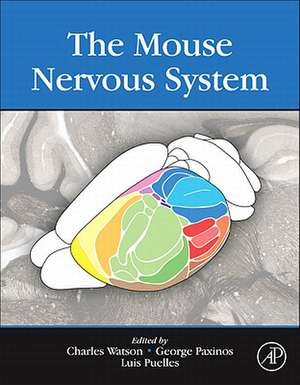
The Mouse Nervous System
Editat de Charles Watson, George Paxinos, Luis Puellesen Limba Engleză Hardback – 23 noi 2011
- Systematic consideration of the anatomy and connections of all regions of the brain and spinal cord by the authors of the most cited rodent brain atlases
- A major section (12 chapters) on functional systems related to motor control, sensation, and behavioral and emotional states
- A detailed analysis of gene expression during development of the forebrain by Luis Puelles, the leading researcher in this area
- Full coverage of the role of gene expression during development and the new field of genetic neuroanatomy using site-specific recombinases
- Examples of the use of mouse models in the study of neurological illness
Preț: 1290.29 lei
Preț vechi: 1710.68 lei
-25%
Puncte Express: 1935
Carte tipărită la comandă
Livrare economică 30 noiembrie-14 decembrie
Livrare prin curier în România Termenul estimat este afișat lângă disponibilitate.
Transport gratuit pentru acest produs Plată online sau ramburs, în funcție de opțiunile comenzii.
Retur gratuit în 14 zile Comandă securizată și suport în română.
Specificații
ISBN-13: 9780123694973
ISBN-10: 0123694973
Pagini: 814
Dimensiuni: 216 x 276 x 46 mm
Greutate: 2.51 kg
Editura: ELSEVIER SCIENCE
ISBN-10: 0123694973
Pagini: 814
Dimensiuni: 216 x 276 x 46 mm
Greutate: 2.51 kg
Editura: ELSEVIER SCIENCE
V-ar putea interesa
-
 The Brain: An Introduction to Functional NeuroanatomyCharles Watson-21%Preț: 354.56 lei450.35 lei
 -
 The Biology and Conservation of Wild CanidsDavid W. Macdonald-30%Preț: 548.87 lei780.98 lei
 -
 Otters: ecology, behaviour and conservationHans Kruuk-24%Preț: 572.90 lei753.87 lei
 -
 Wolves: Behavior, Ecology, and ConservationL. David MechPreț: 294.66 lei
 -
 Sperm Whales: Social Evolution in the OceanHal WhiteheadPreț: 383.80 lei
 -
 Evolution of Tertiary Mammals of North AmericaChristine M. Janis-14%Preț: 980.54 lei1140.17 lei
 -
 The Thalamus 2 Volume Hardback SetEdward G Jones-23%Preț: 5483.31 lei7121.18 lei
Public țintă
Neuroscientists, neuropathologists, neurologists, graduate students in neuroscience, and medical students.Cuprins
Section A - Development
Genetic regionalisation morphogenesis
Gene targeting
Genetic neuoanatomy
Section B - Structure
Neocortex
Hippocampus
Piriform cortex
Subpallial structures
Hypothalamus
Diencephalon
Midbrain
Cerebellum
Hindbrain
Spinal cord
Vascular supply
Imaging techniques
Section C - Motor and Sensory Systems
Motor nuclei of the cranial nerves
Visceral motoneurons
Neurosecretory nuclei of the hypothalamus and preoptic area
Cortical structures in motor control
Hypothalamic goal directed behavior
Subpallial structures
Somatosensory
Gustatory
Pain
Auditory
Visual
Olefactory
Vestibular
Section D - Behavioral States
Basal nucleus of Meynert
Section E - Emotional States
Introduction to emotional states
Orbitofrontal coretex
Section F - Mouse Models of Mental Illness and Neurological Disease
Overview of mouse models
Huntington's
Drug addictions
Genetic regionalisation morphogenesis
Gene targeting
Genetic neuoanatomy
Section B - Structure
Neocortex
Hippocampus
Piriform cortex
Subpallial structures
Hypothalamus
Diencephalon
Midbrain
Cerebellum
Hindbrain
Spinal cord
Vascular supply
Imaging techniques
Section C - Motor and Sensory Systems
Motor nuclei of the cranial nerves
Visceral motoneurons
Neurosecretory nuclei of the hypothalamus and preoptic area
Cortical structures in motor control
Hypothalamic goal directed behavior
Subpallial structures
Somatosensory
Gustatory
Pain
Auditory
Visual
Olefactory
Vestibular
Section D - Behavioral States
Basal nucleus of Meynert
Section E - Emotional States
Introduction to emotional states
Orbitofrontal coretex
Section F - Mouse Models of Mental Illness and Neurological Disease
Overview of mouse models
Huntington's
Drug addictions
Recenzii
A mouse may appear insignificant due to its small size, but its complex nervous system has played a significant role in neuroscience studies. Such a system is intricate enough for a book, the thickness of 4 adult mice lying on top of one another, to be written about it. There were three main reasons for such a book: it would serve as an introductory guide to neuroscience for molecular biologists, provide insight on the new discoveries of gene expression, and highlight that mice are unique as compared to the more commonly studied rats. The Mouse Nervous System, edited by Charles Watson, George Paxinos, and Luis Puelles, does just that by thoroughly venturing through the crevices of the central nervous system of the mouse.
To the general public, the mouse brain may appear to be a simple chunk of mass, but neurologists and anatomists would beg to differ. This book, having been composed by professionals in the fields of neurology and anatomy, shows how complicated the mouse brain actually is. Of the 33 chapters devoted to the anatomy of the mouse brain, the first three are about its stages of development. These earlier chapters also include past experiments which provide support for the facts about development. For more than half of the book, from chapter four until chapter fifteen, the structure of the brain is presented as a whole and then as individual parts. Thus, the text and real life anatomy figures both serve as dissections of the mouse brain. Furthermore, images throughout the book are useful and relevant not only to those who learn from viewing pictures but also serve as supplemental information for those who learn from reading text.
After introducing the reader to the fundamentals of the mouse brain, the systems and their respective functions are presented in chapters 16 through 27. With most important information already provided in the first half of the book, these later chapters serve to assist the reader in connecting the dots on how all those structures function together. In addition to providing background knowledge about the nervous system of the mouse, this book is also user-friendly because a table of contents that is chapter-specific is present at the beginning of each respective chapter. The helpfulness continues at the conclusion of chapters where a list of references is presented so the reader can read more about an intriguing subject. Perhaps the most unique feature of this book is the abbreviations list which is located near the end of certain chapters. This list is beneficial to both the writers and readers; the writers can provide the intended definitions which will lessen the likelihood that the reader searches and finds an inaccurate abbreviation.
A textbook of this size is expected to contain an abundance of information about the nervous system of the mouse, which it does. Although its content is focused on an audience of molecular biologists and neuroscientists, the cleverly organized layout offers enough background knowledge for any reader to be able to understand the later chapters when human diseases, using the mouse brain as a model, are discussed. This book is highly recommended for someone striving to learn about the mouse nervous system in great detail.—Katalina J. Sher, Jack W. Tsao
Department of Neurology, Uniformed Services University of the Health Services
To the general public, the mouse brain may appear to be a simple chunk of mass, but neurologists and anatomists would beg to differ. This book, having been composed by professionals in the fields of neurology and anatomy, shows how complicated the mouse brain actually is. Of the 33 chapters devoted to the anatomy of the mouse brain, the first three are about its stages of development. These earlier chapters also include past experiments which provide support for the facts about development. For more than half of the book, from chapter four until chapter fifteen, the structure of the brain is presented as a whole and then as individual parts. Thus, the text and real life anatomy figures both serve as dissections of the mouse brain. Furthermore, images throughout the book are useful and relevant not only to those who learn from viewing pictures but also serve as supplemental information for those who learn from reading text.
After introducing the reader to the fundamentals of the mouse brain, the systems and their respective functions are presented in chapters 16 through 27. With most important information already provided in the first half of the book, these later chapters serve to assist the reader in connecting the dots on how all those structures function together. In addition to providing background knowledge about the nervous system of the mouse, this book is also user-friendly because a table of contents that is chapter-specific is present at the beginning of each respective chapter. The helpfulness continues at the conclusion of chapters where a list of references is presented so the reader can read more about an intriguing subject. Perhaps the most unique feature of this book is the abbreviations list which is located near the end of certain chapters. This list is beneficial to both the writers and readers; the writers can provide the intended definitions which will lessen the likelihood that the reader searches and finds an inaccurate abbreviation.
A textbook of this size is expected to contain an abundance of information about the nervous system of the mouse, which it does. Although its content is focused on an audience of molecular biologists and neuroscientists, the cleverly organized layout offers enough background knowledge for any reader to be able to understand the later chapters when human diseases, using the mouse brain as a model, are discussed. This book is highly recommended for someone striving to learn about the mouse nervous system in great detail.—Katalina J. Sher, Jack W. Tsao
Department of Neurology, Uniformed Services University of the Health Services