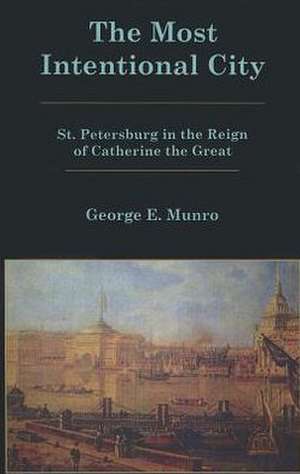
The Most Intentional City: St. Petersburg in the Reign of Catherine the Great
Autor George E. Munroen Limba Engleză Paperback – 13 aug 2012
The Most Intentional City is based extensively on unused archival sources from central archives in St. Petersburg and Moscow as well as regional archives and manuscript collections. These are flavored with published accounts by Russians as well as foreign residents and visitors from a number of countries, including Great Britain, France, the Netherlands, Italy, and various German states. The rich secondary literature, especially that produced by Russian and Soviet scholars, adds to the interpretation.
It is said that the first wife of Peter the Great once placed a curse on Peter's new city: "May Petersburg be empty!" The city's detractors over the centuries have enumerated many reasons why the city never should have been established and why it should not have grown. Yet grow it did. No other city in the world situated so far north (almost on the sixtieth parallel) is more than a fifth its size. In Catherine's reign the city assumed the vitality, the social and economic strength, and the identity in myth and legend that assured that the curse pronounced against it would remain unfulfilled. The Most Intentional City reveals how it all took place.
Preț: 332.39 lei
Preț vechi: 470.72 lei
-29%
Puncte Express: 499
Carte tipărită la comandă
Livrare economică 08-22 iunie
Specificații
ISBN-13: 9781611475845
ISBN-10: 1611475848
Pagini: 372
Dimensiuni: 151 x 228 x 27 mm
Greutate: 0.58 kg
Editura: Bloomsbury Publishing
Colecția Fairleigh Dickinson University Press
Locul publicării:New York, United States
ISBN-10: 1611475848
Pagini: 372
Dimensiuni: 151 x 228 x 27 mm
Greutate: 0.58 kg
Editura: Bloomsbury Publishing
Colecția Fairleigh Dickinson University Press
Locul publicării:New York, United States
Recenzii
This book's 10 chapters begin by providing background on St. Petersburg (founded in 1703) until the beginning of Catherine II's reign (1762) and end with a look at it at the conclusion of her rule (1796). They are followed by a chapter on the capital's impact on the rest of Russia and a conclusion. In between, Munro examines in thorough detail the city during Catherine's reign, especially its demographic and social developments, its administration, and its commerce and industry. The author's chief conclusion is that Catherine II attempted to thoroughly regulate and develop the capital for the good of the state and oversaw many changes in this, her favorite city, but that 'in the final analysis the city took on a life and will of its own' (p. 281). The czarist government in the years following Catherine's reign would also discover how difficult it was to control urbanization. This is a scholarly work based on thorough archival and other types of research and contains over 80 pages of endnotes, bibliography, and index. There are also useful maps, charts, and graphs. Summing Up: Recommended.
Munro. has written a fine, well-structured account of the physical face and internal life of Imperial Russia's capital city during the third of a century when it was the residence of, and governed by, Catherine II. While he attempts to resolve old debates in Russia's urban history, a principal theme is a reaffirmation of her 1770 comment that 'she found St. Petersburg built of wood and would leave it dressed in marble.' Having previously published widely on the laws and economic life of 18th century Russia, the author can marshal much secondary literature and impressive archival research to emphasize those arenas within a multi-faceted portrait of the city. Individual chapters describe its population and social structure, its administration in law and practice, the provisioning of its inhabitants, its commercial links to the Russian hinterland and to the outside world, industrial production within its boundaries, and urban planning and construction. A thoughtful epilogue considers alien Petersburg in the context of Russian thought and imagery. The tone is sober, detailed, and serious. Professor Munro has contributed an essential chapter to the oft-neglected urban history of modern Russia.
[Munro] has produced a work that reflects not only a deep love and reverence for the city [of St. Petersburg], but, more importantly, his patient and ultimately successful grappling with a mountain of printed and archival sources. .It is a study shaped like a sandwich: two excellent slices, presenting an overall view of the city in 1761 (ch. 1) and in 1795 (ch. 9), enclose a generous and satisfying filling of seven intervening chapters. These chapters are devoted to thoroughgoing analyses of, in order, population and social mix, urban administration on paper and in practice, commerce, and industry. Each represents a major research triumph, a sifting of vast and frequently conflicting data, and a convincing presentation, bolstered by graphs and tables and maps.Munro's achievement is considerable and confirms his reputation as a major scholar of eighteenth-century Russia.
The book begins with an enjoyable progulka through the residential, commercial, industrial, and governmental sections of the city before 1762. Near the end of the book, another progulka, this time in 1796, dramatically underscores the complete transformation of St. Petersburg, both topographically and architecturally. The chapters in between deftly itemize the elements that contributed to its becoming Russia's major city and the seventh largest in Europe. .Munro's study is a welcome addition to the literature on one of the great cities of the eighteenth-century world.
Munro succeeds in demonstrating that St. Petersburg took on a life and will of its own, undergoing not simply growth but true urbanization, and influencing even rural Russia with new ideas, technology, and economic activities. And this development resulted not primarily from imperial edicts but from the underlying social and economic realities that Munro examines. This well-documented challenge to statist analysis would be beneficial for graduate students as well as advanced undergraduates.
Munro has been working on this study for many years, and his thoroughly researched and well-written monograph enhances our understanding of the values and objectives of Catherine the Great while providing exceptional detail for those interested in the history of imperial Russia's great capital.
Munro. has written a fine, well-structured account of the physical face and internal life of Imperial Russia's capital city during the third of a century when it was the residence of, and governed by, Catherine II. While he attempts to resolve old debates in Russia's urban history, a principal theme is a reaffirmation of her 1770 comment that 'she found St. Petersburg built of wood and would leave it dressed in marble.' Having previously published widely on the laws and economic life of 18th century Russia, the author can marshal much secondary literature and impressive archival research to emphasize those arenas within a multi-faceted portrait of the city. Individual chapters describe its population and social structure, its administration in law and practice, the provisioning of its inhabitants, its commercial links to the Russian hinterland and to the outside world, industrial production within its boundaries, and urban planning and construction. A thoughtful epilogue considers alien Petersburg in the context of Russian thought and imagery. The tone is sober, detailed, and serious. Professor Munro has contributed an essential chapter to the oft-neglected urban history of modern Russia.
[Munro] has produced a work that reflects not only a deep love and reverence for the city [of St. Petersburg], but, more importantly, his patient and ultimately successful grappling with a mountain of printed and archival sources. .It is a study shaped like a sandwich: two excellent slices, presenting an overall view of the city in 1761 (ch. 1) and in 1795 (ch. 9), enclose a generous and satisfying filling of seven intervening chapters. These chapters are devoted to thoroughgoing analyses of, in order, population and social mix, urban administration on paper and in practice, commerce, and industry. Each represents a major research triumph, a sifting of vast and frequently conflicting data, and a convincing presentation, bolstered by graphs and tables and maps.Munro's achievement is considerable and confirms his reputation as a major scholar of eighteenth-century Russia.
The book begins with an enjoyable progulka through the residential, commercial, industrial, and governmental sections of the city before 1762. Near the end of the book, another progulka, this time in 1796, dramatically underscores the complete transformation of St. Petersburg, both topographically and architecturally. The chapters in between deftly itemize the elements that contributed to its becoming Russia's major city and the seventh largest in Europe. .Munro's study is a welcome addition to the literature on one of the great cities of the eighteenth-century world.
Munro succeeds in demonstrating that St. Petersburg took on a life and will of its own, undergoing not simply growth but true urbanization, and influencing even rural Russia with new ideas, technology, and economic activities. And this development resulted not primarily from imperial edicts but from the underlying social and economic realities that Munro examines. This well-documented challenge to statist analysis would be beneficial for graduate students as well as advanced undergraduates.
Munro has been working on this study for many years, and his thoroughly researched and well-written monograph enhances our understanding of the values and objectives of Catherine the Great while providing exceptional detail for those interested in the history of imperial Russia's great capital.