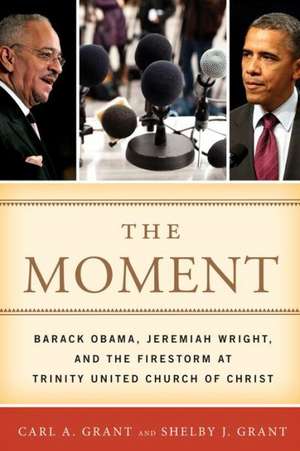
The Moment: Barack Obama, Jeremiah Wright, and the Firestorm at Trinity United Church of Christ
Autor Carl A. Grant, Shelby J. Granten Limba Engleză Hardback – 25 oct 2012
The Moment tells the inside story of Trinity UCC during this time of turmoil. Carl and Shelby Grant describe "the Moment" as it unfolded, from Wright's first appearances in the media to Obama's resignation from Trinity Church. They also provide helpful background information, including general history of the black church, African American immigration to Chicago, and black politics in the Windy City. In this context, the voices of Trinity UCC members come alive to show the impact of "the Moment" within and beyond the presidential election, illustrating the thorny intersections of religion, race, politics, and the media in the United States.
Preț: 343.68 lei
Preț vechi: 508.22 lei
-32%
Puncte Express: 516
Carte tipărită la comandă
Livrare economică 19 noiembrie-03 decembrie
Livrare prin curier în România Termenul estimat este afișat lângă disponibilitate.
Transport gratuit de la 400.00 lei Plată online sau ramburs, în funcție de opțiunile comenzii.
Retur gratuit în 14 zile Comandă securizată și suport în română.
Specificații
ISBN-13: 9781442219977
ISBN-10: 1442219971
Pagini: 196
Dimensiuni: 159 x 236 x 19 mm
Greutate: 0.42 kg
Ediția:New.
Editura: Bloomsbury Publishing
Colecția Rowman & Littlefield
Locul publicării:New York, United States
ISBN-10: 1442219971
Pagini: 196
Dimensiuni: 159 x 236 x 19 mm
Greutate: 0.42 kg
Ediția:New.
Editura: Bloomsbury Publishing
Colecția Rowman & Littlefield
Locul publicării:New York, United States
Cuprins
Authors' Note
Introduction
Prologue
1: Back to The Moment
2: Race, Migration, and Politics in the Windy City
3: The African American church in Chicago
4: Trinity United Church of Christ
5: The Unheard Voices of Trinity Church Speak
Epilogue
Appendix: Interview Questions
Notes
Introduction
Prologue
1: Back to The Moment
2: Race, Migration, and Politics in the Windy City
3: The African American church in Chicago
4: Trinity United Church of Christ
5: The Unheard Voices of Trinity Church Speak
Epilogue
Appendix: Interview Questions
Notes
Recenzii
In 2008, the media broadcast snippets from the sermons of the Reverend Jeremiah Wright, pastor of the church Barack Obama had attended for many years, in which he was heard to say "God damn America" and appeared to suggest the United States had brought the attacks of 9/11 on itself. The ensuing furor resulted in Obama publicly leaving Trinity Church, a move many believe saved his presidential candidacy. Messrs. Grant recount the media frenzy, question the adequacy and forthrightness of its coverage, and adjure the reader to go beyond the sound bites and listen to the complete sermons. They trace the historical development of African American churches-places that nurture dreams of freedom and equality for marginalized communities-and highlight the preacher's role, inflammatory at times, in demanding justice. Finally, they allow members of Trinity's congregation to share their views on the controversy, Reverend Wright, and Obama's decision to leave. This is a worthwhile book simply because it presents a side of the story-more complicated than it might seem-many have likely not yet heard.
While the world was hearing about Rev. Jeremiah Wright and his potential spiritual and perhaps political influence on then presidential candidate Barack Obama, the voices of Rev. Wright's parishioners were silent. They have found their voices in The Moment with the help of Carl and Shelby Grant. For those who wondered about the parishioners of Trinity UCC church, wonder no more. A must-read for the curious and those who want to know more than the media presentation regarding this moment.
By placing the story of Barack Obama and the Trinity Church within the histories of Black enslavement, migration and community development, the authors do a superb job of unraveling the rich layers of 'the moment' with a keen analysis of the enduring and contentious relationship between African American communities and US racial ideology.
The spectacle that was made of Jeremiah Wright and Barack Obama in 2008 reveals far more about ourselves than about those two individuals. Drawing on history, media, and the voices of Trinity Church members, Carl and Shelby Grant paint a stunning and troubling picture that historicizes Black churches, city politics, and community formations to help us understand the insidious nature of racial politics in the United States today. This book names The Moment in ways that forever change our lenses for doing so.
This volume opens the door to a wealth of insights related to a form of Black church life, politics, and the lived experiences of Chicago's South Siders. The examination of the thoughts and perspectives of Trinity's congregants is timely in light of the 2012 presidential election and important as a future guidepost for generations to come.
The Moment powerfully documents an often forgotten aspect of racial politics in the U.S.-the voices of the community. Grant and Grant offer a stunning counter narrative of the confluence of race, theology, class, ideology, history and media within the 2008 ascendancy of Barack Obama.
This narrative speaks to the lives and souls of a Black community and its most powerful institution-the Black church. Grant and Grant provide a history ignored by the media, and in doing so, reveal the story that needed to be told. Through the voices of the Trinitarians, Grant and Grant reveal a belief that the 'media firestorm' was larger than the Wright and Obama relationship. There were those that believed they were witnessing an attack by the white power structure on their most essential and sacred institution. The book may move us closer to having that conversation about a post-racial society-such a conversation is clearly well overdue.
Revives a hot controversy during the 2008 presidential election. After relating the story of the 2008 political crisis over the fiery preacher's words and Obama's leaving the church (and the intense media coverage), the authors stand back to provide some context of Black migration north and the role of churches in that population.
At a critical juncture during the 2008 primary elections, in which then-Senator Barack Obama emerged as the front-runner for the Democratic Party, the seemingly unstoppable momentum he had generated since the Iowa caucus stalled. His former minister, the formidable Jeremiah Wright, had made a series of controversial remarks, raising questions about the minister's patriotism. Obama, the first viable African American presidential candidate, likely could have ridden out the political firestorm Wright created. Instead, Obama's handlers encouraged him to deliver a forceful address that addressed issues of race in the 21st-century US; he also used the speech to sever his relationship with Wright. Carl (education, Univ. of Wisconsin-Madison) and Shelby (teacher) Grant, two churchgoers from Wright's congregation, provide many layers of historical and sociological contexts. They explore the impact of the Great Migration and the emergence of the black church and provide interviews with several charter members of Trinity United Church of Christ. Not surprisingly, they arrive at a much more nuanced understanding of Wright's role in liberation theology and Chicago's black church. The book's most powerful and enduring lesson will be to not place great reliance on any one sound bite. Summing Up: Recommended. Undergraduates, graduates, researchers
While the world was hearing about Rev. Jeremiah Wright and his potential spiritual and perhaps political influence on then presidential candidate Barack Obama, the voices of Rev. Wright's parishioners were silent. They have found their voices in The Moment with the help of Carl and Shelby Grant. For those who wondered about the parishioners of Trinity UCC church, wonder no more. A must-read for the curious and those who want to know more than the media presentation regarding this moment.
By placing the story of Barack Obama and the Trinity Church within the histories of Black enslavement, migration and community development, the authors do a superb job of unraveling the rich layers of 'the moment' with a keen analysis of the enduring and contentious relationship between African American communities and US racial ideology.
The spectacle that was made of Jeremiah Wright and Barack Obama in 2008 reveals far more about ourselves than about those two individuals. Drawing on history, media, and the voices of Trinity Church members, Carl and Shelby Grant paint a stunning and troubling picture that historicizes Black churches, city politics, and community formations to help us understand the insidious nature of racial politics in the United States today. This book names The Moment in ways that forever change our lenses for doing so.
This volume opens the door to a wealth of insights related to a form of Black church life, politics, and the lived experiences of Chicago's South Siders. The examination of the thoughts and perspectives of Trinity's congregants is timely in light of the 2012 presidential election and important as a future guidepost for generations to come.
The Moment powerfully documents an often forgotten aspect of racial politics in the U.S.-the voices of the community. Grant and Grant offer a stunning counter narrative of the confluence of race, theology, class, ideology, history and media within the 2008 ascendancy of Barack Obama.
This narrative speaks to the lives and souls of a Black community and its most powerful institution-the Black church. Grant and Grant provide a history ignored by the media, and in doing so, reveal the story that needed to be told. Through the voices of the Trinitarians, Grant and Grant reveal a belief that the 'media firestorm' was larger than the Wright and Obama relationship. There were those that believed they were witnessing an attack by the white power structure on their most essential and sacred institution. The book may move us closer to having that conversation about a post-racial society-such a conversation is clearly well overdue.
Revives a hot controversy during the 2008 presidential election. After relating the story of the 2008 political crisis over the fiery preacher's words and Obama's leaving the church (and the intense media coverage), the authors stand back to provide some context of Black migration north and the role of churches in that population.
At a critical juncture during the 2008 primary elections, in which then-Senator Barack Obama emerged as the front-runner for the Democratic Party, the seemingly unstoppable momentum he had generated since the Iowa caucus stalled. His former minister, the formidable Jeremiah Wright, had made a series of controversial remarks, raising questions about the minister's patriotism. Obama, the first viable African American presidential candidate, likely could have ridden out the political firestorm Wright created. Instead, Obama's handlers encouraged him to deliver a forceful address that addressed issues of race in the 21st-century US; he also used the speech to sever his relationship with Wright. Carl (education, Univ. of Wisconsin-Madison) and Shelby (teacher) Grant, two churchgoers from Wright's congregation, provide many layers of historical and sociological contexts. They explore the impact of the Great Migration and the emergence of the black church and provide interviews with several charter members of Trinity United Church of Christ. Not surprisingly, they arrive at a much more nuanced understanding of Wright's role in liberation theology and Chicago's black church. The book's most powerful and enduring lesson will be to not place great reliance on any one sound bite. Summing Up: Recommended. Undergraduates, graduates, researchers