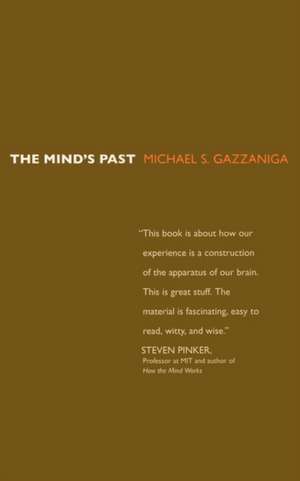
The Mind′s Past
Autor Michael Gazzanigaen Limba Engleză Paperback – 2 oct 2000
În această ediție revizuită a lucrării The Mind′s Past, Michael Gazzaniga aduce în prim-plan o perspectivă provocatoare asupra neuroștiinței cognitive: ideea că suntem „ultimii care află” ce se petrece în propriul creier. Considerăm că noutatea fundamentală a acestui volum rezidă în explicarea mecanismului de interpretare automată, acel „interpret” intern care transformă procesele neurologice brute în narațiuni coerente, dar adesea fictive, despre sine și realitate. Spre deosebire de literatura clasică ce tratează conștiința ca pe un centru de control, Michael Gazzaniga demonstrează că majoritatea acțiunilor noastre sunt rezultatul unor circuite înnăscute, lăsând mintea conștientă să fabrice explicații post-factum.
Descoperim aici o analiză riguroasă a modului în care biologia dictează cultura. Autorul extinde ideea lui William James, argumentând că omul este dotat cu mai multe instincte decât orice alt animal, aceste circuite fiind active încă de la naștere pentru a procesa lumea fizică și socială. Găsim în text o demontare sistematică a acurateței memoriei; ceea ce numim „trecut” este, în esență, o construcție plină de erori de percepție și judecată. Lucrarea acoperă aceeași arie tematică precum A New Theory of Mind, dar cu o abordare mult mai ancorată în neurobiologia experimentală, punând accent pe sistemele automate ale creierului, spre deosebire de focusul pe transcendența prin narațiune din titlul menționat. De asemenea, dacă Pieces of Light de Charles Fernyhough se concentrează pe natura reconstructivă a memoriei prin povești umane, The Mind′s Past oferă cadrul teoretic și biologic care explică de ce creierul este forțat evolutiv să creeze aceste povești pentru a supraviețui.
Preț: 200.30 lei
Carte tipărită la comandă
Livrare economică 11-25 august
Specificații
ISBN-10: 0520224868
Pagini: 222
Dimensiuni: 127 x 202 x 15 mm
Greutate: 0.23 kg
Ediția:Revised
Editura: University of California Press
V-ar putea interesa
-
 Psychological ScienceElizabeth A. Phelps-14%Preț: 1061.69 lei1234.53 lei
 -
 Preț: 115.00 lei
 -
 Who's in Charge?: Free Will and the Science of the BrainMichael Gazzaniga-28%Preț: 65.96 lei91.71 lei
 -
 François Arago 2e ÉditionAlbert LévyPreț: 77.92 lei
 -
 Preț: 176.58 lei
 -
 Preț: 133.18 lei
 -
 Introduction à l'étude de la métallurgieLe Chatelier-HPreț: 238.77 lei
 -
 Preț: 77.09 lei
 -
 Preț: 184.39 lei
 -
 Preț: 165.11 lei
 -
 Preț: 119.60 lei
De ce să citești această carte
Recomandăm această carte oricărui cititor pasionat de psihologie și neuroștiințe care dorește să înțeleagă de ce percepțiile noastre sunt adesea iluzii. Michael Gazzaniga oferă o explicație clară asupra modului în care creierul ne construiește identitatea, transformând procese biologice complexe în termeni accesibili. Veți câștiga o perspectivă nouă asupra propriei memorii și a modului în care instinctele ne ghidează viața socială fără să realizăm.