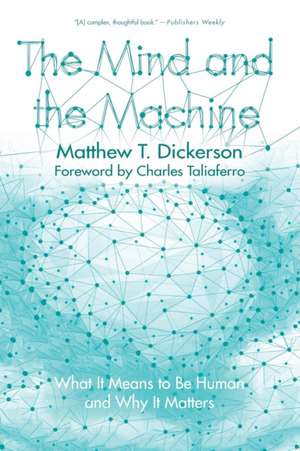
The Mind and the Machine
Autor Matthew T. Dickersonen Limba Engleză Paperback – 29 iul 2016
În centrul lucrării The Mind and the Machine se află o interogație fundamentală pentru era digitală: este mintea umană doar un software complex rulat pe un suport biologic, sau există o dimensiune care transcende mecanicul? Observăm cum Matthew T. Dickerson, profesor de informatică, demontează cu rigoare premisa că suntem simple mașini biochimice într-un univers materialist închis. Autorul analizează critic lucrările unor figuri precum Daniel Dennett sau Raymond Kurzweil, oferind o perspectivă rară ce îmbină expertiza tehnică în sisteme computaționale cu filozofia creștină. Descoperim aici o structură argumentativă în cinci puncte împotriva fizicalismului, prin care Dickerson avertizează că reducerea omului la stadiul de mașină anulează concepte vitale precum liberul arbitru, creativitatea și responsabilitatea ecologică. În loc să rămână la o critică defensivă, el propune „dualismul integrativ” — un model care nu neagă importanța proceselor fizice, ci le integrează într-o viziune în care spiritul rămâne o realitate ontologică distinctă. Comparabil cu Consciousness and the Mind of God de Charles Taliaferro în rigurozitatea cu care apără o teorie non-materialistă a persoanei, volumul lui Dickerson este actualizat pentru provocările specifice ale secolului XXI, precum ideea descărcării conștiinței în computere. În contextul operei sale, această carte reprezintă o sinteză teoretică a temelor explorate în lucrări precum Ents, Elves, and Eriador, unde analiza lumilor lui Tolkien servea ca punct de plecare pentru reflecții despre natură și spirit. Dacă în scrierile anterioare abordarea era mai degrabă narativă sau ecologică, aici Dickerson oferă fundamentul filozofic și computațional necesar pentru a înțelege de ce demnitatea umană nu poate fi redusă la algoritmi.
Preț: 176.68 lei
Carte disponibilă
Livrare economică 14-28 noiembrie
Specificații
ISBN-10: 1498203841
Pagini: 242
Dimensiuni: 152 x 229 x 15 mm
Greutate: 0.4 kg
Editura: CASCADE BOOKS
V-ar putea interesa
-
 A ConfessionLeo TolstoyPreț: 55.44 lei
 -
 Of Human FreedomEpictetus-21%Preț: 44.70 lei56.30 lei
 -
 A Review of the Principal Questions in MoralsRichard Price-30%Preț: 353.40 lei503.06 lei
 -
 -30%Preț: 701.74 lei1001.92 lei
 -
 Oxford Studies in Ancient Philosophy, Volume 38Brad Inwood-22%Preț: 374.34 lei482.66 lei
 -
 Oxford Studies in Metaethics, Volume 5Russ Shafer-Landau-22%Preț: 361.78 lei466.00 lei
 -
 -24%Preț: 389.41 lei509.87 lei
 -
 -17%Preț: 207.26 lei248.33 lei
 -
 Preț: 228.95 lei
 -
 Action, Perception and the BrainJ. SchulkinPreț: 391.45 lei
 -
 Beyond HumanismB. NooteboomPreț: 393.74 lei
 -
 Memory, History, Justice in HegelAngelica NuzzoPreț: 395.55 lei
 -
 Preț: 194.64 lei
 -
 The Ultimate Harry Potter and PhilosophyWilliam IrwinPreț: 136.66 lei
 -
 Preț: 325.51 lei
 -
 Art in Theory 1900-2000 - An Anthology of Changing Ideas 2eCharles HarrisonPreț: 315.21 lei
 -
 -19%Preț: 76.57 lei94.02 lei
 -
 Second Manifesto for PhilosophyAlain BadiouPreț: 145.65 lei
 -
 Badiou and Deleuze Read LiteratureJean-Jacques Lecercle-14%Preț: 207.74 lei240.83 lei
 -
 The Hegel DictionaryDr Glenn Alexander Magee-16%Preț: 208.20 lei248.85 lei
De ce să citești această carte
Această carte este esențială pentru cititorii interesați de intersecția dintre tehnologie, filozofie și credință. Veți câștiga o înțelegere profundă a limitelor inteligenței artificiale în raport cu experiența umană autentică. Este o recomandare excelentă pentru studenții la filozofie sau informatică care caută un contraargument solid la adresa determinismului materialist, oferind un cadru coerent pentru a apăra unicitatea spiritului uman într-o lume tot mai automatizată.
Despre autor
Matthew T. Dickerson este profesor la Middlebury College, fiind un scriitor și cercetător remarcabil prin capacitatea de a face conexiuni între domenii aparent disparate: informatica, literatura fantastică și teologia. Expertiza sa tehnică îi conferă autoritate în analiza sistemelor computaționale, în timp ce pasiunea pentru opera lui J.R.R. Tolkien și C.S. Lewis îi modelează viziunea asupra naturii umane și a creației. Prin lucrări precum Downstream sau Ents, Elves, and Eriador, Dickerson s-a impus ca o voce importantă în dialogul despre ecologie și spiritualitate, The Mind and the Machine reprezentând contribuția sa majoră la dezbaterea contemporană despre conștiință.