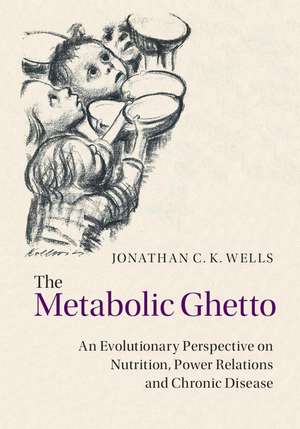
The Metabolic Ghetto
Autor Jonathan C K Wellsen Limba Engleză Hardback – 21 iul 2016
| Toate formatele și edițiile | Preț | Express |
|---|---|---|
| Paperback (1) | 286.31 lei 6-8 săpt. | |
| Cambridge University Press – 28 mar 2019 | 286.31 lei 6-8 săpt. | |
| Hardback (1) | 768.76 lei 6-8 săpt. | |
| Cambridge University Press – 21 iul 2016 | 768.76 lei 6-8 săpt. |
Preț: 768.76 lei
Preț vechi: 893.92 lei
-14%
Puncte Express: 1153
Preț estimativ în valută:
135.91€ • 158.12$ • 118.22£
135.91€ • 158.12$ • 118.22£
Carte tipărită la comandă
Livrare economică 17 aprilie-01 mai
Specificații
ISBN-13: 9781107009479
ISBN-10: 1107009472
Pagini: 622
Ilustrații: 187 b/w illus. 27 tables
Dimensiuni: 176 x 256 x 32 mm
Greutate: 1.33 kg
Editura: Cambridge University Press
Locul publicării:New York, United States
ISBN-10: 1107009472
Pagini: 622
Ilustrații: 187 b/w illus. 27 tables
Dimensiuni: 176 x 256 x 32 mm
Greutate: 1.33 kg
Editura: Cambridge University Press
Locul publicării:New York, United States
V-ar putea interesa
-
 The Primate Visual SystemJan Kremers-9%Preț: 1072.14 lei1178.18 lei
 -
 -19%Preț: 458.94 lei566.59 lei
 -
 Animal TraditionsEytan AvitalPreț: 454.20 lei
 -
 Preț: 396.68 lei
 -
 The Evolutionary Biology of Human Body Fatness: Thrift and ControlJonathan C. K. Wells-11%Preț: 541.56 lei608.49 lei
 -
 Lucy's Legacy Lucy's LegacyAlison JollyPreț: 210.02 lei
 -
 Preț: 328.82 lei
 -
 The AntsB Holldobler-15%Preț: 975.01 lei1147.07 lei
 -
 Journey to the AntsBert HölldoblerPreț: 227.78 lei
 -
 Demography and Evolutionary Ecology of Hadza Hunter-GatherersNicholas Blurton Jones-14%Preț: 759.48 lei883.13 lei
 -
 The Evolution of Senescence in the Tree of LifeRichard P. Shefferson-14%Preț: 948.23 lei1102.59 lei
 -
 EthnoprimatologyKerry M Dore-24%Preț: 489.07 lei642.89 lei
 -
 -27%Preț: 779.68 lei1072.48 lei
 -
 BrassicaceaeIhsan Ali Al-Shehbaz-23%Preț: 1042.26 lei1356.73 lei
 -
 Preț: 105.27 lei
 -
 Preț: 104.06 lei
 -
 Preț: 336.80 lei
 -
 Preț: 337.43 lei
 -
 Preț: 100.85 lei
Cuprins
Preface; 1. Introduction; Part I. The Physiology of Chronic Disease: 2. Models of chronic disease; 3. Links between nutrition and health; 4. The developmental origins of disease; 5. Life-course models of chronic disease aetiology; 6. Applying the capacity-load model; Part II. An Evolutionary Perspective on Human Metabolism: 7. Life history strategy; 8. Ancestral environments; 9. The evolution of human adaptability; 10. Sensitivity in early life; 11. The evolutionary biology of inequality; 12. The metabolic ghetto; Part III. A Historical Perspective on Human Nutrition: 13. The emergence of agriculture; 14. Trade, capitalism and imperialism; 15. Hierarchy and metabolic capacity; 16. The emergence of consumerism; 17. Enforcing obedience; 18. The dual burden of malnutrition; Part IV. Power, Nutrition and Society: 19. A series of games; 20. A question of agency; Epilogue; Index.
Recenzii
'Is it really possible to bring together philosophy, economics, history, evolutionary biology, epidemiology, nutrition and metabolism to understand obesity and chronic disease? Jonathan C. K. Wells has done it in an immensely readable and insightful way. A wonderful book.' Michael Marmot, University College London
'No other book before has provided such a sophisticated and eloquent argument integrating knowledge about foetal and childhood environment and nutrition, with impacts of social, economic and historical factors. Jonathan C. K. Wells persuasively argues that a broad scope and an evolutionary framework are necessary to build our understanding of chronic and globally important diseases. Consequently, [he] succeeds in achieving a true consilience of very disparate perspectives on our health.' Grazyna Jasienska, Jagiellonian University, Poland
' [T]his book is a sobering look at how social hierarchy can undermine the health of the lower-ranked within a society and within the global economic order. A significant strength of the book lies in the variety of perspective and conceptual models evaluated. … It is an ambitious book that tackles big questions …' Darna L. Dufour, American Journal of Human Biology
'The Metabolic Ghetto is both a scholarly book and a call to action. Wells's arguments are carefully presented and well documented … Readers who are interested in the ways in which social structures affect health and who would like to understand the central role of nutrition in mediating the effects of socioeconomic inequalities on health will learn much from this book. Readers who are interested in global health will especially welcome Wells's international perspective and his concern for the health of people in low- and middle-income countries as well as for those in economically advantaged societies. … the readers who will be most attracted to the book are those who, in Marx's words, believe that the task of natural philosophers is not only to interpret the world but to change it.' Robert L. Perlman, American Journal of Physical Anthropology
'No other book before has provided such a sophisticated and eloquent argument integrating knowledge about foetal and childhood environment and nutrition, with impacts of social, economic and historical factors. Jonathan C. K. Wells persuasively argues that a broad scope and an evolutionary framework are necessary to build our understanding of chronic and globally important diseases. Consequently, [he] succeeds in achieving a true consilience of very disparate perspectives on our health.' Grazyna Jasienska, Jagiellonian University, Poland
' [T]his book is a sobering look at how social hierarchy can undermine the health of the lower-ranked within a society and within the global economic order. A significant strength of the book lies in the variety of perspective and conceptual models evaluated. … It is an ambitious book that tackles big questions …' Darna L. Dufour, American Journal of Human Biology
'The Metabolic Ghetto is both a scholarly book and a call to action. Wells's arguments are carefully presented and well documented … Readers who are interested in the ways in which social structures affect health and who would like to understand the central role of nutrition in mediating the effects of socioeconomic inequalities on health will learn much from this book. Readers who are interested in global health will especially welcome Wells's international perspective and his concern for the health of people in low- and middle-income countries as well as for those in economically advantaged societies. … the readers who will be most attracted to the book are those who, in Marx's words, believe that the task of natural philosophers is not only to interpret the world but to change it.' Robert L. Perlman, American Journal of Physical Anthropology
Descriere
A multidisciplinary analysis of the role of nutrition in generating hierarchical societies and cultivating a global epidemic of chronic diseases.