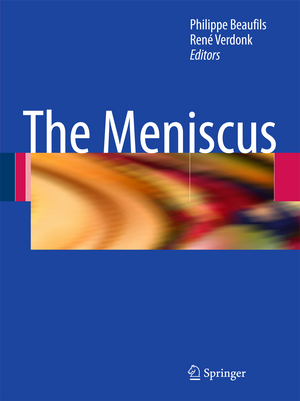
The Meniscus
Editat de Philippe Beaufils, René Verdonken Limba Engleză Hardback – 22 apr 2010
Descoperim în The Meniscus, editat de Philippe Beaufils și René Verdonk, un volum de referință în format hardback, esențial pentru înțelegerea evoluției chirurgiei ortopedice moderne. Organizată riguros în secțiuni ce facilitează tranziția de la teorie la practică, lucrarea debutează cu bazele științifice — ontogenie, histologie și biomecanică — oferind fundamentul necesar pentru abordarea clinică a leziunilor. Observăm o structură logică ce ghidează cititorul prin clasificarea complexă a leziunilor traumatice și degenerative, culminând cu detalii tehnice despre meniscectomie și repararea meniscală. Subliniem importanța perspectivei istorice oferite, care trasează drumul parcurs de la exciziile radicale de acum un secol la tehnicile de conservare artroscopică utilizate astăzi. Cuprinsul relevă o acoperire exhaustivă, incluzând nu doar actul chirurgical, ci și imagistica avansată (RMN, CT-artrografie) și protocoalele de reabilitare. Această abordare integrată transformă volumul într-un instrument de lucru indispensabil pentru evaluarea rezultatelor pe termen lung și a calității vieții pacienților. În comparație cu Surgery of the Meniscus de Christophe Hulet, care este o alternativă excelentă pentru cei care caută o revizuire în cooperare cu ESSKA, volumul de față se distinge prin profunzimea analizei istorice și prin sintezele clinice care ancorează fiecare capitol în realitatea practicii chirurgicale. Dacă The Management of Meniscal Pathology de Eric J. Strauss se concentrează pe tehnici curente și dovezi recente, The Meniscus rămâne pilonul teoretic care explică „de ce-ul” din spatele fiecărei decizii terapeutice, fiind de o valoare inestimabilă pentru rezidenții și chirurgii care doresc o stăpânire completă a subiectului.
Preț: 1108.32 lei
Preț vechi: 1166.65 lei
-5%
Carte disponibilă
Livrare economică 09-23 noiembrie
Livrare express 23-29 octombrie pentru 69.10 lei
Specificații
ISBN-10: 3642024491
Pagini: 424
Ilustrații: XV, 407 p.
Dimensiuni: 198 x 266 x 32 mm
Greutate: 1.14 kg
Ediția:2010
Editura: Springer
Locul publicării:Berlin, Heidelberg, Germany
V-ar putea interesa
-
 -26%Preț: 2032.60 lei2761.32 lei
 -
 -29%Preț: 1089.08 lei1528.20 lei
 -
 -24%Preț: 1518.98 lei2001.77 lei
 -
 -27%Preț: 1508.31 lei2079.50 lei
 -
 -24%Preț: 1770.85 lei2325.88 lei
 -
 Atlas of Knee ArthroscopyRadu Prejbeanu-5%Preț: 1344.88 lei1415.66 lei
 -
 -29%Preț: 1044.70 lei1470.85 lei
 -
 Knee ArthroscopyBrian McKeon-5%Preț: 725.54 lei763.72 lei
 -
 -21%Preț: 2001.20 lei2534.75 lei
 -
 Lower Extremity Joint PreservationMats Brittberg-5%Preț: 863.27 lei908.70 lei
 -
 Advances in Orthopedic Surgery of the KneeE. Carlos Rodrìguez-Merchán-5%Preț: 619.82 lei652.45 lei
 -
 Surgical Atlas of Sports Orthopaedics and Sports TraumatologyAndreas B. Imhoff-5%Preț: 1456.73 lei1533.40 lei
 -
 Arthroscopy and Sport InjuriesPiero Volpi-5%Preț: 786.06 lei827.43 lei
 -
 ESSKA Instructional Course Lecture Book: Amsterdam 2014Stefano Zaffagnini-5%Preț: 706.73 lei743.92 lei
 -
 -5%Preț: 1067.21 lei1123.38 lei
 -
 Surgery of the MeniscusChristophe Hulet-5%Preț: 1372.36 lei1444.59 lei
 -
 Techniques in Cartilage Repair SurgeryA. Ananthram Shetty-5%Preț: 829.58 lei873.24 lei
 -
 ESSKA Instructional Course Lecture BookMichael Tobias Hirschmann-5%Preț: 661.39 lei696.20 lei
 -
 Minimally Invasive Functional Reconstruction of the KneeJinzhong Zhao-5%Preț: 1171.65 lei1233.31 lei
 -
 Innovative Approaches in Knee ArthroscopyVikram Arun Mhaskar-5%Preț: 630.30 lei663.48 lei
Public țintă
ResearchDe ce să citești această carte
Această lucrare este recomandată chirurgilor ortopedzi și rezidenților care au nevoie de o bază teoretică și practică solidă în patologia genunchiului. Cititorul câștigă o înțelegere profundă a biomecanicii meniscale și acces la tehnici detaliate de sutură și meniscectomie. Este un ghid clinic precis care transformă experiența acumulată în peste 120 de ani de chirurgie într-o resursă modernă pentru optimizarea recuperării pacienților.
Cuprins
Basic Science.- Ontogeny-Phylogeny.- Anatomy.- Histology-Ultrastructure-Biology.- Biomechanics.- Synthesis.- Meniscal Lesions: Classification.- Traumatic Lesions: Stable Knee, ACL Knee.- Degenerative Lesions-Meniscal Cyst.- Meniscus and Osteoarthritis.- Synthesis.- Preoperative Clinical Examination and Imaging.- Clinical Examination: Standard X-Rays.- MRI, MR-arthrography and CT-arthrography.- Bone Scan.- Synthesis.- Technique.- Meniscectomy: Medial-Lateral.- Meniscal Repair: Biomechanics.- Meniscal Repair: Technique.- Meniscal Repair: Enhancement of Healing Process.- Meniscal Cysts.- Rehabilitation.- Synthesis.- Postoperative Evaluation.- Functional and Objective Scores. Quality of Life.- Postoperative Imaging: X-Rays, Arthro CT, Arthro MRI.- Results.- Meniscectomy: Global Results-Complications.- Meniscal Repair: Intra- and Postoperative Complications.- Meniscal Repair: Results.- Indications: Adults.- Traumatic Meniscal Lesions in a Stable Knee: Masterly Neglect, Meniscectomy, Repair.- Traumatic Lesions, ACL Knee: Masterly Neglect, Meniscectomy, Repair.- Degenerative Meniscal Lesions in a Stable Knee.- Lavage, Debridement, and Osteoarthritis.- Synthesis.- Meniscal Lesions in Children.- Classification: Discoid Meniscus, Traumatic Lesions.- Discoid Meniscus: Histology.- Technique of Meniscoplasty and Meniscal Repair in Children.- Meniscus Lesions in Children-Indications and Results.- Synthesis.- Post-meniscectomized Knee.- Postoperative Osteonecrosis of the Condyle: Diagnosis and Management.- Management of Early and Late Failure of Lateral Meniscus.- Synthesis.- Meniscal reconstruction- Allograft.- Basic Science.- Organization: Type of Grafts, Conservation, Regulation.- Meniscal Allograft: French Organization.- Open Technique.- Arthroscopic Technique Without Plugs.- Arthroscopic Technique with Bone Plugs.- Results and Indications.- Meniscal Reconstruction – Substitutes.- Menaflex (TM) Collagen Meniscus Implant: Basic Science.- Collagen Meniscus Implant: Technique and Results.- Actifit, Polyurethane meniscus implant: basic science.- Polyurethane Meniscus Implant: Technique.- Synthesis.- The Future.- The Future.- Conclusion.- General Conclusion.
Recenzii
“The editors have done something no one else has done - created one of the most comprehensive treatises on meniscus injuries ever compiled. … This is a wonderful reference that will be of particular value for non-European surgeons … . great value to residents and fellows in training as well as researchers performing cutting-edge research on meniscus pathologies. … should be part of every organizational orthopedic library and will be a welcome read for any orthopedic surgeons who perform meniscal surgery. I strongly recommend it.” (Mark R. Hutchinson, Doody’s Review Service, September, 2010)
Textul de pe ultima copertă
This clinical guide provides a special focus on the normal meniscal mechanism, body and function. Meniscal pathology and therapy are depicted in detail, followed by the presentation of long-term experience of meniscal transplantation and a look into the future of meniscal surgery.
During the last few decades, as the management of meniscal trauma has evolved, and knowledge gained on meniscal function, the orthopaedic surgeon has attempted to preserve the meniscus whenever possible. Arthroscopic meniscal repair has become the treatment of choice when the tear is located in the peripheral rim. Partial meniscectomy has become limited to such an extent that the deleterious effect of total meniscectomy is avoided. Meniscal allograft replacement, which has been available for the last two decades, is used when the patient is confronted with a painful total meniscectomy. Future research and experiments may suggest that partial meniscal replacement might be indicated in the presence of a painful knee compartment after failed meniscal repair or partial meniscectomy.
Caracteristici
Fills a void in guiding through the diagnosis and treatment of meniscal lesions
Descriere
The Meniscus The management of meniscus lesions is an unbelievable story of so-called scient- cally based, controversial treatment, covering a time span of more than 120 years, including: The time when a locked knee was manipulated in order to reduce a bucket-handle or a fap tear back into place to restore motion. The time when famous surgeons excised the meniscus in thousands of patients and kept the resected specimens as trophies in large glass jars. The time of animated discussions on whether either partial meniscectomy, only removing the ruptured parts, should be performed or total meniscectomy, as ad- cated by Smillie, because some meniscus-shaped semilunar tissue regeneration had been shown by Mandic after complete removal. The time when the next milestone was reached as Trillat introduced intramural resection, which preserved the circular stabilizing fbrous rim with its menis- ligamento-capsular attachments to the tibia and femur, to maintain more rotational knee stability. Prior to these mainstream meniscal resection treatments, pioneering work had been done by Thomas Annandale in 1883 and Moritz Katzenstein in 1908, who sutured the menisci back into place, with the latter achieving a series of good results. In 1921, Eugen Bircher was the frst to perform a diagnostic knee arthroscopy for internal knee derangement, just using a standard Jacobaeus laparoscope Nowadays, the fundamental importance of the menisci to normal knee function, e.g., motion, load distribution, and rotational stabilization, is scientifcally acknowledged."