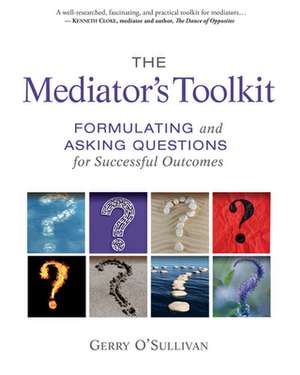
The Mediator's Toolkit
Autor Gerry O'Sullivanen Limba Engleză Paperback – 20 sep 2018
După parcurgerea acestui volum, veți fi capabili să formulați întrebări incisive, capabile să modifice paradigmele de gândire ale părților aflate în dispută, transformând medierea dintr-un simplu dialog într-un proces strategic de rezolvare. The Mediator's Toolkit nu este doar un manual de tehnici, ci un instrumentar avansat care utilizează „Modelul S Questions” pentru a naviga prin complexitatea conflictului. Găsim în această carte o analiză riguroasă a modului în care procesăm informația, autorul punând accent pe dimensiunile esențiale ale unei întrebări reușite: de la subiect și structură, până la capacitatea de a genera un „paradigm shift”.
Descoperim aici o abordare ancorată în neuroștiință și psihologie, explicând nu doar ce să întrebăm, ci mai ales de ce anumite structuri lingvistice funcționează mai bine decât altele. Dacă The Mediator's Handbook de Jennifer E Beer v-a oferit cadrul teoretic fundamental al procesului de mediere, această carte oferă instrumentele practice și precizia chirurgicală necesară pentru intervențiile de profunzime. Notăm cu interes capitolul dedicat Modelului de Comunicare NLP, care dezvăluie cum distorsiunile și generalizările din limbajul părților pot fi demontate pentru a ajunge la esența problemei.
Organizarea volumului este progresivă, pornind de la fundamentarea teoretică a The Mediator's Toolkit în prima secțiune și avansând spre aplicarea secvențelor de întrebări care ghidează părțile către soluționare. Această lucrare reprezintă punctul culminant al expertizei lui Gerry O'Sullivan, rafinând tehnicile prezentate în The Mediator's Toolkit, Second Edition și oferind o claritate superioară față de lucrările sale anterioare de ficțiune istorică, precum Flag of All Nations, prin concentrarea exclusivă pe pragmatismul rezolvării disputelor.
Preț: 276.06 lei
Carte disponibilă
Livrare economică 09-23 noiembrie
Specificații
ISBN-10: 0865718970
Pagini: 208
Dimensiuni: 203 x 254 x 19 mm
Greutate: 0.59 kg
Editura: New Society Publishers
V-ar putea interesa
-
 International Arbitration in KoreaJoongi Kim-30%Preț: 1572.33 lei2250.51 lei
 -
 -32%Preț: 1071.23 lei1585.89 lei
 -
 Mediation RepresentationHarold Abramson-33%Preț: 624.23 lei934.96 lei
 -
 -22%Preț: 413.18 lei531.60 lei
 -
 Legal MindsRobert L. DavisPreț: 74.33 lei
 -
 Gangsters of ShanghaiMR Gerry O'SullivanPreț: 106.06 lei
 -
 The Dance of OppositesKenneth ClokePreț: 199.44 lei
 -
 Flag of All NationsGerry O'SullivanPreț: 140.59 lei
 -
 Get Off ProbationMR J. JonesPreț: 92.03 lei
 -
 Sapiens: A Brief History of HumankindDerek PerkinsPreț: 232.68 lei
 -
 The Illustrated Guide to Criminal Procedure, Vol INathaniel BurneyPreț: 230.11 lei
 -
 Mediation Behaviour: Why We Act Like We DoStephen Walker-27%Preț: 542.76 lei746.76 lei
 -
 The Bad Boys of DiplomacyS. NovikovPreț: 36.26 lei
 -
 Dominate Your DivorceSchoeneberg Jd, WaynePreț: 55.74 lei
 -
 Preț: 103.66 lei
 -
 Mediation Skills and Strategies: A Practical GuideTony Whatling-26%Preț: 197.75 lei267.97 lei
 -
 Arbitration ACT 2010 and Model Law: A CommentaryBarry Mansfield-35%Preț: 601.73 lei921.57 lei
 -
 Alternative Dispute Resolution in European Administrative LawDacian C. Dragos-18%Preț: 1110.43 lei1354.19 lei
 -
 MehrparteienschiedsverfahrenRüdiger Wilhelmi-13%Preț: 481.96 lei553.98 lei
De ce să citești această carte
Această carte se adresează mediatorilor profesioniști, formatorilor și studenților care doresc să depășească nivelul conversațional în gestionarea conflictelor. Cititorul câștigă o metodologie clară, Modelul S Questions, care îi permite să identifice rapid blocajele cognitive ale interlocutorilor. Este o investiție în eficiența profesională, oferind siguranța că fiecare întrebare adresată are un scop strategic bine definit și un fundament psihologic solid.
Despre autor
Gerry O'Sullivan este un mediator, formator și facilitator de renume internațional, cu o carieră de peste 30 de ani dedicată rezolvării conflictelor. Membru avansat al Mediators' Institute of Ireland și consultant în cadrul echipei Mediators Beyond Borders, ea a colaborat inclusiv cu Lawyers Without Borders pentru livrarea programelor de instruire. În calitate de director al O'Sullivan Solutions, Gerry își folosește experiența vastă pentru a transforma teorii complexe de comunicare în instrumente practice. Deși a explorat și genul ficțiunii istorice, autoritatea sa principală rezidă în dezvoltarea modelelor strategice de mediere utilizate astăzi la nivel global.
Descriere scurtă
Learn how to formulate and ask penetrating, paradigm-shifting questions for successful outcomes in any conflict
"An invaluable analysis, not merely of questions, but of a range of process interventions, to equip mediators in all sectors to deepen the effectiveness of their work."
¿ Tony Allen, mediator and senior consultant, CEDR, London
"A must-have book. It strikes the right balance between theory and practice making sure mediators know what to ask and why these questions are important. "
¿ Dr. Juan Diaz-Prinz, Mediator and Trainer in Conflict Management, Berlin, Germany
KNOWING HOW to formulate and ask incisive questions to get to the core of a conflict, challenge entrenched thinking, and shift perspectives are the main challenge for mediators and the key to successful conflict resolution.
The Mediator's Toolkit employs the author's powerful "S Questions Model," to provide readers with the skills and tools to develop and ask strategic questions that will shift the thinking and approaches of parties in conflict. The S Questions Model toolkit dives into four dimensions of successful questions for mediation: the subject matter dimension, the structure dimension, the information seeking dimension, and the shifting thinking dimension. The toolkit clearly explains:
- The theory behind each question type, including exploration of relevant neuroscience and psychology
- The purpose of different types of questions
- How the questions work
- When to use different types of questions
- How to build and apply questions to mediation in a non-threatening way.
This essential practical guide will radically sharpen, focus, and improve the questioning skills of qualified mediators, students, lecturers, trainers, and those using questions to challenge and effect change, in any context.
"Questions are the steering wheel for navigating difficult conversations, and at long last mediators have a valuable guide in the Mediator's Toolkit. Highly recommended."
¿ Jennifer Beer, co-author, The Mediator's Handbook
"Stands out among all books for mediators and trainers."
¿ Irena Vanenkova , former executive director, International Mediation Institute
GERRY O'SULLIVAN is a mediator, trainer, and facilitator with over 30 years' experience in conflict resolution and training. She is an advanced member of the Mediators' Institute of Ireland (MII), a member of the US-based Mediators Beyond Borders Consultants Team, and has delivered training with Lawyers Without Borders. Gerry is Director of O'Sullivan Solutions, and lives on the southwest coast of Ireland.
Cuprins
Acknowledgments
Glossary
Introduction
Book Content
Terminology
Sequences of Questions
SECTION I: The S Questions Model ¿ Theory
Chapter 1: Introduction and Purpose of the S Questions Model
The S Questions Model
Premise on Which the S Questions Model Has Been Developed
Outline Summary of the Model
The S Questions Model
The Purpose of Mediation Questions
Perspective and Paradigm
Chapter 2: How We Process and Communicate Information
How Information Is Processed
Factors That Contribute to the Information That We Process
The NLP Model of Communication
Our Created Paradigm Becomes Our Reference Point for Interpreting Information
How We Communicate Information to Others
Distortion, Deletion and Generalization When Communicating to Others
The Surface Structure Language We Use When We Communicate with Others
Using Mediation Questions to Create a Paradigm Shift
Chapter 3: Working with the Brain in Mediation
The Brain
Working with the Avoid-threat Reflex in Mediation
SECTION 2: Practical Application of the S Questions Model
Chapter 4: Methodology to Minimize an Avoid-threat Reflex When Asking Questions
Methodology
Chapter 5: The S Questions Model Applied to a Mediation Process
Reflective Preparation for Questions
The S Questions Model
S Questions Model Applied to Initial Separate Meeting
S Questions Model Applied to Joint Meeting
SECTION 3: Practical Application of S1, S2 and S3 Questions
Chapter 6: S1: The Subject Matter Dimension of Questions
Chapter 7: S2: The Structure Dimension of Questions
Chapter 8: S3: The Seeking Information Dimension of Questions
SECTION 4: Practical Application of S4 Questions
Chapter 9: Introduction: The Eight Types of S4: Shift Thinking Dimension of Questions 91
S4: The Shift Thinking Dimension of Questions
Chapter 10: S4: Journey of Inference Questions
S4: The Shift Thinking Dimension of Questions ¿ Journey of Inference Questions
How Do Journey of Inference Questions Work?
When to Ask Journey of Inference Questions
Methodology
Chapter 11: S4: Neuro-Linguistic Programming Questions
S4: The Shift Thinking Dimension of Questions ¿ Neuro-Linguistic Programming Questions
How Do Neuro-Linguistic Programming Questions Work?
When to Ask Neuro-Linguistic Programming-based Questions
Methodology
Chapter 12: S4: Distinction and Difference Questions
S4: The Shift Thinking Dimension of Questions ¿ Distinction and Difference Questions
How Do Distinction and Difference Questions Work?
When to Ask Distinction and Difference Questions
Methodology
Chapter 13: S4: Reflective Connecting Questions
S4: The Shift Thinking Dimension of Questions ¿ Reflective Connecting Questions
How Do Reflective Connecting Questions Work?
When to Ask Reflective Connecting Questions
Methodology
Chapter 14: S4: Cognitive Elements-based Questions
S4: The Shift Thinking Dimension of Questions ¿ Cognitive Elements-Based Questions
How Do Cognitive Elements-based Questions Work?
When to Ask Cognitive Elements-based Questions
Methodology
Chapter 15: S4: Other People Questions
S4: The Shift Thinking Dimension of Questions ¿ Other People Questions
How Do Other People Questions Work?
When to Ask Other People Questions
Methodology
Chapter 16: S4: Underlying Interests Questions
S4: The Shift Thinking Dimension of Questions ¿ Underlying Interests Questions
How Do Underlying Interests Questions Work?
When to Ask Underlying Interests Questions
Methodology
Chapter 17: S4: Future Focus Questions
S4: The Shift Thinking Dimension of Questions ¿ Future Focus Questions
How Do Future Focus Questions Work?
When to Ask Future Focus Questions
Methodology
Endnotes
Index
About the Authors
A Note about the Publisher