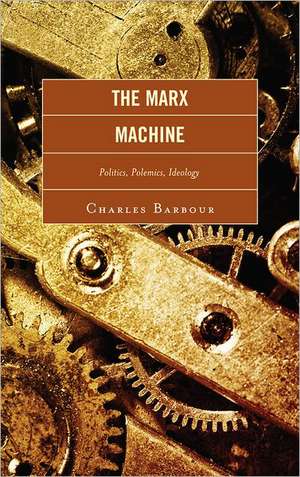
The Marx Machine: Politics, Polemics, Ideology
Autor Charles Barbouren Limba Engleză Hardback – 21 iun 2012
Focusing primarily on Marx's early polemical writings, and especially the debates with Bruno Bauer and Max Stirner that make up most of the voluminous manuscript now called "The German Ideology," The Marx Machine endeavors to show how some of Marx's most consistently denigrated and ignored works can in fact be approached as responses to Marx's contemporary critics.
Preț: 568.40 lei
Preț vechi: 862.67 lei
-34%
Puncte Express: 853
Carte tipărită la comandă
Livrare economică 04-18 decembrie
Livrare prin curier în România Termenul estimat este afișat lângă disponibilitate.
Transport gratuit pentru acest produs Plată online sau ramburs, în funcție de opțiunile comenzii.
Retur gratuit în 14 zile Comandă securizată și suport în română.
Specificații
ISBN-13: 9780739110461
ISBN-10: 0739110462
Pagini: 148
Dimensiuni: 158 x 236 x 17 mm
Greutate: 0.41 kg
Editura: Bloomsbury Publishing
Colecția Lexington Books
Locul publicării:New York, United States
ISBN-10: 0739110462
Pagini: 148
Dimensiuni: 158 x 236 x 17 mm
Greutate: 0.41 kg
Editura: Bloomsbury Publishing
Colecția Lexington Books
Locul publicării:New York, United States
Cuprins
Introduction: Another Marx
Chapter 1: Of Multiple Breaks: Marx in Res Publica
Chapter 2: Copying Machines: Reading "The Leipzig Council"
Chapter 3: The Fractured Essence: On Historical Materialism
Chapter 4: Allegories of Writing: Marx and Literature
Conclusion: Marx and Us
Chapter 1: Of Multiple Breaks: Marx in Res Publica
Chapter 2: Copying Machines: Reading "The Leipzig Council"
Chapter 3: The Fractured Essence: On Historical Materialism
Chapter 4: Allegories of Writing: Marx and Literature
Conclusion: Marx and Us
Recenzii
The triumph of neoliberalism and the end of the Cold War have virtually obliterated Marx's legacy - outside doctrinaire circles. Going beyond both structuralist and deconstructive readings, Barbour's book presents 'another Marx' whose texts reveal multiple plateaus of meaning (held together by a commitment to equality). What becomes evident in the study is that exorcising legacies exacts a steep price on critical thought.
In this extraordinary study Babour shows that he is Marx's star reader, finding subtleties in neglected minor works as well as in major ones supposedly well known. Deploying an impressive philosophical apparatus-Althusser to Rancière-Babour's work creates a stimulating and lively intertextuality that liberates Marx from his best friends and worst enemies.
Barbour (Univ. of Western Sydney, Australia) adopts what he calls a deliberately averted gaze when analyzing Marx and the tension between theory and practice. Given the volume of work produced on Marx, and the volume of his works still left underanalyzed, the book's conceit is that the construct of "Marx" represents "components or parts [that] can be attached to or assembled with other texts, or other components and parts both inside and outside of the Marxist tradition or traditions." The book intends to reconstruct a version of Marxism that is conscious of its mechanistic conception of Marx through a system of meanings launched from "a thousand plateaus," which must be deciphered by recognizing that the "literary form of Marx's work is as significant as is its supposedly scientific content." Toward this end, the first two chapters cohere much more clearly than the latter two. Although each of the latter have their independent merits, the whole project, perhaps intentionally, lacks a precisely consistent overall arc. Since the author seeks to show the import and revealing character of the discontinuities in Marx's work in order to undermine the simple, mechanistic readings, this might be intentional. Summing Up: Recommended. Upper-division undergraduate, graduate, and research collections.
In this extraordinary study Babour shows that he is Marx's star reader, finding subtleties in neglected minor works as well as in major ones supposedly well known. Deploying an impressive philosophical apparatus-Althusser to Rancière-Babour's work creates a stimulating and lively intertextuality that liberates Marx from his best friends and worst enemies.
Barbour (Univ. of Western Sydney, Australia) adopts what he calls a deliberately averted gaze when analyzing Marx and the tension between theory and practice. Given the volume of work produced on Marx, and the volume of his works still left underanalyzed, the book's conceit is that the construct of "Marx" represents "components or parts [that] can be attached to or assembled with other texts, or other components and parts both inside and outside of the Marxist tradition or traditions." The book intends to reconstruct a version of Marxism that is conscious of its mechanistic conception of Marx through a system of meanings launched from "a thousand plateaus," which must be deciphered by recognizing that the "literary form of Marx's work is as significant as is its supposedly scientific content." Toward this end, the first two chapters cohere much more clearly than the latter two. Although each of the latter have their independent merits, the whole project, perhaps intentionally, lacks a precisely consistent overall arc. Since the author seeks to show the import and revealing character of the discontinuities in Marx's work in order to undermine the simple, mechanistic readings, this might be intentional. Summing Up: Recommended. Upper-division undergraduate, graduate, and research collections.