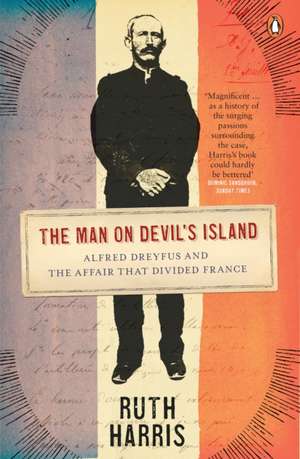
The Man on Devil's Island: Alfred Dreyfus and the Affair that Divided France
Autor Ruth Harrisen Limba Engleză Paperback – 6 apr 2011
Observăm că, deși Afacerea Dreyfus este un subiect recurent în istoriografia europeană, puține lucrări reușesc să depășească relatarea cronologică a procesului pentru a investiga trauma profundă care a fracturat statul francez. The Man on Devil's Island completează această lacună academică, oferind o analiză exhaustivă a modului în care un document sustras dintr-un coș de gunoi în 1894 a declanșat o criză de identitate națională ale cărei ecouri au ajuns până în pragul celui de-al Doilea Război Mondial. Ruth Harris nu se limitează la biografia căpitanului Alfred Dreyfus, ci reconstruiește mecanismele puterii și ale prejudecății care au permis condamnarea unui om nevinovat la izolare pe Insula Diavolului.
Ne-a atras atenția rigoarea cu care autoarea analizează dovezile fabricate de serviciile de informații și modul în care opinia publică a fost manipulată pentru a susține reintroducerea pedepsei cu moartea. Volumul reprezintă o alternativă la The Dreyfus Affair de Piers Paul Read pentru cursurile de istorie modernă a Europei, cu avantajul unei perspective mai largi asupra repercusiunilor sociale și politice pe termen lung, nu doar a intrigii militare. În timp ce alte lucrări se concentrează pe eroarea judiciară, Ruth Harris demonstrează cum acest caz a devenit catalizatorul unei diviziuni între tradiționalismul clerical și valorile republicane, oferind o lecție despre fragilitatea democrației în fața naționalismului exacerbat. Stilul este precis și academic, dar narat cu o fluență care face accesibile nuanțele complexe ale dreptului militar și ale politicii de la finalul secolului al XIX-lea.
Preț: 109.04 lei
Carte disponibilă
Livrare economică 09-23 noiembrie
Livrare express 23-29 octombrie pentru 28.06 lei
Specificații
ISBN-10: 0141014776
Pagini: 560
Ilustrații: Illustrations
Dimensiuni: 129 x 198 x 24 mm
Greutate: 0.39 kg
Editura: Penguin Books
Colecția Penguin
Locul publicării:London, United Kingdom
V-ar putea interesa
-
 The German TraumaGitta Sereny-19%Preț: 87.80 lei108.16 lei
 -
 Stalin and His HangmenDonald RayfieldPreț: 130.19 lei
 -
 Frederick the GreatTim Blanning-22%Preț: 112.92 lei144.95 lei
 -
 The Holy Roman EmpirePeter H. Wilson-20%Preț: 118.35 lei147.92 lei
 -
 The Gates of EuropeSerhii Plokhy-30%Preț: 66.40 lei94.23 lei
 -
 The VikingsElse Roesdahl-30%Preț: 66.31 lei94.17 lei
 -
 -18%Preț: 378.69 lei459.21 lei
 -
 The ItaliansJohn Hooper-31%Preț: 63.49 lei91.77 lei
 -
 Cold WarJim Wilson ObePreț: 114.22 lei
 -
 The Kremlin ConspiracyDouglas BoydPreț: 98.43 lei
 -
 Hidden AberdeenshireFiona-Jane Brown-16%Preț: 61.54 lei73.58 lei
De ce să citești această carte
Este o resursă esențială pentru studenții la istorie și științe politice care doresc să înțeleagă rădăcinile antisemitismului modern și ale polarizării politice. Cititorul câștigă o perspectivă documentată asupra modului în care un scandal juridic poate remodela instituțiile unui stat. Volumul oferă o analiză premiată a unui moment care a definit Franța modernă, fiind mai mult decât o biografie, un studiu de caz despre justiție și putere.
Despre autor
Ruth Harris este o istorică reputată, cunoscută pentru capacitatea de a îmbina cercetarea academică riguroasă cu o narațiune captivantă. Expertiza sa în istoria Franței i-a adus recunoașterea internațională, culminând cu premiul Wolfson History Prize pentru volumul de față. Activitatea sa se concentrează pe intersecția dintre politică, religie și societate, reușind să scoată la lumină complexitatea perioadei Belle Époque. Prin The Man on Devil's Island, Harris își consolidează statutul de autoritate în studiul Afacerii Dreyfus, oferind interpretări noi bazate pe o sifting atentă a dovezilor istorice.
Notă biografică
Descriere scurtă
Ruth Harris writes beautifully and engagingly on a moment in French history that polarized society and undermined the French state; the repercussions of which were felt up to the outbreak of the Second World War.
At the end of September 1894 a charlady stole an undated and unsigned letter from the wastepaper bin of the German military attaché in Paris. Torn to pieces but stuck back together by French intelligence, this document contained French military secrets. By the middle of October a Jewish captain in the army called Alfred Dreyfus was accused of being its author. As it turned out, he was entirely innocent, but at the time few questioned the verdict of the subsequent court martial, nor the unanimous decision to sentence him to a life of penal servitude. Public opinion was outraged, and the War Minister, General Auguste Mercier, asked for the reintroduction of the death penalty so Dreyfus could be guillotined. Although the request was turned down, Dreyfus was still subjected to special conditions: rather than going to New Caledonia like other transported convicts, he was sent to the much harsher Devil's Island off the coast of French Guiana, and condemned to solitary confinement in murderous conditions. The French authorities did not expect - and probably did not want-him to survive.
So undisputed was Dreyfus' conviction that no one had any inkling it would be queried, let alone that the case would become the scandal that nearly brought down the French state. It changed the political course of the nation and transformed the way the country viewed itself and was viewed by others.
Recenzii
An extraordinary study of the affair as a tragic drama that swept up a man, his family and friends, and more widely French society and the French state.
A triumph of research and analysis.
Ruth Harris offers us one of the most thorough and eloquent accounts of this turbulent episode.
With the aid of copious illustrations, helpful chronology and a list of leading characters, [Harris] offers a compelling account of incidents
Ruth Harris' minutely detailed examination of the rich mulch from which the Dreyfus case sprouted its fleurs du mal, adds a new level of learning to the affair that defined 20th-century France
a highly imaginative, deeply-researched inquiry into the battle over Dreyfus which revels in paradox and complexity.
"Harris is a first-rate narrative historian... What marks Harris's contribution is her formidable research skills, her exceptionally wide general and historical reading, and her always interesting eye for the revealing anecdote or pen portrait."
"Scrupulous and well-written... Harris is to be thanked for the care and measure of her sifting and weighing, and for the deep historical perspective that she brings to the undertaking."