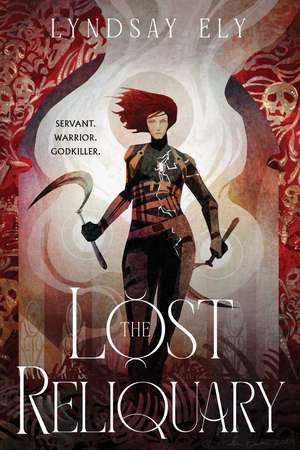
The Lost Reliquary: Divine Thrall, cartea 1
Autor Lyndsay Elyen Limba Engleză Paperback – 20 noi 2025
A divinely-blessed warrior bound to the last living goddess plots deicide to win her freedom in this propulsive epic fantasy for fans of Godkiller and Gideon the Ninth.
The Devoted Lands was once home to many gods: Salt, Stone, Storm, Green, Shadow. Now, after centuries of devastating wars, only Tempestra-Innara, the Eternal Flame, remains.
Conscripted as a child, Lys, potentiate of the Dawn Cloister, is outwardly a loyal servant to her goddess. If she harbors impossible dreams of deicide, that’s her business. But when a routine heretical execution erupts into a near-fatal assassination attempt on Tempestra-Innara, Lys sees a glimmer of hope for her freedom.
Lys is chosen to hunt down the heretics and find an ancient reliquary that holds the power to kill a god. Annoyingly, she’s not alone. Paired with Nolan, a potentiate from a rival cloister who is as pious as he is determined, Lys must feign devotion if she hopes to keep her own heretical thoughts hidden and god-killing ambitions within reach.
As they pursue a dangerous network of heretics linked to the assassination, Lys uncovers a world brimming with more possibility—and peril—than she ever anticipated.
Preț: 63.04 lei
Preț vechi: 74.79 lei
-16% Recomandat
Carte disponibilă
Livrare economică 13-25 noiembrie
Livrare express 23-29 octombrie pentru 41.89 lei
Specificații
ISBN-10: 1668080311
Pagini: 464
Ilustrații: b-w map illustration in fm;
Dimensiuni: 152 x 229 x 28 mm
Greutate: 0.43 kg
Editura: S&S/Saga Press
Colecția S&S/Saga Press
Seria Divine Thrall
V-ar putea interesa
-
 GodkillerHannah KanerPreț: 71.85 lei
 -
 The River and the StarGabriela Romero LacruzPreț: 122.99 lei
 -
 -23%Preț: 56.78 lei74.13 lei
 -
 Preț: 125.83 lei
 -
 The GuardianSherrilyn Kenyon-26%Preț: 52.75 lei71.36 lei
 -
 Fallen GodsRachel Van Dyken-31%Preț: 75.65 lei110.37 lei
 -
 Preț: 159.80 lei
 -
 Preț: 117.27 lei
 -
 -23%Preț: 95.79 lei125.21 lei
 -
 The Eternal OnesNamina FornaPreț: 72.97 lei
 -
 -24%Preț: 95.55 lei125.42 lei
 -
 The Dragons of Deepwood FenBradley P. Beaulieu-22%Preț: 58.06 lei74.67 lei
 -
 A God of Countless GuisesBradley P. Beaulieu-29%Preț: 137.33 lei194.76 lei
 -
 Guardians of the Gods - In the Shadow of the FallTobi Ogundrian-20%Preț: 61.92 lei77.83 lei
 -
 To Cage A GodElizabeth MayPreț: 72.84 lei
 -
 The Strength of the FewJames Islington-14%Preț: 130.36 lei151.83 lei
 -
 The Things Gods BreakAbigail OwenPreț: 112.34 leiRecomandat
Notă biografică
Lyndsay Ely is an author of science fiction and fantasy across YA and adult categories. Her debut, Gunslinger Girl, was a YA genre-bent dystopian Western. She has also published an Overwatch tie-in novel, Deadlock Rebels, is a contributor to Overwatch 2: Heroes Ascendant: An Overwatch Story Collection, and is currently working on an upcoming interactive adventure novel for Five Nights at Freddy’s: Escape the Pizzaplex. She currently resides in Boston.
Extras
When they whisper, we wake…
EVERY DIVINE EXECUTION BEGINS pretty much the same: with me, bored and sweaty, staring down at the worn patch that sits before the altar of Tempestra-Innara, last living goddess of the Devoted Lands.
I hate that spot.
Even from the highest gallery of the Cathedral, it stands out like a stain, darker than the stone surrounding it, burnished smooth over centuries by the knees of countless devoted, conquered, and condemned. The Cathedral’s apse curls around it like an embrace, oil lamps on spidery chains flickering among the golden, bejeweled bones that line the walls. Some of those bones’ owners knelt too. I’m not sure they would have taken it as a compliment, having their flesh stripped away, skeletons gilded and set with gemstones, but that’s the honor the Goddess bestows upon their worthiest of enemies: a tacky eternity as the Cathedral’s most striking décor. From this angle, I can’t quite see my favorite skull—the one with its front teeth missing and jeweled daggers in its eye sockets—but it’s there. I named it Alastair.
Like the apse, the Cathedral is crowded with bodies, but fleshy living ones, which is why I am melting like a damn cake left in the sun. Even as high above them as my fellow Potentiates and I are, practically wedged into the skeletal ribbing of the vaulted ceiling, there’s no relief. It must be worse in the gallery below ours, which, despite the upcoming entertainment, remains sparsely occupied by our superiors in the Orders—some huddled Priors oozing bureaucracy, a pair of Bellators in their snappy military garb, one rather wilted-looking Cleric of the Blood. And I can’t imagine the pure torture on the floor, where a lagoon of onlookers churns endlessly, their perfumes and sachets long ago congealed into a smothering overripeness that I can practically taste.
Somehow the corporeal bouquet does nothing to temper the unwashed-armpit smell of my helm. We may not put on our ceremonial armor often, but the least the Dawn Cloister attendants could do is give it a good airing out before we do. Unlike those in the Orders, we don’t get a choice in attendance. For Potentiates, an execution is a requirement. But for the devoted, it’s their lucky day, the culmination of a pilgrimage to the holy city of Lumeris—garish, throbbing heart of the Goddess’s empire—and that slight chance to find themselves in Tempestra-Innara’s revered presence. Thousands of the less fortunate wait outside the sprawling Cathedral complex, prayers on their lips, regret for not successfully talking (or bribing) their way past the guards in their hearts, and still hoping, hoping, hoping for a glimpse of the Goddess’s glory.
“At this rate,” I say under my breath, shifting uncomfortably as a trickle of sweat runs down the small of my back toward my swampy nethers, “we’ll be dead before the condemned is.”
To one side of me, Jeziah lets out a brief yip of laughter, as fox-like as the creature his helm depicts. On the other, Morgan is silent, but I can sense the simmering annoyance beneath her hawk, which stares unflaggingly at the Cathedral’s apse. It would probably take me literally exploding into flames to break her focused, ever-obedient attention.
“Lys!”
I turn my head slightly at the hiss of my name, down the line of my fellow Potentiates to where a warning expression flashes beneath Prior Petronilla’s hood. There and gone, her face shadowed again, but the message is clear. Especially when her attention snags fleetingly on the gallery directly across from us, where the Potentiates of the Dusk Cloister stand: Do not embarrass us. But if the Dusk Potentiates or their Prior noticed my indiscretion, they give no indication, as straight and still as the statues honoring our distinguished predecessors that line the halls of the Cathedral complex.
We are a mirrored set, the gold-trimmed ebon gray of their armor contrasting with the polished red and gold of ours in a perfect theatrical duality. I don’t know the names or faces of the Dusk acolytes, and they don’t know ours. There are only helmed facades: raven, wraith, weasel, serpent, and, at the very end, a demon, with horns that curl as delicately as seashells. Until we join the higher Orders, we are nameless, faceless things to everyone outside our Cloister, our sole purpose to train and learn to serve the Goddess to the highest degree. Within the Dawn, competition to be the best is fierce. But Prior Petronilla never lets us forget that, no matter how we excel, the Dusk Potentiates might be that much better, that much more devoted. I expect her counterpart seeds the same expectation about us, forcing not an ounce of potential to go unrealized.
But anonymous or not, pitted against one another or not, we are all the children of Tempestra-Innara. Their Chosen. Every one of us once knelt on that infamous spot below and received the gift of the Goddess’s blessing: our communion of blood.
A shiver runs through me. But not from the memory.
Tempestra-Innara has arrived.
Instinctively, I stand straighter, discomfort forgotten as a sudden, diminishing sensation takes me. I am small, smaller even than when I first beheld them, when their gift trickled its way over my lips and into my veins. That shared blood sings now, their holy presence like a rush of fever as the bones in the apse shift, revealing the hidden door to the Goddess’s sanctum in the Cathedral spire. Below, the crowd cries out with pleasure, fear, awe. They clutch the reveries that hang around their necks—tiny representations of the holy flame wrought in gold, silver, marble—and reach out for a touch that will never deign to grace them. There is no acclimating to the arrival of the Goddess, not even for those with their divine gift. I’ve stood in their presence countless times, and still it overwhelms, turning my mouth dry and making me ache to throw myself down onto the weathered stone below, to supplicate myself. To bask and bathe in their godly power.
They glide forward. At the edge of the dais that marks the boundary between the apse and the Cathedral’s nave, the Goddess stops and raises their hands. Flames appear, filling their palms with a clean, white blaze. I feel the trembling in my legs again. Many in the crowd fall to their knees. I hear whimpers. I see tears.
I get it. For most, it’s their first time this close to the Goddess’s glory. Do they see the same thing I do? The unnerving amalgamation of flesh and divinity, familiar and alien at the same time? Describing Innara, the chosen vessel, is easy enough: tall and slight of frame, with a light complexion and brown hair.
But that is not a description of Tempestra.
They tower.
They radiate.
They glow with the cold brightness of a full moon, their tresses flowing with the power of a river swollen by spring thaw. And their flames… even from a distance the flickering tongues of divinity feel hungry with a need to cleanse the impure.
When they whisper, we wake…
The prayer begins without need for a cue, a rising swell of voices.
At their command, we follow. In their light, we are seen… we are judged…
My lips move automatically, reciting words I’ve known longer than I can remember, brought to my village by soft-tongued clerics long before a Bellator’s forces arrived to deliver their enlightenment in a more bellicose manner.
May their blessed flame find purity of faith, or else leave cinder and ash.
Jeziah once told me he thought the air seemed thinner at the end of a prayer. Lighter, as if something has been burned out of it. I agreed at the time. But it was a lie. The air seems as thick and cloying as it did before. No matter how fervent the delivery, prayers are just words dressed up fancy. And as this one tapers off, Tempestra-Innara lowers their hands, letting their flames extinguish before they address the crowd.
“Bring forward the condemned.”
They don’t waste time getting down to business. Which I appreciate, since the initial shock of their arrival has faded, and now I feel the sticky sweat again. The quicker this is over, the better.
The massive doors at the front of the Cathedral swing open, admitting a welcome rush of cool air. The condemned in question has probably been waiting just beyond them for ages, but there’s an order to these sorts of things. An anticipatory fear that needs to be constructed, a level of threatening theatricality that must be reached. After all, anything less than a showy execution is simply an invitation for further insurrection.
The man’s name is Emmaus. He stumbles as he’s dragged down the center aisle by the rope around his neck, hampered by chains binding his ankles and wrists. The restraints hardly seem necessary; even from a distance, he moves feebly, bruises covering his exposed skin, barely keeping upright. Not that it earns him any sympathy from the onlooking crowd. They hiss and spit, rancor as thick as their perfumes. Because common criminals don’t get divine executions. Because Emmaus is more than that—he’s a heretic. And a proficient one at that. He has preached against the Goddess and distributed sacrilegious tracts. He and his coconspirators have murdered magistrates and clerics, and eluded the Goddess’s forces for nearly two years.
Until they sent Andronica.
One hand gripping Emmaus’s rope, Andronica saunters her way to Tempestra-Innara, not a trace of humility in her razor-sharp gaze. As the Goddess’s Executrix, such things are below her. My fellow Potentiates and I briefly break our static vigil to tap the sigil of the Dawn Cloister on our shoulders. Respect for the Executrix, who was once one of us. They are the Goddess’s right hand, their hunter, their blade. Prior Petronilla absolutely puffs with pride as Andronica stops before the Goddess.
We are all stronger, faster, more resilient than a normal person, thanks to the Goddess’s gift. Our senses are sharper, our wounds quicker to heal. We can call the divine flame (some, like me, with less competency than others). But of all the paths a Potentiate will follow—Bellator, Prior, Arbiter, Cleric of the Blood—the position of the Executrix is the most revered. The most desired. And utterly out of reach. Andronica is still in her prime, radiating with vitality. But nothing, save the Goddess, lasts forever. The gift of Tempestra-Innara’s power is given in youth; and like youth, it fades. Eventually, Andronica’s strength will wane; when that happens, another young Potentiate will take up the Executrix mantle.
But long before that, I will be assigned to an Order. An irritating thought. Within months, maybe a year, Prior Petronilla will choose my fate. And it won’t be in Lumeris, where the best of us strive to remain, constantly awash in the Goddess’s light. Nor any of the Ordained Cities, farther from their radiance, but still pampered pillars of their empire. No, if I know Petronilla, she’ll shunt me off to the farthest posting from the Goddess she can manage, the sort of position usually reserved for Chosen in their waning years. And I’ll accept it like the good, obedient child that I am, because what other choice is there?
Andronica yanks the rope, sending Emmaus to his knees. There’s no fight left in him, his head hanging heavy to his chest. A reverie escapes his tattered shirt, a simple painted plaster pendant in the style favored by the lower classes. And by heretics. Easy to smash quickly if one needs to hide their spiritual inclinations. That Andronica has allowed Emmaus to keep wearing it is a clear mockery. Even with my divinely assisted eyesight, I can’t tell which dead god Emmaus is so devoted to that he risked ending up exactly where he is now, but it doesn’t matter. One is as damning as another.
And ridiculous. There are no other gods, not anymore. Tempestra-Innara killed the last of their siblings well over a century ago. All that’s left are beliefs that refuse to die too.
“Mother.” Andronica bows. “As you commanded, as you entrusted me to do, I have brought you the heretic Emmaus.”
Tempestra-Innara inclines their head slightly. “And for that, my daughter, you have my thanks and love. Emmaus.” The Goddess speaks the name with a measure of respect. More than he merits, but it’s there nonetheless, a minute concession from a victor whose triumph was never in question. “You are guilty of treason and heresy. For that, you will die with greater honor than you deserve, by the hand of divinity.”
Emmaus laughs, a creaking, defiant sound that sends a ripple of offended gasps through the crowd. “You may be divine…” I’m damn near impressed by the venom he summons. “But you are not my goddess.”
More scandalized murmurs, cut off by a single word from Tempestra-Innara.
“Heretic.” The sound shivers through the Cathedral, curdling my guts. Even Morgan flinches a little. The humanity in Tempestra-Innara’s features slips away, turning as cold as a marble statue’s. “I am the only goddess.”
No one, save Andronica, is unaffected by the declaration. She smirks a little, beaming with devoted pride. Then, almost indifferently, she turns and kicks Emmaus in the side. He lets out a cry of pain, worse than the blow warranted, which makes me suspect it’s not the first kick his ribs have taken lately.
“I should have cut out his tongue to gift you, Mother,” Andronica says. “If he speaks again, I will.”
But Emmaus doesn’t quiet. Instead, he reaches for his necklace and wraps his hand around the pendant. His lips begin to move, and though he speaks too quietly to make out, I know a prayer when I see it. I almost laugh. Fool.
I’m not the only one who anticipates the Goddess’s rage. The whole Cathedral collectively holds its breath, waiting for the inevitable execution, which, if it might have been merciful before, sure won’t be now. Now the Goddess will undoubtedly want to make an example of an example. Which means things are about to get graphic.
Divine execution might be an honored way to die, but it’s not a pleasant one.
Displeasure hardens the Goddess even further as they raise their hands again. But Emmaus doesn’t falter when the flames reappear. He continues to pray, rocking slightly as he brings the necklace to his lips and kisses it. Making peace with the last moments of his life.
At least, that’s what I think. Until I see his fist tighten. Until I hear the faint, chalky crunch an instant before Emmaus throws his head back.
It all happens so quickly. Even Tempestra-Innara doesn’t have time to react.
Suicide by poison. A syrupy moment passes as Emmaus stands and smiles—no, grins, lips blackened by whatever was secreted in the necklace. Mocking. Triumphant. I smirk beneath my helm. Maybe Emmaus isn’t as much a fool as I thought. To escape the wrath of Tempestra-Innara’s flame, in full view of hundreds of their followers and chosen gifted—heretics have certainly rallied behind less compelling tales.
Silence falls on the Cathedral. Not even Andronica moves, waiting, prudently, for the Goddess to react, to say something. This execution has turned into a colossal fuckup. Someone will have to bear the fault of it.
Tempestra-Innara does not speak. Nor do they move. And for the first time, I glimpse something I’ve never seen on the Goddess’s face. Something that must be anything else, because it can’t possibly be what I think it is.
Fear.
The Goddess strikes—a divine blow, unnatural in its speed. A blow that should leave Emmaus in as many pieces as his reverie.
A blow that Emmaus blocks.
Cries erupt from the crowd as Emmaus grips the Goddess’s wrist with one hand and snatches their neck with the other. He begins to squeeze. A blade swings—Andronica’s—but Emmaus glides beneath it, landing a kick that sends the Executrix flying. With unsettling vigor, Emmaus laughs. Impossibly, his bruises have disappeared, and he doesn’t move like a man with shattered ribs. Instead, he stands tall as his fingers tighten further. A truncated cough escapes the Goddess.
Then, abruptly, he begins to wheeze. To choke.
The heretic pitches forward, eyes squeezing shut as he loses his grip on Tempestra-Innara. Freed, the Goddess stumbles backward, the look on their face…
I don’t need to see it clearly to know something is truly wrong.
Especially not when Emmaus’s eyes open again. All humanity there is gone. In its place is blackness, oily and fetid. A darkness that spreads, bubbling over Emmaus’s face, pouring from his nose and mouth in a hideous gush. One that starts to consume him. To change him. Emmaus raises his arms, flesh disintegrating as spears of the grim effluvia burst from what used to be his hands, sharpening to a point as they plunge into Tempestra-Innara’s shoulder, stomach, thigh.
The Goddess screams, a sound that grates across my soul.
The world upends, turns fragmented. For a moment, I think I am impaled too. But when my vision clears, I am uninjured, and have moved without realizing it, hands now gripping the stone balustrade of the gallery. I cannot look away from the horror below, blood pounding in my ears even as it seems to drain out of me.
What I am seeing shouldn’t be possible. Cannot not be possible.
And yet, the blackness continues to grow. Faster even than my stunned disbelief as I watch Emmaus about to succeed in doing what I have secretly dreamed of since the first time I knelt on that worn Cathedral floor:
Killing Tempestra-Innara.
Recenzii
"The multilayered mythology, ambitious quest narrative, and urgency of Lys’s sarcastic narrative voice keep the pages flying. With twists, betrayals, and revelations aplenty, this will have readers hooked.”
“Steeped in ancient secrets and heart-pounding adventure, The Lost Reliquary will sweep you into a brutal world of corrupted power and uneasy alliances. A ruthless, epic, and darkly hilarious read.”
“Fun, irreverent, and propulsive. Ely creates an oppressive theocratic world populated by dodgy gods and fascinating mortals. This is the start of an explosive series!”
Descriere
For fans of Tamsyn Muir's Gideon the Ninth and Hannah Kaner’s Godkiller comes a sharp, propulsive fantasy debut in which a servant bound to the last living goddess plots deicide to win her freedom in a medieval Catholicism-inspired world.