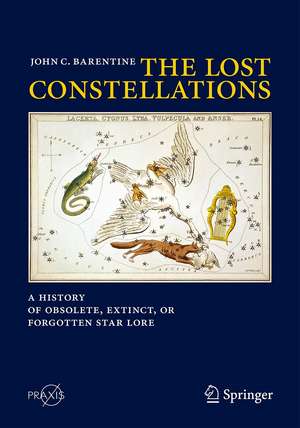
The Lost Constellations: Springer Praxis Books
Autor John C. Barentineen Limba Engleză Paperback – 23 noi 2015
Din seria Springer Praxis Books
-
 Preț: 300.82 lei
 -
 Preț: 289.78 lei
 -
 Preț: 212.55 lei
 -
 Preț: 322.33 lei
 -
 Preț: 324.12 lei
 -
 Preț: 299.26 lei
 -
 Preț: 507.31 lei
 -
 Preț: 223.52 lei
 -
 Preț: 310.41 lei
 -
 Preț: 333.61 lei
 -
 Preț: 230.44 lei
 - 18%
 Preț: 911.62 lei
 -
 Preț: 216.42 lei
 -
 Preț: 227.02 lei
 -
 Preț: 315.58 lei
 -
 Preț: 215.75 lei
 -
 Preț: 266.34 lei
 -
 Preț: 260.26 lei
 -
 Preț: 253.05 lei
 -
 Preț: 351.38 lei
 -
 Preț: 227.17 lei
 -
 Preț: 281.23 lei
 -
 Preț: 159.75 lei
 - 18%
 Preț: 1256.95 lei
 - 18%
 Preț: 990.74 lei
 -
 Preț: 323.74 lei
 - 18%
 Preț: 1290.02 lei
 - 18%
 Preț: 975.90 lei
 -
 Preț: 216.72 lei
 -
 Preț: 269.95 lei
 -
 Preț: 217.22 lei
 -
 Preț: 316.07 lei
 -
 Preț: 256.84 lei
 - 18%
 Preț: 972.77 lei
 -
 Preț: 219.27 lei
 -
 Preț: 222.12 lei
 -
 Preț: 392.52 lei
 -
 Preț: 257.95 lei
 -
 Preț: 319.85 lei
 -
 Preț: 350.65 lei
 - 15%
 Preț: 632.63 lei
 -
 Preț: 330.21 lei
 -
 Preț: 322.04 lei
 -
 Preț: 208.76 lei
 -
 Preț: 246.55 lei
 -
 Preț: 326.81 lei
 -
 Preț: 106.06 lei
 - 18%
 Preț: 1178.23 lei
 -
 Preț: 298.45 lei
Preț: 443.89 lei
Puncte Express: 666
Carte disponibilă
Livrare economică 02-16 noiembrie
Livrare prin curier în România Termenul estimat este afișat lângă disponibilitate.
Transport gratuit pentru acest produs Plată online sau ramburs, în funcție de opțiunile comenzii.
Retur gratuit în 14 zile Comandă securizată și suport în română.
Specificații
ISBN-13: 9783319227948
ISBN-10: 3319227947
Pagini: 528
Ilustrații: XX, 506 p. 257 illus.
Dimensiuni: 168 x 240 x 29 mm
Greutate: 0.88 kg
Ediția:1st edition 2016
Editura: Springer
Colecția Springer Praxis Books
Seria Springer Praxis Books
Locul publicării:Cham, Switzerland
ISBN-10: 3319227947
Pagini: 528
Ilustrații: XX, 506 p. 257 illus.
Dimensiuni: 168 x 240 x 29 mm
Greutate: 0.88 kg
Ediția:1st edition 2016
Editura: Springer
Colecția Springer Praxis Books
Seria Springer Praxis Books
Locul publicării:Cham, Switzerland
V-ar putea interesa
-
 The Eerie SilencePaul Davies-31%Preț: 63.97 lei92.80 lei
 -
 Galaxy CollisionsCurtis StruckPreț: 209.27 lei
 -
 The SunR. A. SampsonPreț: 227.37 lei
 -
 Return to the MoonHarrison SchmittPreț: 285.15 lei
 -
 ColumbiaPhilip ChienPreț: 257.75 lei
 -
 The Seven Secrets of How to Think Like a Rocket ScientistJames LonguskiPreț: 206.50 lei
 -
 Lonely Minds in the UniverseGiancarlo GentaPreț: 164.62 lei
 -
 Mars, A Cosmic Stepping StoneKevin NolanPreț: 163.95 lei
 -
 Space TourismMichel Van PeltPreț: 207.20 lei
 -
 Once Upon a UniverseRobert GilmorePreț: 267.09 lei
 -
 Star ClustersCharles A. Cardona IIIPreț: 204.07 lei
 -
 Russian Space ProbesBrian HarveyPreț: 309.27 lei
 -
 Preț: 355.19 lei
 -
 Mystery of the Ashen Light of VenusJohn C. BarentinePreț: 157.83 lei
 -
 Uncharted ConstellationsJohn C. BarentinePreț: 310.41 lei
 -
 Einstein's Enigma or Black Holes in My Bubble BathC.V. VishveshwaraPreț: 222.93 lei
 -
 Understanding the HeavensJean-Claude PeckerPreț: 292.54 lei
 -
 AstronauticsAnatoli I. KiselevPreț: 326.94 lei
 -
 Supernovae und kosmische GammablitzeHans-Thomas JankaPreț: 216.91 lei
Public țintă
Popular/generalCuprins
Introduction.- What Is A Constellation?.- The Celestial Cartographers.- IAU Commission 3 and the 'Modern 88'.- The Lost Constellations.- Asterisms, Single-Sourced Constellations, and 'Re-branded' Figures.- Conclusion.- Appendices.- Bibliography.- Index.
Notă biografică
John Barentine currently serves as the Director of Public Policy for the International Dark Sky Association (IDA) in Tucson, Arizona. He grew up in the Phoenix area and was involved in amateur astronomy there from early on. Later, he attended the University of Arizona, doing research at the National Optical Astronomy Observatories and National Solar Observatory headquarters in Tucson. From 2001-06 he was on the staff of Apache Point Observatory in New Mexico, serving first as an observing specialist on the Astrophysical Research Consortium 3.5-m telescope and then as an observer for the Sloan Digital Sky Survey. John obtained a master's degree in physics at Colorado State University and a master's and doctorate in astronomy at the University of Texas at Austin. John has contributed to science in fields ranging from solar physics to galaxy evolution while helping develop hardware for ground-based and aircraft-borne astronomy. Throughout his career, he has been involved ineducation and outreach efforts to help increase the public understanding of science. In addition to his work for IDA, John is a member of the steering committee of the University of Utah Consortium for Dark Sky Studies and serves on light pollution committees of the American Astronomical Society and the International Astronomical Union. In 2018, he was elected a Fellow of the Royal Astronomical Society.
John is the author of two books on the history of astronomy for Springer: "The Lost Constellations" and "Uncharted Constellations." The asteroid (14505) Barentine is named in his honor. His interests outside of astronomy and dark skies include history, art/architecture, politics, law and current events.
Textul de pe ultima copertă
Casual stargazers are familiar with many classical figures and asterisms composed of bright stars (e.g., Orion and the Plough), but this book reveals not just the constellations of today but those of yesteryear. The history of the human identification of constellations among the stars is explored through the stories of some influential celestial cartographers whose works determined whether new inventions survived. The history of how the modern set of 88 constellations was defined by the professional astronomy community is recounted, explaining how the constellations described in the book became permanently “extinct.” Dr. Barentine addresses why some figures were tried and discarded, and also directs observers to how those figures can still be picked out on a clear night if one knows where to look. These lost constellations are described in great detail using historical references, ennabling observers to rediscover them on their own surveys of the sky. Treatment of the obsolete constellations as extant features of the night sky adds a new dimension to stargazing that merges history with the accessibility and immediacy of the night sky.
Caracteristici
Summarizes the history of the major discarded Western constellation of which a written record remains Extensively illustrated with figures drawn from classic works of celestial cartography from the 17th-19th centuries Allows star gazers to pick out constellations from distant times in today's night sky