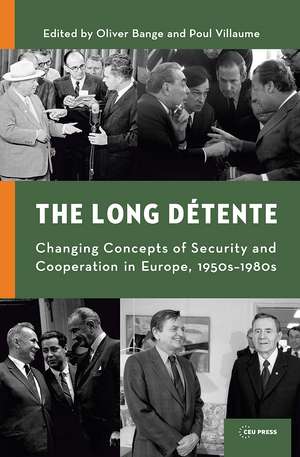
The Long Détente: Changing Concepts of Security and Cooperation in Europe, 1950s-1980s
Editat de Oliver Bange, Poul Villaumeen Limba Engleză Hardback – 10 feb 2017
Preț: 902.92 lei
Preț vechi: 1049.90 lei
-14%
Puncte Express: 1354
Carte disponibilă
Livrare economică 31 octombrie-14 noiembrie
Livrare prin curier în România Termenul estimat este afișat lângă disponibilitate.
Transport gratuit pentru acest produs Plată online sau ramburs, în funcție de opțiunile comenzii.
Retur gratuit în 14 zile Comandă securizată și suport în română.
Specificații
ISBN-13: 9789633861271
ISBN-10: 9633861276
Pagini: 370
Dimensiuni: 152 x 229 x 25 mm
Greutate: 0.66 kg
Ediția:1
Editura: Amsterdam University Press
Colecția Central European University Press
Locul publicării:Oxford, United Kingdom
ISBN-10: 9633861276
Pagini: 370
Dimensiuni: 152 x 229 x 25 mm
Greutate: 0.66 kg
Ediția:1
Editura: Amsterdam University Press
Colecția Central European University Press
Locul publicării:Oxford, United Kingdom
Public țintă
AcademicNotă biografică
Oliver Bange is senior historian at the Centre for Military History and Social Sciences, German Armed Forces, in Potsdam and lecturer at the University of Mannheim.
Poul Villaume is professor of contemporary history at the Saxo Institute, University of Copenhagen.
Poul Villaume is professor of contemporary history at the Saxo Institute, University of Copenhagen.
Cuprins
Acronyms and Abbreviations, Introduction Oliver Bange and Poul VillaumePART I: Long Perspectives On Détente 1 East-West Conflict: Short Cold War and Long Détente An Essay on Terminology and Periodization Gottfried Niedhart 2 The Long Détente and the Soviet Bloc, 1953-1983 Csaba BékésPART II: East-West Trade 1 Soviet Snowdrops in the Ice Age? The Surprising Attempt of an Early Economic Détente in 1952 Mikhail Lipkin 2 European Long-Term Investments in Détente The Implications of East-West Economic Cooperation Werner LippertPART III: The Inextractability of External and Domestic Security 1 No End to Political Ideological Diversion The Stasi Perspective as Circumstantial Evidence for a Long Détente Oliver Bange 2 New Security Concepts and Transnational Party Networks, 1976-1983. The Socialist International, Scandilux, and the Overcoming of the Crisis of Détente Rasmus MariagerPART IV: Détente in Europe: Change in Perceptions 1 Continuity and Transformation Alternate Visions of Italy's Three Decades of Détente Laura Fasanaro 2 Perception of the Other: Kremlinologists and Westerners East and West German Analysts and Their Mutual Perceptions, 1977-1985 Sabine Loewe-HannatzschPART V: Détente in Europe: Change in Diplomatic Framings 1 Pathfinders and Perpetuators of Détente Small States of NATO and the Long Détente: The Case of Denmark, 1969-1989 Poul Villaume 2 Overcoming the Crisis of Détente, 1979-1983 Coordinating Eastern Policies between Paris, Bonn, and London Christian WenkelPART VI: The U.S. Story: from Cooperation to Confrontation and Back 1 Lyndon B. Johnson and the Building of East-West Bridges Catching Up with Détente in Europe, 1963-1966 Gry Thomasen 2 Between Power Politics and Morality The United States, the Long Détente, and the Transformation of Europe, 1969-1985 Stephan KieningerSelect Bibliography, Index, About the Editors and Contributors.
Descriere
This book presents evidence that challenges the traditional Cold War narrative, arguing for a fundamentally different understanding of East-West relations during the conflict's later decades.